

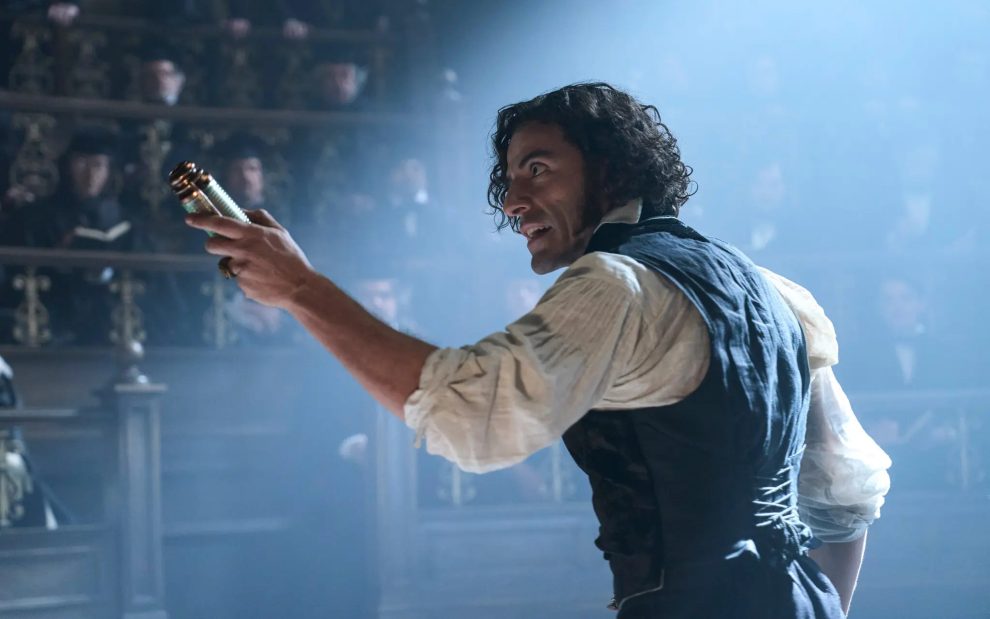
In October 2025, Mary Shelley’s renowned monster tale got a new cinematic treatment in Guillermo del Toro’s Frankenstein. Produced by Netflix, the film draws on skillful cinematography and brilliant acting from its leads to entice the audience into yet another story revolving around the scientist and his creature. Unlike some iterations that preceded it—such as the 1931 adaptation which focused more on the frightening nature of the creature—del Toro’s movie honors the pensive and philosophical atmosphere of Shelley’s original story, published in 1818, inviting reflection on the underlying themes, beyond a fascination with the grotesque.
Like his work in other Oscar-winning creature films such as Pan’s Labyrinth (2006) and The Shape of Water (2017), del Toro invites empathy for beings at first considered horrifying. In his Frankenstein story, we witness the relationship between a creature and his creator in troubling detail. It is hardly a tale of joyous nurturing. For Christian viewers, observing the dysfunctional creature / creator dynamic play out on film can prompt us to think about our own relationship to our creator, and God’s response to humanity’s imperfection—and how different it is from the scientist’s fearful and cruel reaction.
While the creature / creation relationship is a feature of both the original tale and del Toro’s adaptation, the film adds an intriguing twist which is not in Shelley’s story but offers an intriguing perspective for Christian viewers: the creature, surprisingly, forgives his creator.
Del Toro, having been raised Catholic before leaving the church, does not shy away from Christian symbolism and messaging in his films. As he stated in a 2017 NPR interview about The Shape of Water, many of his films are informed by his Catholic upbringing, so it is not surprising that some of the changes he makes to the Frankenstein story hold religious connotations.

The movie starts toward the end of the main plotline—like Shelley’s book—with a ship captain finding Victor Frankenstein (Oscar Isaac) half-dead in a frozen tundra. The captain brings him aboard, unaware that there’s a vengeful and violent creature (Jacob Elordi) stalking Victor, the creature’s maker. After the creature attacks the crew and is driven off, Victor recounts the story of how his own ambition drove him to make the very thing that now haunts him—a creature developed by joining parts of multiple dead humans to form life out of death.
Later, the creature shares his own side of the story when he manages to board the ship, allowing the audience to see his development from a newly-formed being with child-like curiosity to a philosopher reflecting on the nature of his own existence, and finally a vengeful soul pursuing the root cause of his emotional suffering.
As an avid reader of classics who is still awed by the novel, I found some of the changes del Toro made distracting. The tale already offers room for wrestling with the (im)morality of Victor Frankenstein’s quest to reach divine heights and transgress the boundaries set on humans—and with the question of belonging, which is at the heart of the creature’s struggle. So altering scenes that highlight this tension might leave the audience with a rather different message when the credits roll.
For example, in the novel, when Victor first sees the creature alive and watching him, he quickly runs in horror from his own construction. In del Toro’s film, Victor does not initially run from the scene. Instead, he imprisons the creature in his basement where he tries to teach him, but he gets increasingly frustrated by his creation’s imperfections. Eventually Victor tortures the creature, injuring his view of his creator. However, drawing out the period before Victor turns on the creature, instead of having the creature immediately be confronted with his lack of belonging, weakens the intensity of the revelation.

Shelley’s novel places Victor in the role of an abandoning mother—birthing his child then, horrified by his abnormal appearance, running away. In del Toro’s version, Victor is framed more as a bad father who is overly demanding in his expectations for his offspring. This parallels del Toro’s depiction of Victor’s own father being cruel and perfectionistic and suggests a cycle of abuse repeating itself. Shelley’s novel, however, showed a healthier connection between Victor and his father Alphonse, thus inviting the reader to contrast Victor’s relationship with his creature to how his father raised him.
The scientist’s reaction, in both the novel and del Toro’s film, is unbefitting of a creator figure. In the Genesis story of the fall, the Creator neither ran from nor abused Adam and Eve, but instead paved a way for humanity to be in relationship with God and each other, recovering that feeling of belonging. Del Toro’s Victor, while attempting to be a god through defying death, reveals his human shortcomings as he is impatient with his “child,” obsessing over his imperfections, thus exacerbating the creature’s pain and alienation.
As previously mentioned, the movie closes with the creature forgiving Victor before the inventor passes away. Victor pleads with him, saying, “Forgive me. My son. And if you have it in your heart, forgive yourself into existence. If death is not to be, then consider this, my son. While you are alive, what recourse do you have but to live? Live.” The creature responds with a gentle, “Victor, I forgive you.”
This once again invites a fascinating reflection, when compared with the original. In the novel, the creature only finds Victor after his creator has already died aboard the ship. He then expresses remorse and despair as he realizes he is now fully alone in the world, even planning to kill himself afterward. The creature’s final response to Victor highlights that he still feels trapped in an existence that does not welcome him.
Del Toro’s film, on the other hand, allows the creature to experience liberation in this moment of grace. It ties into the idea that sometimes forgiving a family member who has hurt us is less about them and more about finding freedom in choosing not to be defined by their actions.
This view of forgiveness aligns with Christ’s teachings in the gospels. But while biblical passages speak of forgiveness between humans (Matthew 18:21-22) and God forgiving humans (Ephesians 4:32), the film’s plot change proposes a bold, and potentially disorienting, new question: Is there ever a circumstance when humanity would need to forgive their creator?
Shelley’s novel left readers dwelling on issues like the danger of removing the divine hand from the human creation process and the inherent misogyny in Victor’s thought of erasing women from the birthing process—a marker of the sexist ideologies often latent in man-led invention. But del Toro’s changes mean the story ends on a note of reconciliation rather than moral warning.
This, however, does not take away from the film’s immersive experience and its potential to rank alongside del Toro’s other grand monster stories. It remains a worthwhile watch for anyone looking for a well-directed adaptation. The changes in Frankenstein might be jarring to anyone who has read Shelley’s novel, but they offer interesting challenges for a Christian audience to wrestle with, reminding us that sometimes choosing forgiveness can free a person to live more authentically.
Image: Ken Woroner/Netflix








Add comment