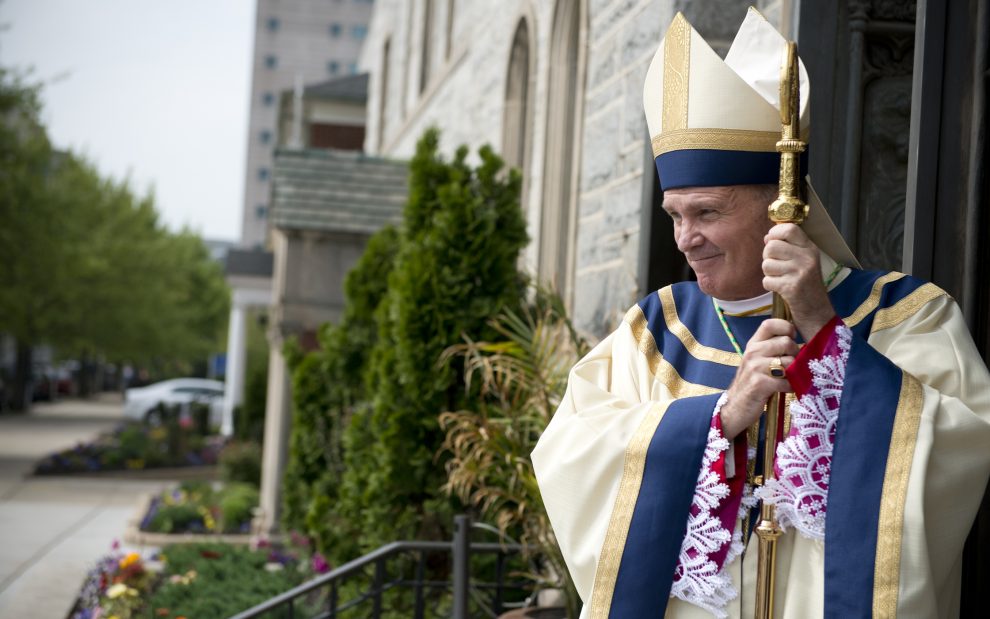
“Which one is the bishop?” a friend asked me recently at a diocesan liturgy. Before I could respond, my coworker quickly answered: “The one with the hat and the stick!”
When at a big liturgy, these very visible and symbolic objects make it easy to spot the bishop in the crowd. Yet they are more than just liturgical decoration. The “hat” and “stick”—actually called a miter and crozier, respectively—are tools of a bishop, symbolizing his office and responsibilities.
To be ordained a bishop means that one receives the fullness of the sacrament of holy orders. Usually, a bishop is assigned as an ordinary, which means he is installed in a diocese to be the shepherd of the local church: to teach the word of God to the people, to govern the diocese administratively, and to sanctify the people by word, deed, and example.
The church provides that the outward representation of the office of the bishop points to this understanding of what it means to serve as bishop. Articles such as the miter and crozier, as well as the bishop’s ring and pectoral cross, are external symbols of the role.
Scholars have found that miters came into practice around 1100 C.E. When a bishop is ordained, the miter is blessed by the ordaining bishop before the ceremony and, in the midst of the rite of ordination, placed on the newly ordained bishop’s head in silence.
A bishop’s crozier looks like a shepherd’s crook to symbolize his role as shepherd of his diocese. The rite of ordination of a bishop says: “Take this staff as a sign of your pastoral office: keep watch over the whole flock in which the Holy Spirit has appointed you to shepherd the Church of God.” The crozier also symbolizes spiritual fatherhood: God has entrusted the souls of the diocesan faithful to the care of the diocesan bishop.
The bishop’s ring, worn on the ring finger of his right hand, and pectoral cross are signs of his fidelity to the church. Whereas the miter and crozier are worn only during the celebration of Mass, the ring and pectoral cross are worn both during and outside of Mass.
The rich meaning and symbolism behind the tools of a bishop point to the importance of his role in the life of the church and the deep spiritual relationship bishops are called to have with the faithful of their dioceses.
This article also appears in the September issue of U.S. Catholic (Vol. 85, No. 9, page 49). Click here to subscribe to the magazine.
Image: Flickr.com/Jeffrey Bruno