Practicing Radical Advent
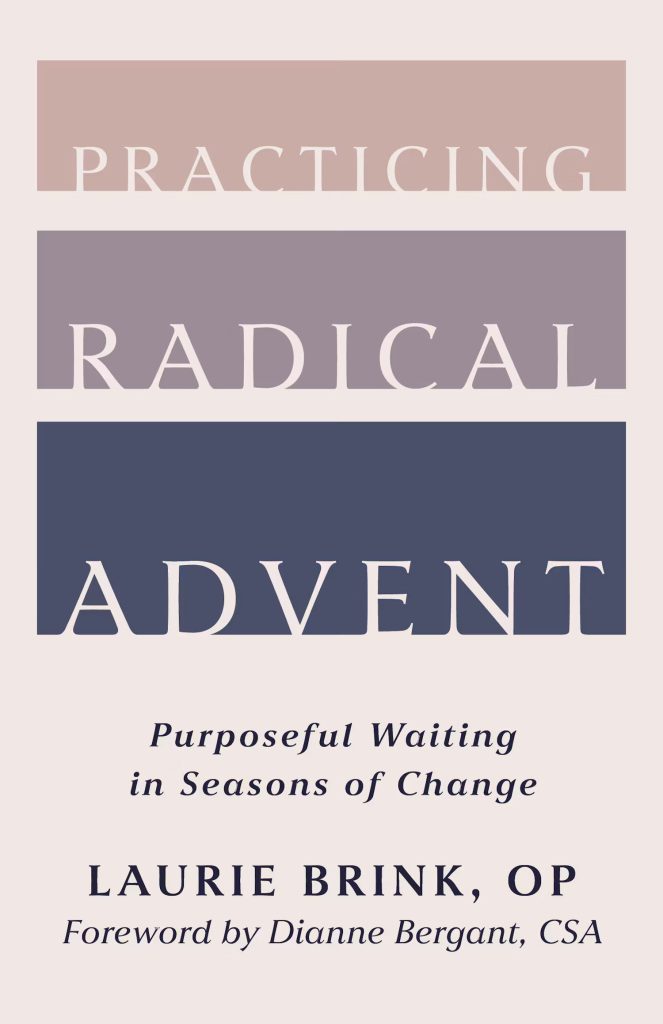
By Laurie Brink, O.P. (Eerdmans, 2026)
Young or old, we know what it is to wait for something—a report card, party invitation, job interview, the birth of a child, a medical report. And of course, the little moments of waiting—a long line in a crowded store, a telephone hold, that interminable traffic light. In the season of Advent, the church asks us to reflect on the experience of waiting, even to celebrate the split-screen moment, a time fully inhabited by Jesus yet situated between the historical birth of Jesus and the second coming of Christ.
Author, New Testament professor, and Dominican Sister Laurie Brink upends the notion that waiting is necessarily passive in Practicing Radical Advent: Purposeful Waiting in Seasons of Change. Radical Advent is not limited to four weeks before Christmas; it is the liminal time that we experience during periods of change. She asks readers to discern, in the spirit of Advent, these times as alive with God’s love and purpose. Identifying eight stepping stones in the process, Brink explores each step with biblical figures, personal anecdotes, insights from poets and thinkers, and concludes with a modified lectio divina exercise for biblical passages.
First comes the invitation. Abram, later renamed Abraham, answers God’s call to leave his homeland and journey to Canaan. In contrast, there is Jonah: he resists God’s request and spends a few unpleasant days reconsidering his decision. I enjoyed how Brink takes Jonah’s spiritual challenge seriously: he refuses to preach to the Ninevites because he does not want the people he despises to receive God’s mercy. As a scholar of biblical spirituality, Brink is adept at providing historical background to enliven temporally remote and, in some cases, caricatured figures.
Chapter by chapter, the book traces the movement from first hearing an invitation to fulfilling a calling. Familiar and not so familiar figures flesh out the narrative. Ruth chooses to accompany her mother-in-law Naomi. Peter discerns his vocation. The Samaritan woman at the well dramatizes the need to cross boundaries. That scriptural passage is especially poignant in this time of suspicion and distrust of anyone “different.”
Midway through the process, we have to weigh the cost. In the Sermon on the Mount, Jesus explains what Brink calls the “fine print” of following him. A compelling example is Augustus Tolton, who was born into slavery yet became a Catholic priest despite great opposition, even from within the church.
Other chapters and challenges follow until the eighth and final stepping stone, exemplified by Mary Magdalene at Jesus’ tomb. As her understanding increases, she must change her expectations. This step brings us into the heart of God, whose hesed (loving-kindness) has been with us all along.
As Brink would be the first to admit, real life does not play out so systematically. Sometimes we circle back to previous steps or jump ahead. Whatever our challenges, this book offers insight for our own radical Advents.
This article also appears in the December 2026 issue of U.S. Catholic (Vol. 91, No. 12, page 47). Click here to subscribe to the magazine.