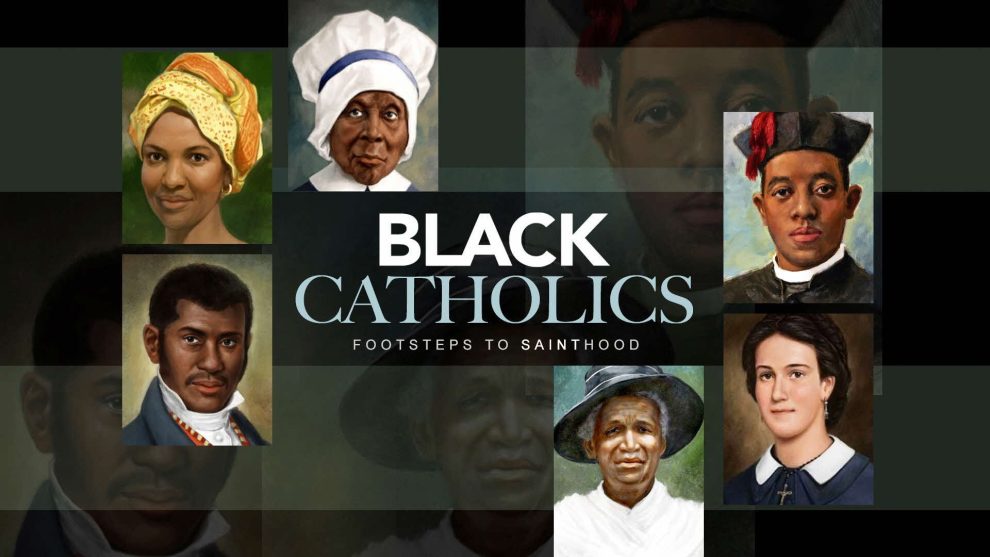
A breeze of community drifted through the room, enough to clear the auditorium’s often stifling pre-movie silence. Everyone who came for the screening of CatholicTV’s Black Catholics: Footsteps to Sainthood seemed to know one another, and as the minutes elapsed, the number of “It’s been a while!” and “I haven’t seen you in forever!” grew. Bishop Joseph N. Perry then started the screening with a prayer: “If it be your Will, O God, glorify your servant, Father Tolton, by granting the favor I now request through his intercession so that all may know the goodness of this priest whose memory looms large in the church he loved.” In what turned out to be a heartwarming coincidence, the community in that room spoke to the community-oriented themes of the series’ first episode.
Set to premiere on November 2, the episode narrates the life of Father Augustus Tolton (1854-1897), his journey to the religious vocation, and the difficulties he faced as a Black American and Black Catholic. As the pamphlet CatholicTV provided reports, Augustus carries the “reputation of being the first identified priest of African descent in the United States by reason of his mother and father being direct descendants of Africans who were brought here as slaves.” As the episode demonstrates, this was no simple feat.
After escaping slavery, his mother, Martha Jane, arrived in Quincy, Illinois, where Augustus attended the city’s parochial and public schools. He was “met with askance looks and threats from fellow pupils and parents” to the point where he was “expelled or removed from several schools.” However, despite experiencing racism and discrimination at several schools, eventual Father Peter McGirr welcomed him into St. Peter’s Parish and School, where he received the sacraments of communion and confirmation. Years later, after numerous rejections from diocesan and religious seminaries due to his race, Augustus attended the Propaganda Fide in Rome. He was later ordained a priest on April 24, 1886, at St. John Lateran Basilica, and returned to the United States as America’s first Black priest.
The rest of the episodes in Black Catholics chronicle the lives of five other Black American Catholics who serve as awe-inspiring models of faith and endurance—and whose sainthood still requires communal attention and effort today. Each episode includes biographical information as well as reflections from living religious figures to raise public awareness and recognition of their ministries. As the series’ title implies, its project moves these figures further down their path to sainthood, or canonization, by foregrounding the indispensability of grassroots efforts.
Perhaps most poignant in the episode I saw was the realization that figures such as Father Tolton are often so focused on helping others that they elide raising awareness about themselves. It becomes incumbent on the grassroots efforts of the communities he helped and those that come after to raise awareness of his benevolent character and mission. Father Tolton’s narrative, along with those of the other men and women in the series, is alive because of joint efforts whose dedication speaks to the generative potential of collective action.
A few moments after the screening ended, producer Richard Brown waited in the lobby as viewers came by with questions or appreciation. Curious about the project’s motivations, I asked, “What drove you to create this project?” to which he said it was to raise awareness. “Many people don’t even know November is Black Catholic History Month,” he said. He added that he wanted lay Catholics to know about these individuals with the hope that their intercessions would result in the world’s first African American saint. Likewise, at one point in the series, the host, Dr. Ansel Augustine, notes that the possibility of the first African American saint also opens the prospect of a parish named after Father Tolton, creating a space where Black Catholics can feel adequately recognized and represented.
Days after the screening, I was on my way to an event and kept looking at my maps app to make sure I was going in the right direction. According to the app, I was to get off at the “Augustus” bus stop. To my surprise, when I arrived, the bus stop read “Augusta,” not “Augustus.”
I might have been driven by the vertigo of that particular Friday and so was less attentive than usual, or maybe Bishop Perry’s prayer still lingered in my subconscious. Whatever the reason, I prefer to think the bus stop was actually marked “Augustus” on my phone, if only because the coincidence created in me a sense of relief and serenity—one that carried into that Friday evening.
Image: OSV News photo/CatholicTV Network