The clearest glimpses I have had of God’s creative work have come through the bodies of women and their children. After a decade of practice, midwifery has become the way I read the world: a language of living systems, the through line of relationship, a golden thread-like matrix or web connecting all things.
I recently attended a birth for a devoutly faith-filled couple. A brief 48 minutes after I arrived at their home, their son was born healthy and vigorous, slippery, warm, and squealing, guided into his father’s hands on the living room floor. Shortly thereafter, his mother apologized to the room for bleeding on her own carpet. Then she apologized to us again moments later: “I am so sorry, but could someone get me some toast? I am so hungry!’’
Women apologize at the strangest times. Here we were witnessing something holy. Love and the precious nature of life hung in the room. I was in awe of life, this woman, and creation, filled with a divine reverence. And this woman was apologizing for bleeding on her own floor and being hungry after fast-and-furiously delivering a large baby. I’d like to say that was the first time I have encountered such a dynamic, but it’s not.
I wonder: How many women truly seek to know God within themselves, versus how many women have allowed inherited stories to permeate their understanding of what it means to exist in this world as a woman created in God’s image? What is their understanding of condition and consequence? Is the woman apologizing for her bodily functions and human needs aware of the internalized shame she carries for existing? Is it possible that the origin of this belief does not even belong to her conscious mind?
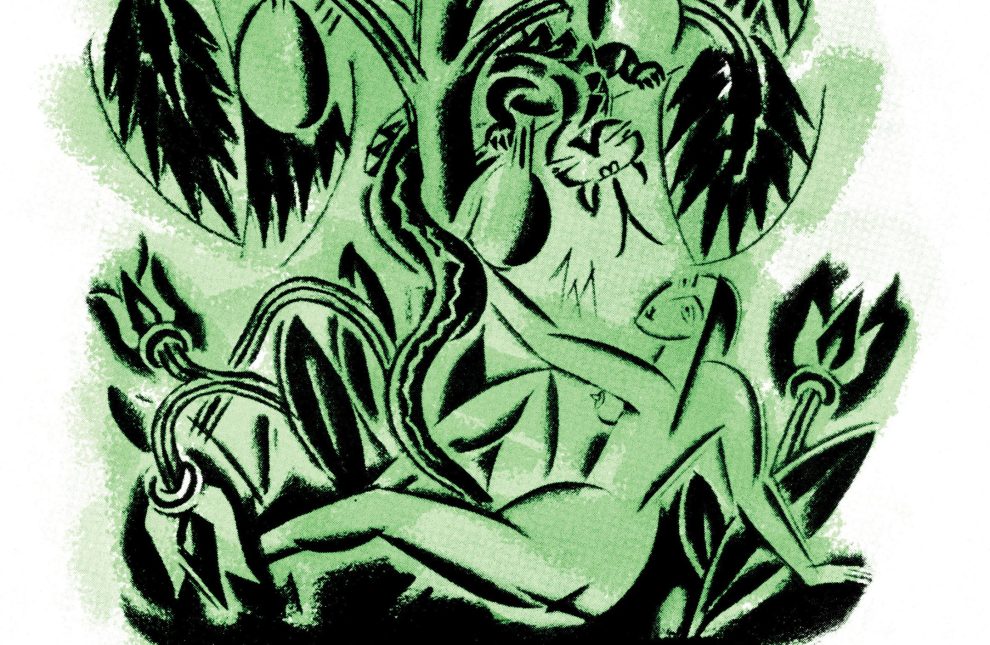
The story begins in a garden. A womb. Eve reaches for the fruit of the tree in the middle of the garden, which grants knowledge of good and evil, after hearing a serpent’s promise that it will make her wise. She eats, gives the fruit to her husband, Adam, and together they become aware of their nakedness before leaving the Garden of Eden (Gen. 3:1–7). Scripture tells us they both ate the fruit, yet in much of the Christian imagination Eve is who became synonymous with temptation, transgression, and blame. Adam’s participation is seldom discussed or dismantled.
We inherit stories through scripture. And we inherit ways of interpreting them. As human beings we seek belonging and find safety in it. But where do we truly belong, and what truly belongs to us? We understand story through lens, color, culture, context, and tone. Neither scripture nor story are merely words, but language and energetic inheritance in the oldest somatic sense. Who are we in God’s image if not what we have learned to be?
Like many people, I inherited a misogynistic interpretation of Eve’s story long before I ever opened the Book of Genesis to read it for myself. For many of us, because she was a woman seeking knowledge, Eve became the woman who wanted too much, reached too far, and bore the burden of humanity’s first transgression; a thought framework that became systematically woven into the fabric of almost all modern-day canonical preaching. Language is powerful.
I have started to wonder about the seeds planted by the stories we carry intergenerationally and the downstream impact they have within the relationships women cultivate with themselves and the sacred. Could the apologies women carry be internalized from the received meanings of stories that quietly shape our imaginations long before we know they are doing so?
How many of us view Eve as the temptress rather than the seeker or women as the gateway through which sin entered the world rather than as gateways of life? When framed in this way it is easy to see how Eve’s curiosity might be recast as rebellion or her desire remembered as danger.
How does one version of a story become woven into the fabric of a generation’s belief, consciousness, and sense of cultural belonging while another is forgotten almost entirely? A man and a woman both ate from the tree, yet we only carry a strong condemnation of one of them. I wonder: How long does it take for a belief to be undone and knitted anew in an individual mind, let alone in our common, communal knowledge? This shift often requires direct seeking of God and a different understanding or interpretation. It places the seeker outside of commonplace acceptance. Surely God lives there, too.
We remember Eve as the one who ate the forbidden fruit, but scripture calls her the “mother of all living” (Gen. 3:20). What might change if we first encountered her story and focused our attention there?
It was the story of Eve that first compelled me to seek a deeper theological understanding of belonging, uncover deeper knowledge of the sacred, and ultimately develop a deeper relationship with the divine force we call God.
I think about her often during the first hours after a birth, when my team and I gather around a newly delivered placenta with parents. We turn the warm organ over in our hands, tracing the architecture that sustained a child for months, explaining its function. On its fetal surface, branching vessels radiate outward from the umbilical cord like the limbs of an ancient tree. Two arteries and a single vein spiral together through the umbilical cord, like a helix of DNA, carrying oxygen, nutrients, hormones, immune signals, and countless forms of biological information between two bodies. Mother and child are not separate systems negotiating a temporary alliance but instead stand as participants in an astonishing communion. Every heartbeat, nutrient, and hormonal shift shared is a kind of dialogue that only they understand. A relationship of no words that remains profoundly conversational.
Eve’s story, and every human gestation, begin in enclosure and carry a bestowed gift. They also culminate in nourishment being freely given before choice, labor, and separation become part of the human story. They show life can be transformed through grace.
Mohawk midwife Katsi Cook famously described a woman’s body as the “first environment.” Her words have changed the way I look at pregnancy, and, unexpectedly, they have changed the way I understand the story of Eve, creation, and God. Before we inherit culture, doctrine, or even our own names, we inherit an environment. Our first experience of existence is not independence but a relationship to a source: our mother. And her source: creation. And its source: God.
Perhaps this is why I no longer read scripture searching for certainty but instead seek to know God through the gifts and the stumblings of humanity. Perhaps this is why I now approach theology and the birth room with the same reverence. I no longer view my craft as something to master, but as a mystery to behold and of which to be in gracious awe.
Observing women give birth humbles every illusion of the mastery of human craftsmanship. I have watched hundreds of people enter the world the same way. No two births are the same, but every person enters, as childbirth educator Penny Simkin emphasizes, as a passenger, through a passage, working with powers greater than our human bodies alone. The spirit is an undeniable participant in the process of human embodiment. In the clinic and birth room, I stand as witness and servant of this sacred mystery.
If I have learned anything about creation, I have learned it first by watching women create. Knitting together the world within a womb. A living relational matrix of spirit and flesh. Mother and child. Hormone and receptor. Placenta and uterus. Breath and body. Nothing exists alone. Everything interdependent and responding within a perfectly orchestrated role. All with its own language, constantly communicating.
After years of standing beside women as they labor, bleed, nourish, grieve, and welcome new life into the world, I have come to believe that God is rarely found in domination or perfection. More often, God is encountered in the relationships we hold with ourselves and others. We find God in the slow experiential unfolding of trust, in the humility to remain present, and in the willingness to be changed by what we behold, surrender to, and accept in the worlds we have built.
And perhaps, in the end, that is what Eve’s story has been teaching from the very beginning. Before we learn to speak about God, we are first invited to learn the language through which God so often speaks: relationship, communion, and the quiet, patient work of bringing life into the world.
This article also appears in the October 2026 issue of U.S. Catholic (Vol. 91, No. 10, pages 18-19). Click here to subscribe to the magazine.
Image: Adapted from Jewish drawings, 1924, General Research Division, The New York Public Library