The church has many titles for Mary. The ones with which people may be most familiar are “Mother of God” (Theotokos) or the “Blessed Virgin.” She is known as the “Immaculate Conception” and “Queen of Heaven.” Sometimes we refer to her through the names of places where apparitions have appeared: Our Lady of Lourdes or Our Lady of Fatima. And of course, she is known as Our Lady of the Rosary, a title which is celebrated every year on October 7. While the feast was originally instituted to celebrate a decisive naval battle between European forces and the Ottoman Empire—the Battle of Lepanto—it is also associated with prayers for Mary’s protection.
Some Marian titles indicate that she is a protector and a defender: Mirror of Justice, Seat of Wisdom, Solace of Migrants, and Comfort of the Afflicted. Marian images also carry specific messages for certain situations and certain people. For instance, the Mater Dolorosa (Mother of Sorrows) says to those who grieve that they’re seen and heard, and that she is present with them in their pain and grief. The image of Our Lady of Guadalupe has been used in justice movements, as she assures the downtrodden, especially Indigenous people, that they belong and that their human dignity is sacred.
Images depicting Mary and the Holy Family’s flight to Egypt says to the homeless, refugees, and asylum seekers that God is present with them and feels the pain of their displacement, as Jesus himself was displaced. As Mary sheltered the child Jesus during their flight, so also Mary will offer refuge to us. To the economically oppressed and poor, Our Lady of the Magnificat says that injustices caused by this world’s systems will not have the final word.
Praying the rosary can be one way to remind us of Mary’s protection. But sacred artwork can also do this. The incorporation of art into prayer, a tradition known as visio divina, is an invitation to encounter the sacred through images. Just as Mary leads us to her son, Marian art points ultimately to Christ and the new life to which he calls us.
Here are six ways Catholics can practice this prayer tradition by incorporating Marian images into home décor.
Our Lady Seat of Wisdom
One title for Mary is “Our Lady Seat of Wisdom.” This title honors Mary as the bearer of Jesus, wisdom incarnate. Multiple works of art depicting Mary as the “seat of wisdom” show her sitting regally on a throne, with Jesus sitting on her lap. Others show her more relaxed and maternal. In one image, Mary holds the infant Jesus while he rests his head on her breast. The image of Mary as the “seat of wisdom” in the home can inspire everyone in the family to enthrone wisdom as she did: to bear Jesus to others. The gospel also says that Mary “treasured all these words and pondered them in her heart.” Mary, seat of wisdom can remind us to slow down and think carefully, and to listen to one another from the heart, especially when facing difficult challenges and decisions.
The painting of the Madonna and Child by Carlo Maratta
Museums and churches are filled with images of Mary holding baby Jesus. These images come from all eras and regions, and depict different aspects of Mary’s maternal care for her child. Baroque painter Carlo Maratta’s painting of the Madonna and Child depicts the Blessed Virgin with a soft, thoughtful expression that is slightly obscured by a hint of sorrow. She has her hand around the infant Jesus as if she’s protecting him. In contrast to some images, here the face of the Child Jesus is partially hidden. It’s as if he’s being protected from the outside world. An image such as this in our homes can remind us to imitate Mary’s maternal care for others. Our homes, and essentially our lives, should be a sanctuary. When people come to us with their afflictions, we might not be able to fix them magically, but we should be able to extend Mary-like love, so they should be able to pause, heal, and feel heard and seen.
Blue fabrics for Mary’s mantle
Mary is often depicted wearing a blue veil or mantle. In Hebrew scriptures, the color blue is associated with the heavens, and in several passages, God commands the Israelites to use blue for sacred things. For instance, God commands the Israelites to make blue threaded tassels on the corners of their garments (Num. 15:38–39), and God commands that sacred vessels be covered with blue cloths during transportation from Egypt to the Promised Land (Num. 4:5–14). Mary clothed in blue, in the artistic tradition, points to her being God’s sacred vessel. But her veil, often depicted as blue, is also associated with her protection of all of creation. In the Orthodox liturgical calendar, there is even a feast day dedicated to the protection of Mary’s veil. The use of blue fabrics in the home can remind us of the holiness of all creation and of Mary’s protective covering of humanity. This can in turn encourage us to turn our homes into spaces where everyone feels welcomed and human dignity is respected.
The Magnificat
Mary’s Magnificat is a strong proclamation of faith in God and in divine justice. It boldly declares that God provides good things to the hungry, casts down the arrogant, and uplifts the lowly. The words of this prayer have provided comfort to many who are downtrodden or vulnerable and who await justice and liberation. Art depicting Mary’s powerful prayer can be a comforting assurance that God cares for all of God’s people and loves those who are forgotten by the world. For those of us who have been fortunate and who wield power, this prayer can also reminds us that we have to allow humility to color our character and our lives, and to use our influence to aid the marginalized, not to defend oppression. It reminds us that genuine happiness arises in a society where everyone has access to necessities and no one abuses their position of authority or hoards the goods of life.
The Marian clock for the Angelus
The Angelus is a traditional prayer that religious communities and laypeople often pray throughout the day. Traditionally, the Angelus was said in the morning, at noon, and in the evening. Having Marian inspired clocks on the walls is a way to merge this Catholic devotion with practical timekeeping. Clocks aren’t only symbols of time ticking away and passing. They also remind us to pray, and the Angelus is a prayer anyone can fit into their day, no matter how busy they are. It can help you meditate on the moment when the angel came to Mary and Mary agreed to bring Jesus into the world, so that you are also inspired to be Christ for others. Praying the Angelus at 3 p.m. might be a good choice for people experiencing sorrow and loss as it connects you with Mary’s strength as she stood at the foot of the cross and watched her son take his last breath.
The Mary garden
The exterior of our homes can also invoke Marian spirituality with flowers in a Mary garden. The first such garden was created in the 7th century by St. Fiacre, an Irish-born monk who later became a priest and gardener in France. Flowers that are usually planted in a Mary garden are the assumption lily (August lily), dandelions, lily of the valley, chrysanthemums, dianthus, poinsettia, and carnations. Especially prominent in a Mary garden is the queen of all flowers, the rose, as Mary is called the Mystical Rose—a title going back to the 16th century Litany of Loreto. The title of Mystical Rose is connected with images of flowers from Hebrew scripture such as that of a shoot sprouting from the stump of Jesse and bearing a blossom; this image from Isaiah has often been taken to point prophetically to Jesus. Even if you don’t have space in which to plant a garden, just growing a few flowers can help you pray with creation.
In his final moments, Jesus said to the beloved disciple who stood with Mary at the foot of the cross: “Here is your mother.” The disciple listened, obeyed, and took Mary into his home. We can do the same, primarily through our actions, but also through the art and symbols we choose. Her image serves as a reminder that we shouldn’t only admire her, but we should also emulate her in bringing Jesus into the world and living out her care and protection.
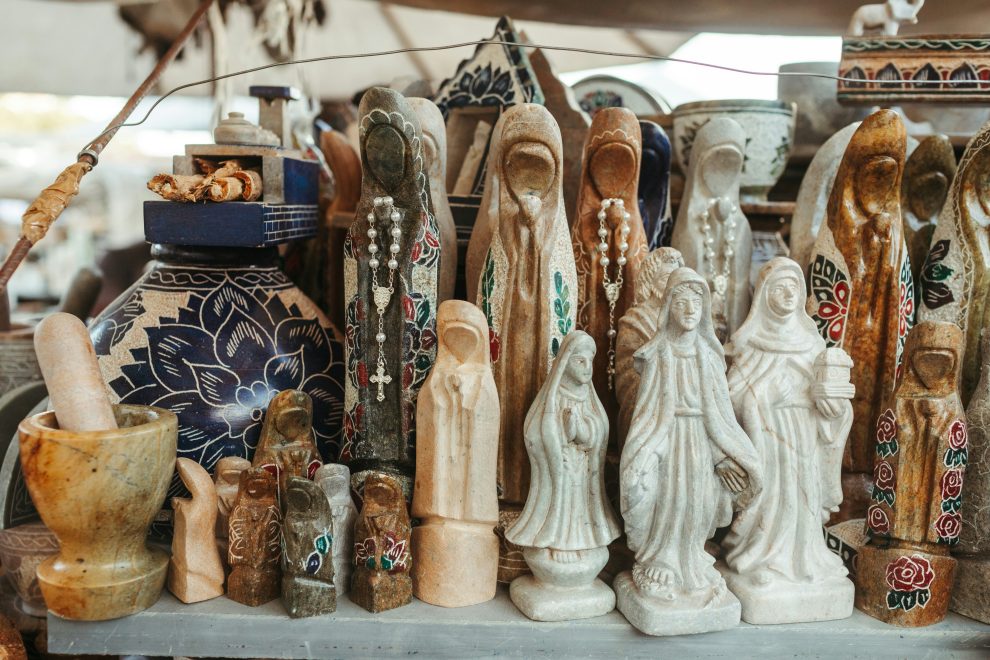
Image: Unsplash/JSB Co.