Why do we like to watch people shoot one another?
On film and television screens, we shock, frighten, and torment ourselves with scenes of killing. We scare ourselves into believing that the world really is terrifying, that danger lurks around every corner, and that we should trust almost no one.
We fetishize shootings into sartorial statements. When dressed to kill, women on screen totter on spike heels in low-cut dresses, flipping their flowing locks—less than practical wardrobe choices for discharging weapons. Male movie assassins stride the streets in expensive suits and flapping trench coats that hide automatic weapons the size of vacuum cleaners. The dry-cleaning bills alone must be staggering.
Killers look cool. Consider the transformation of Walter White (Bryan Cranston) from meek chemistry teacher to murderous drug kingpin in Breaking Bad (AMC), and John Wick’s (Keanu Reeves) evolution from grieving husband to vengeance-seeking hitman (John Wick, Summit Entertainment).
We make shooting into a reason for a good one-liner. Consider Harry Callahan’s (Clint Eastwood) “Go ahead, make my day” in Sudden Impact (Warner Bros.) and “Do I feel lucky?” in Dirty Harry (Warner Bros.) or Tony Montana’s (Al Pacino) “Say hello to my little friend” in Scarface (Universal Pictures). Wise cracks help convert killing into entertainment and minimize what’s actually happening. If the killer thinks what he’s doing is no big deal, well . . . why should we?
There are exceptions to the casual violence on screen. The Pitt (HBO Max), a drama series about life in an urban hospital emergency department, offers an alternate take. The nurses and physicians who deal daily, hourly, and minute-by-minute with the results of gun violence don’t shrug it off with silly one-liners. They save the forever-changed life (or don’t) and then go into the bathroom and cry—or they go home and suffer with PTSD.
Casino Royale famously upset the James Bond franchise of a tuxedo-clad hero impervious to attacks. Daniel Craig’s more human Bond loses teeth in a vicious fight and requires weeks of medical care after being tortured (MGM, Sony Pictures, and Columbia Pictures). And in As Good as It Gets (TriStar Pictures and Sony Pictures), artist Simon (Greg Kinnear) is brutally beaten and robbed and does not bounce back—he spends days in a hospital, undergoes rehab, and is black-and-blue, scarred, and limping through most of the film. These more realistic portrayals of violence remind us that in real life, violence isn’t easy to survive or witness.
So why do we voluntarily expose ourselves to it and consume violent stories on screen?
Some people argue that we watch violence for the same reasons we ride roller coasters. We like the anticipation of terror and the adrenaline rush, knowing the whole time that we don’t want to actually plunge to our deaths or actually shoot someone.
However, it turns out that those vicarious thrills and chills still do real damage. Watching violent entertainment doesn’t necessarily make a person more violent. The effects of screen gun violence are worse than that.
George Gerbner, pioneering media violence theorist of the 1970s and ’80s, studied thousands of TV episodes (including children’s cartoons), and developed two enduring theories—cultivation theory and mean world syndrome theory—that boil down to this: The more television you watch, the scarier you think the world is.
The world doesn’t become scarier. You get taught to believe that it is.
Gerbner was prescient. He warned us, long before there were laptops and phone screens, that we’d get too used to watching violent entertainment and start to think danger lurked around every corner. In 1981, Gerbner testified before Congress that “fearful people are more dependent, more easily manipulated and controlled, more susceptible”—and might even welcome oppressive public policies that promised to offer relief from fear.
Current research backs up Gerbner’s findings. And yet guns are still ubiquitous on television (in six out of 10 shows, according to an Everytown for Gun Safety Support Fund report).
Some human stories are violent, yes. But not all of our stories.
Reaching for a gun is a lazy way for a storyteller to introduce tension to an audience. Being a human these days delivers a lot of drama. Just look for it. You try raising three children as a single mother in a world where daycare costs more than rent each month. There’s tension for you.
So many stories with guns—too many stories with guns—is a distortion of who we are and certainly a corruption of who we are called to be. We have other stories to tell one another—about understanding and healing, learning from mistakes, pursuing restorative justice, growing and deepening in our own humanity.
We venerate hurting and killing one another, and we eat popcorn while we view it. But we could choose to venerate complex, redemptive, intriguing, realistic, heartbreaking, uplifting stories in which no one is slaughtered, raped, or shot. The most remarkable act a human can commit is surely not lashing out.
Nonviolent screen narratives—like the recent, luminous Remarkably Bright Creatures (Netflix) with Sally Field and Lewis Pullman—are often described on streaming services as being quirky or niche. What they really are, however, is human. With no guns. Not quirky, really. Just, you know, normal.
This article also appears in the September 2026 issue of U.S. Catholic (Vol. 91, No. 9, pages 34-35). Click here to subscribe to the magazine.
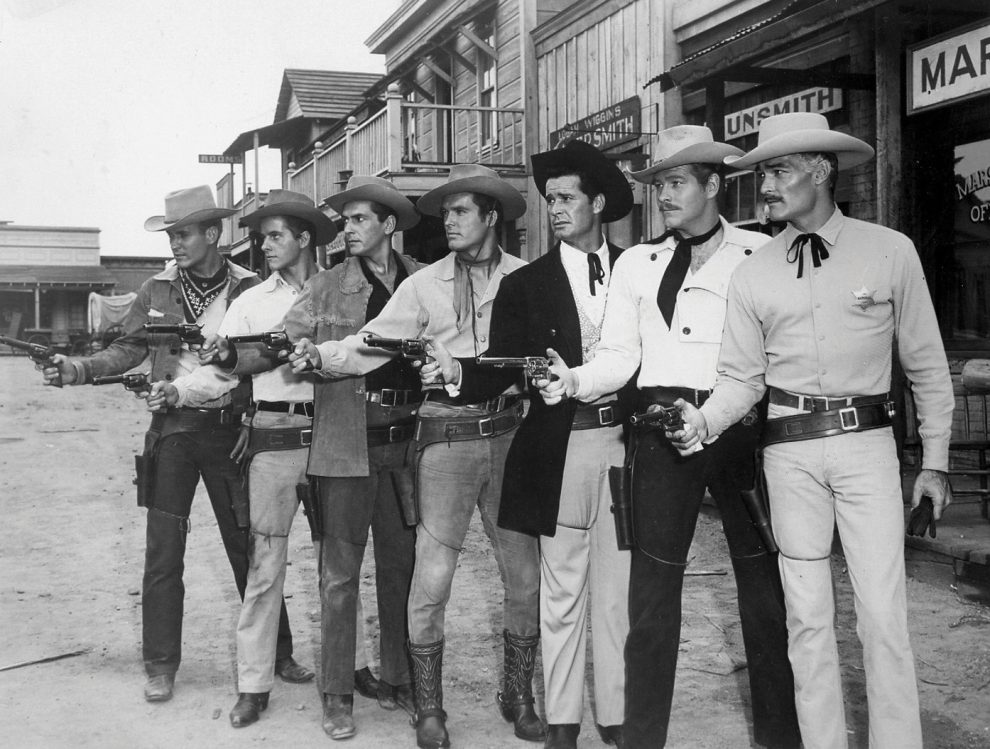
Image: Warner Brothers Studio publicity photo, 1959. Public domain.