Why is the church so obsessed with sex?” Many of us Catholics have fielded this question from our non-Catholic friends, as well as some of our Catholic ones. The question often exposes a jarring disconnect between our lived faith and public perception. Although if we’re honest, we understand why it is asked: the U.S. Catholic Church does devote a fair amount of time and expression to issues of sexual morality.
So it was encouraging to hear Pope Leo XIV say what so many of us struggle to express. On a flight back to Rome, in response to a question about same-sex blessings, he said: “We tend to think that when the church is talking about morality that the only issue of morality is sexual. And in reality I believe there are greater and more important issues such as justice, equality, freedom of men and women, freedom of religion that would all take priority before that particular issue.”
Pope Leo’s stance is obviously not without biblical precedent. Jesus actually spends little time in scripture talking about sexual morality, and quite a lot talking about justice and facilitating human freedom. Certainly Jesus assumed as normative the ethics of the Jewish culture during the time he was raised, but if we look to the story of the woman caught in adultery as told in the Gospel of John, we see an explicit affirmation of Leo’s comments. Here we witness Jesus draw attention away from an unnamed woman caught in the glare of a righteous mob, clearly aware of the less visible and systemic sin that engulfs his community.
The woman caught in adultery is a pawn in a power-play
The moral narrative around this story as preached throughout the centuries goes something like this: a sinful woman is spared punishment when Jesus forgives her sins, and because we are also sinners forgiven by God, we are called to reflect Jesus’ mercy. This interpretation might cause us to feel guilty, righteous, or compassionate, depending on our viewpoint, but it also limits our apprehension of sin by focusing only on the most visible parts of the story.
This limitation is what Pope Leo’s words point to. Our pope is not saying that sexual morality is unimportant, but focusing on this in a narrow way and ignoring how sexual morality intersects with issues of justice and equality keeps us myopic. Furthermore, there are greater, more important, and perhaps less calculable moral issues at stake that cry out for our attention.
Similarly, though Jesus does tell our captured woman: “Go your way, and from now on do not sin again,” there is a more consequential narrative unfolding in the background of John’s gospel. An invisible game is being played, and Jesus clearly understands the tactics being employed. He knows the unnamed woman is not brought to the temple because of her transgression. Though she’s technically broken the law, no one particularly cares about this fact. She is being used as a pawn in a power-play by authorities who are looking to entrap Jesus and thereby achieve a desired political end.
A few verses prior to this story, the chief priests and Pharisees send officers out to arrest Jesus and they return saying, “Never has anyone spoken like this!” Bringing this unnamed woman to the temple might, the authorities hope, accomplish what the officers didn’t have the courage to do. Are they truly concerned about her and her sin? Or are they more concerned with protecting their own power and advantage? In addition, it takes two to commit adultery. Who was the man? Is it someone they are trying to protect?
The vulnerable are still caught in the invisible game of the powerful
A lot has changed since Jesus’ time, but not this invisible game. Throughout history and notably in our society today, poor people, women, and other marginalized communities are routinely used as poker chips for the powerful to secure their own ends. These powerful ones sit in boardrooms and at political banquet tables where the invisible game is played. Lest we take an interest in what they are doing, they keep us distracted by unceasingly pointing out the moral (and increasingly fabricated) sins of individuals, aiming to stoke our outrage and fear of one another. Meanwhile, the game is consistently rigged in favor of those playing it, and broader social sin, massive in scale, is perpetuated unchecked. Indeed, it is often labeled as “success” with remarkable public buy-in.
What is at the heart of this game? Creating false scarcity in the midst of abundance. Think of billionaire CEOs whose workers barely make a living, or who outsource to hiring agencies to avoid providing healthcare and benefits. Think of how in America, home to incredible wealth and resources, one in seven households is hungry. Our federal poverty level in 2026 is $33K for a family of four. A family of four cannot meet their needs with that income, yet as of 2024, roughly 36 million working families were in this earning bracket, with a disproportionate number of them marginalized in other ways, especially those with brown or black skin.
Think of our tax laws, where low-income families are taxed at higher rates than high-income families and wealthy businesses, and an enforcement system which favors tax evasion by the wealthy and large corporations. In his book Poverty, by America (Crown Publishing Group), sociologist Matthew Desmond writes that the United States could eradicate poverty simply by collecting the unpaid taxes already due under current law from the top one percent of earners. Sadly, this only scratches the surface of the broad social sin which is poisoning our planet, stoking wars, spreading disease, targeting immigrants, and rendering life increasingly difficult for many humans, animals, and the earth which sustains us.
Now let’s ponder the personal violations that broader systemic sins might cause. People steal or poach to gain vital resources. They succumb to addiction in their effort to numb the pain of existence. People turn to abortion because they know they cannot afford to feed another child, and the children they already support may end up on the street. Sometimes their only recourse for survival is illegal immigration. This manufactured poverty creates hopelessness and shame. Sometimes it generates abuse that is passed down through generations.
Now let’s reflect on how the very people that create the circumstances leading to these acts of despair point their fingers at those who are suffering, calling them animals, enemies, and dangers to society; calling for them to be locked up or deported.
Some speculate that the unnamed woman in John’s scripture is a prostitute. There is no evidence of this. But even if she was, we might wonder what circumstances led her to this necessity, and what men abetted her situation by engaging her even as they denounced her. Jesus, instead of participating in this unholy game, makes clear he knows about the sin that lives in the shadows. When Jesus frees this unnamed woman, he in effect turns the game on its head. She is brought before him as a pawn to help eradicate the threat to power he embodies, but Jesus instead turns the encounter into grace. The powers using her to entrap Jesus inadvertently save her; through Jesus’ subversive invitation, she goes from being caught to being free.
Jesus is playing a different kind of game
Jesus is playing the infinite game, his view fixed unwaveringly on the vision of God’s kingdom he’s come to proclaim. We too must keep our focus on that same horizon, the “kingdom come” for which we daily pray. The invisible game often remains invisible because it is the water we swim in; and when we do see it, we feel helpless to affect it because we are working so hard to simply stay afloat. Yet in our times, as in times before, the effects of this game have recently become so outrageous, the cruelty so blatant, the greed so flagrant, that we are waking up and claiming anew our responsibility to co-create the kingdom that is both already here and also not yet arrived in its fullness.
As Pope Leo states, justice (and this might include issues where sex and justice intersect), equality, and freedom are the more pressing moral issues of our day. We must work to keep them at the center of our vision and national conversation. We must keep making the invisible game visible.
When we stand, march, and sing in solidarity, when we recognize one another as members of Christ’s body, we proclaim our hope in God’s reign. When we demand that those governing us create a safe society by making sure all of us are fed, have access to health care and education, and are paid adequately and equitably, we have our sights fixed on the same eternal horizon Jesus did. When we create a culture of encounter, when we speak words of mercy and grace, when we pour love out into the world, we move earth one step closer to heaven. In all these things we too choose to play the infinite game and be the Body of Christ we are called to be.
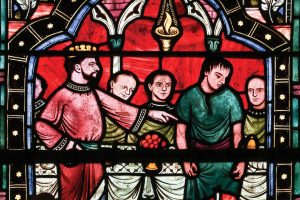
Image: Wikimedia Commons, print depicting the story of Jesus and the woman caught in adultery