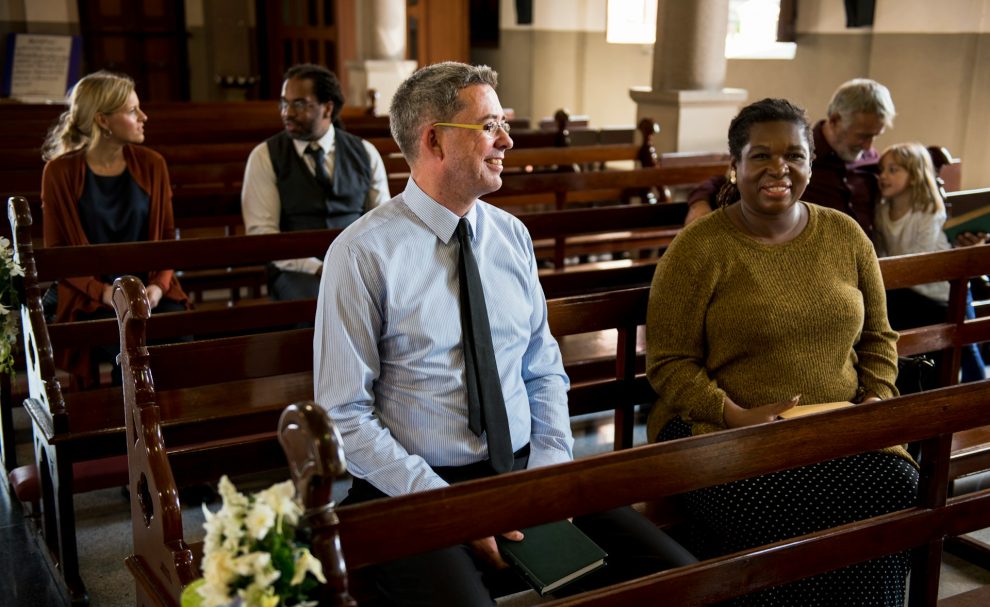
Each week, my parish priest encourages us to stop downstairs after Mass for coffee and donuts and to introduce ourselves to someone new—“No cheating!” he says. And most weeks, I roll my eyes, secure in the knowledge that I will not be introducing myself to anyone new. I am not a small-talker, and introducing myself to a new person rarely feels natural.
But when a new parents’ group started meeting in the gathering space, stopping in and saying hello didn’t seem quite as scary. We had something in common: kids! There wasn’t a lot of deep, thought-provoking conversation at the first event, and yet, the act of gathering with strangers that day—who now have become close friends—has ultimately been transformative. In developing relationships with the people who sit by my side in the pew, my life has been enhanced beyond measure.
Dorothy Day explores this need for community—true, deep community—in her autobiography, The Long Loneliness (Harper & Brothers). Day shares a lesson Peter Maurin taught her: “Community—that was the social answer to the long loneliness.” For Day, community meant a sharing of resources and space in what would become the Catholic Worker Movement. That integration of the individual into a greater whole is an essential aspect of any person’s faith life regardless of vocation.
The U.S. Conference of Catholic Bishops has called for a renewal of the “ministry of community life” as an essential tenet of the faith, saying on their website: “The ministry of community life builds an environment of love, support, appreciation for diversity, and judicious acceptance that models Catholic principles; develops meaningful relationships; and nurtures Catholic faith.”
Pope Francis reminded us in Fratelli Tutti (On Fraternity and Social Friendship), “Human beings are so made that they cannot live, develop and find fulfillment except ‘in the sincere gift of self to others,’” and “life exists where there is bonding, communion, fraternity; and life is stronger than death when it is built on true relationships and bonds of fidelity.”
It’s simple enough to declare the value of community and its importance in the Catholic faith in theory. But in reality, cultivating and sustaining community can be a challenge. I belong to a parish that embraces its members regardless of status, race, age, sexual orientation, or family size. I’ve been part of faith communities that do not. To be in communion with parish members when they deny the fullness of your humanity—or even when they’re just kind of rude—can feel pointless or even impossible.
The building of community requires all of us to set the standard for what it means to love and know one another. Each of us holds an invitation to join in community and a responsibility to make our community welcoming to others. It was easy for me to socialize with other parents, and my attempts to connect were met with immediate acceptance. But unfortunately that’s not everyone’s experience. How do we foster supportive relationships in a parish when common ground with one another isn’t so obvious? What does it mean to build community amid a sense of isolation and loneliness?
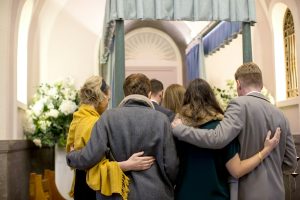
Whether a newcomer or a long-established parishioner, when we make a conscious effort to create connections with people in the pews, it changes our experience of faith. We join our human experience and our prayers together mindfully, intentionally. We allow ourselves to enter into one another’s lives, and we develop a deeper understanding of what that really means. We learn to forsake our own convenience for the community around us, and we find ways to bring love into the world—together.
Members of my parish have helped me feel welcomed and whole on hard days—something Day and her community members felt and knew well. “The only answer in this life, to the loneliness we are bound to feel, is community. The living together, working together, sharing together, loving God and loving our brother, and living close to him in community so we can show our love for Him,” says Day.
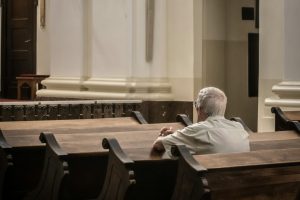
Knowing one’s pewmate is not a requirement of Catholicism, but doing so calls us to engage with the faith in an immediate and relevant way. And this might look different based on our context and capacity. Right now, I’m an active member of an official parish group. At other times in my life, being a part of a parish community has looked like quietly showing up in the same pew each week or going out of my way to greet someone I don’t know during the sign of peace. It has always meant showing up and making an effort.
Day says it well: “We cannot love God unless we love each other, and to love we must know each other. We know Him in the breaking of bread, and we know each other in the breaking of bread, and we are not alone any more. Heaven is a banquet and life is a banquet, too, even with a crust, where there is companionship.”
Mutual hospitality at church is an opportunity to practice how we must live together in the world. Journeying together changes our social and spiritual lives in small but meaningful ways.
I don’t think I’m ever going to love meeting new people or be excited to engage in small talk. But with a little more confidence and motivation to be the welcoming presence that once was offered to me, I’m now approaching the after-Mass coffee hour a little braver and a little more ready to become that community for someone else.
This article also appears in the August 2026 issue of U.S. Catholic (Vol. 91, No. 8, pages 38-39). Click here to subscribe to the magazine.
Image: Unsplash/Curated Lifestyle