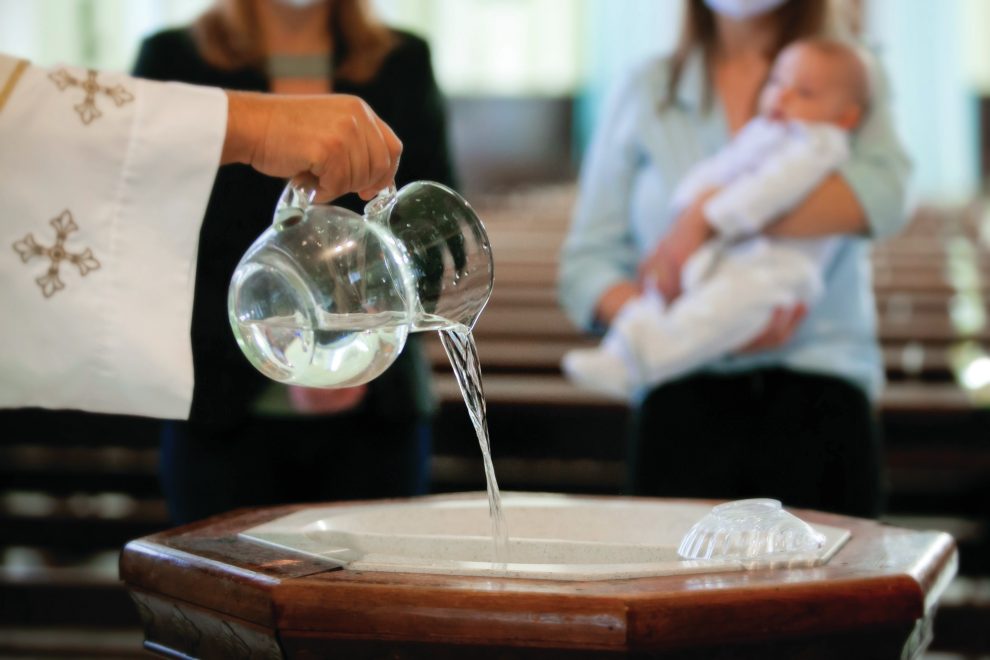
I did a double take when Al Pacino’s face filled the projector screen during my undergraduate class on sacraments. Our professor, a Benedictine priest, wanted to show us the famous baptism scene from The Godfather (1972) to illustrate a point about the theology of the sacrament.
“The reason this scene works is because it gets the theology of baptism right,” he said. The symbols and rituals that signify cleansing from sin and initiation into a merciful community are contrasted with scenes of immorality and violence. Pacino’s character, Michael Corleone, is asked if he rejects Satan and all his works while viewers see his mafiosi carrying out works of evil at his order. Corleone has rejected Jesus’ teachings. To the family, he may be the Godfather, but when it comes to the role’s significance within the Catholic faith, he isn’t a good one.
When my brother and sister-in-law asked me to be godmother to my nephew, I thought about that scene. Unlike Corleone, I wanted to mean the words I said at the font. I wanted to help my nephew know and love Jesus. I wanted to be a good godmother—and not just during his childhood years but throughout his life.
In canon law, godparents are directed to “[help] the baptized person to lead a Christian life in keeping with baptism and to fulfill faithfully the obligations inherent in it.” We are also charged to lead a “life of faith.” These simple phrases commission a massive responsibility: Godparents are mentors and models of what it means to follow Christ.
My godson is getting close to his teenage years, when aunts are not usually considered the most interesting company. I am not very cool, nor do I feel very holy. I like history documentaries and mystery novels. I rarely keep up with fashion and trends. I love Jesus, and I doubt my faith. I pray, and I question. I critique. I wrestle. I sin. And still I want to continue to help him discover and explore his own faith.
I have had many mentors in my own faith journey. Each lived their faith in different ways; all were genuinely seeking Jesus. They walked with me and listened to me, helping me to hear God’s voice in my own life and respond to God’s call. They taught me three meaningful characteristics of a mentor: authenticity, curiosity, and consistency.
Young people are figuring things out, including their identities. They want to experience new things. They ask hard questions and try on new personas as they grow. I am often tempted to tell the young people I love exactly what I think they should do. But the best mentors I’ve had in my faith journey demonstrated curiosity and encouraged my searching. They asked questions rather than gave answers. They were honest about their own experiences and about things they did not know.
Young people aren’t looking for faith mentors who are perfect. The “Relational Authority” study from Springtide Research Institute confirms this. They are looking for people whose experiences resonate with theirs and who help them believe a relationship with Jesus is possible in their own lives. They want to see Christians who are authentically themselves, who share their passions and interests. Being a mentor and model of faith means demonstrating how to love Jesus through every phase and stage of life, complexity and challenges included. It means showing that even when we are not perfectly faithful, we can keep striving for holiness.
But even more than that, mentorship is about listening to young people and centering their experiences. The “Sacred Listening Study” from Future of Faith shows that young people are more likely to engage in faith long-term when they feel heard and seen by their faith community. One of the best gifts a godparent can give is a curious, open heart.
But openness alone is not enough without trust. And building trust requires consistency: showing up again and again for the little things. For me, it has meant proving that I care about the things my nephew cares about. And more importantly, proving that I care about him.
Without consistency, authenticity and curiosity become less effective. Mentors must be intentional and sometimes selfless with their time and energy. At the same time, mentors might model reflection and rest, too. In short, to be a good mentor means to act more like Jesus.
It is a privilege and an honor to hold a mentorship role for those new to and growing in their understanding of the faith, even when you’re not sure if you’re the right person for that job. The opportunity to be the presence of Christ in someone’s life isn’t reserved only for godparents. Every single member of the body of Christ is called to mentor and accompany one another.
Accompaniment happens when friends share their grief over one’s loss of a spouse. It happens when a family invites the pastor for dinner on a Friday night. It looks like teenagers who volunteer to help with religious education lessons, or members of a religious order who spend time together on a Tuesday evening. Everywhere we gather in Christ’s name, accompanying one another, the church is present.
Each of us can live with authenticity, curiosity, and consistency when we show up for others. In doing so, we live out the words of St. Paul to “love one another with mutual affection; outdo one another in showing honor” (Rom. 12:10). Godparent or not, we are all called to walk together along the way.
This article also appears in the July 2026 issue of U.S. Catholic (Vol. 91, No. 7, pages 38-39). Click here to subscribe to the magazine.
Image: adobe.stock.com/Maykol Nack