Every Sunday, during the Creed, Catholics profess their belief in the “communion of saints.” For most of us, most of the time, this conjures an image of disembodied souls, worlds away from our own concerns. Yet, that communion includes not only the Church Triumphant of the saints in heaven, and the Church Penitent in purgatory, but also all of us here on earth—the Church Militant.
In a time when loneliness and fear are more and more prevalent, it can be helpful to look to that “great cloud of witnesses” (Heb. 12:1), not just for their prayers but in how they built community and relied on community in their Christian witness. Isolation and atomization are core tools of authoritarian movements not only in recruiting supporters desperate for meaning, but even more so in preventing meaningful opposition. In Tsarist Russia, which provided the Soviet Union with its authoritarian template, even chess clubs were looked upon with suspicion as they allowed people to mingle.
In the story of each martyr, there are other people—saints with whom they had an affinity, friends who inspired them, co-laborers for justice. Community building is as important in resistance as it is in the life of faith.
Here are five lessons in resistance from courageous saints.
Saint Theodosia of Tyre (d. 308 C.E.)
The value of small, simple acts of solidarity
Theodosia of Tyre is a lesser-known representative of the early virgin-martyrs like Agnes, Lucy, and Agatha. Born in modern-day Lebanon, her story is preserved by another saint: Eusebius, bishop of Caesarea, a coastal city in what is now Israel. When Theodosia, only 17 years old, encountered a group of 24 Christians imprisoned outside the Roman governor’s headquarters in Caesarea, she boldly approached, offering encouragement and asking for their prayers when they reached heaven.
Enraged, officials took her to stand trial before the governor, from where her story plays out like the other virgin-martyrs’: She refuses to deny Christ, undergoes mutilating tortures, and she finally dies when thrown into the sea. In a twist, Eusebius claims the governor was so struck by her resistance that he sentenced the 24 Christians to slave labor in copper mines rather than death. Eusebius also claims the governor himself was put to death shortly after.
In Eusebius’ telling, Theodosia does not seem to have planned to approach her imprisoned fellow Christians; she did not wake up that morning expecting to become a martyr. While the stakes for most of us will be less dire, Theodosia’s story demonstrates that Christian witness does not need to involve a whole-life program of activism. Every day will bring its own opportunities to speak for justice, even in the smallest ways—like encouraging a group of protestors as you pass by.
Theodosia’s feast day is April 2.
Saint Thomas à Becket (c. 1118–1170)
Your witness can inspire for centuries
Also called Thomas Becket, this saint was born into a London merchant family in the early 12th century. Recognized for his intelligence and skill, he rose from the rank of clerk to chancellor of England for Henry II, first king of the Plantagenet dynasty. He and the king became close friends. When the Archbishop of Canterbury, the foremost church office in England, fell vacant, Henry appointed Becket to the position, hoping his friend would give him control over church as well as state affairs. However, Becket resisted, acting in good faith as a bishop and in the best interests of the church.
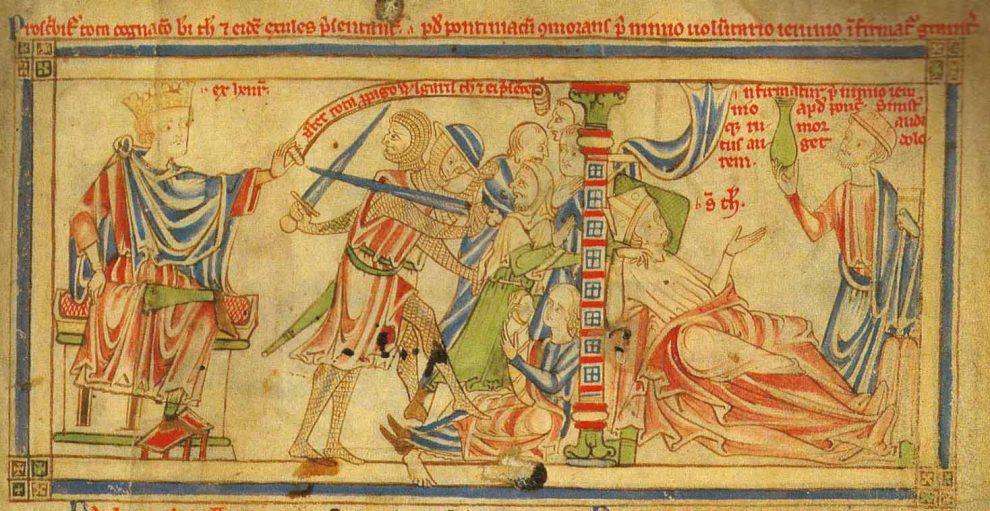
At Christmastide 1170, the frustrated Henry II complained about his estranged friend to his knights and retainers who were gathered in celebration of the season. According to the most popular account of his words, he demanded, “Who shall rid me of this turbulent priest?” Four knights took this as implicit instructions, rode to Canterbury, and confronted Becket inside his cathedral during evening prayers. After failing to drag him from the cathedral, they chopped off the crown of his head and scattered his brains between two side altars.
Henry II, to contain the fallout, built a shrine to his former friend at Canterbury, which became a much-renowned pilgrimage destination. In the 1530s, another King Henry (this one the eighth), who had put his former friend and chancellor Thomas (More) to death, destroyed the shrine at Canterbury and discarded Becket’s bones, suppressing veneration of a man he considered a traitor because he had suggested limits to a king’s power.
Even after 400 years, the example of a man who became a saint by defying a king was far too dangerous. If you feel disappointed that your efforts for justice are seemingly in vain, take heart: Your witness might bear fruit in places and times you never see.
In art, Saint Thomas is recognizable by the missing top of his skull. His feast day is December 29.
Saint Margaret Clitherow (1555–1586)
Protecting your community can be as essential as direct advocacy
Thomas More may be the most famous saint of the English Reformation, but he is far from the only. In the 1500s and 1600s, approximately 600 Catholics were martyred for not recognizing the English monarch as the head of the church. Most of them died during the reign of Elizabeth I. Margaret Clitherow was among these.
Clitherow was a well-to-do woman, living with her husband John, a butcher, and their two children in a commercial district in York. In the early 1570s, she converted to Catholicism and became recusant, a non-attender of Anglican services. Her husband, meanwhile, was responsible for reporting Catholics to the authorities, while he had to pay a fine for his wife’s recusancy. Clitherow was arrested multiple times but, undeterred, went on to create a secret hiding place for priests—known as a priest hole—and for supplies for celebrating Mass. This was punishable by death.
When discovered, Clitherow refused to enter a plea—either to spare her children from having to testify against her, or because of her belief that, in her own words: “Having made no offence, I need no trial.” Despite her pregnancy, she was executed by a form of torture known as pressing, a standard punishment for those who refused to plea. She was stretched out across a sharp rock and the door of her own house was laid atop her. It was then loaded with hundreds of pounds of stones. It took her fifteen minutes to die.
Clitherow was a wife and a mother of middling means, not a politician or full-time activist. Her organizing was for the benefit of her local Catholic community rather than systemic change. Experience repeatedly demonstrates that getting involved at a local level through volunteering, mutual aid networks, or local electoral initiatives is the key both to rapid response to crisis and to long-term change.
Margaret was beatified in 1929 and canonized in 1970. Her feast day is March 26, and her home in York is now a shrine.
Peter To Rot (1912–1945)
Long-haul activism requires a well-balanced life
Peter To Rot, canonized only in October 2025, is Papua New Guinea’s first indigenous saint. The son of a chieftain who converted to Christianity, Peter became a lay catechist. His family arranged a marriage to Paula Ja Varpit, with whom he was very happy. They had three children together.
In 1942, Imperial Japanese forces occupied Papua New Guinea, sending the foreign missionaries and priests to prison camps. Peter took on a leadership role, encouraging the local Christians and leading prayer services. However, the occupiers soon banned not only public worship, but private prayer, on pain of imprisonment. Yet Peter continued to lead services, even conducting baptisms and marriages.
Marriage was to be the cause of Peter’s martyrdom. In an effort to appeal to the locals, the Japanese occupiers reinstituted polygamy, which had largely died out, allowing local men to take a second wife. Powerful local officials used this as grounds to seize women who were already married to others. Peter provided material support for the victims of forced marriage, as well as denouncing polygamy. This resulted in his arrest by Japanese authorities.
He was imprisoned and tortured for two months before a military doctor killed him with a combination of lethal injection and brutal beating. Two months later, the Japanese occupying force surrendered to Australian liberators.
The Japanese occupation was a time of oppression and terror—but Peter rose to the challenges of his time in part because of his long-term experience in organizing and serving his community. That experience took years to develop, requiring the support of his relationships and his faith. Abandoning everything to engage in activism full-time is a guarantee for burnout and disillusionment, especially if someone has never volunteered before.
Peter To Rot’s feast day is July 7.
Óscar Romero (1917–1980)
It’s never too late to get involved
From his early teens, Óscar Arnulfo Romero y Galdámez felt a calling to the priesthood. After studying theology and being ordained in Rome, he returned to minister in his native El Salvador. In 1970, he was appointed auxiliary bishop of San Salvador, the capital, and titular bishop of Tambeae. Seven years later he was made Archbishop of San Salvador.
El Salvador was, through the 20th century, marked by widespread poverty, extreme wealth inequality, and pervasive violence. In the 1960s and 1970s, right-wing government forces, termed “death squads,” strengthened the control of oligarchs, militarists, and secret police forces. In 1979, a coup triggered 12 years of civil war, in which over 70,000 people would be murdered.
Among those killed in early 1980 was Romero’s friend, Jesuit Father Rutilio Grande, an organizer of peasants. This affected Romero tremendously; while he had previously given noncontroversial calls for peace, he now made pointed criticisms of the ruling junta. He also criticized the United States for its military aid to the regime. In a March homily, Romero called on soldiers to disobey orders to kill civilians: “When you hear a man telling you to kill, remember God’s words, ‘thou shalt not kill.’ No soldier is obliged to obey a law contrary to the law of God. In the name of God, in the name of our tormented people, I beseech you, I implore you; in the name of God I command you to stop the repression.”
The next day, while Romero was saying Mass in a hospital chapel, a sniper shot and killed him with a single bullet through the heart. No one was ever convicted of his murder.
Romero was the first bishop to be killed in his cathedral since Thomas Becket. During his funeral, smoke bombs and rifle shots caused a stampede, and over 30 people in attendance were killed.
El Salvador today is ruled by a strongman who operates the ultra-secure CECOT prison camp, using the threat of resurgent gang violence to consolidate his hold on power.
While Romero’s most visible and impactful advocacy for justice lasted only a few months, it was so potent that it cost him his life. If you regret not getting involved earlier, or not being more involved, it is never too late to do more.
Óscar Romero’s feast day is March 24.
All these saints were martyred by governments, even for the most minor opposition. American Catholics are in a historically privileged position with legal protections for speech, press, and assembly in the context of a society habituated to freedom of thought. We have a duty to use these protections for the benefit of the most vulnerable, especially as those rights have been under escalating attack for more than a decade.
If you are afraid, or unsure how to get started, look around you and connect with those closest to you, like St. Peter To Rot and St. Theodosia. Work for those in your own community first, like St. Margaret Clitherow. If speaking out directly becomes the right course of action, look to the example of bishop-martyrs Thomas Becket and Óscar Romero.
And do not forget to pray for their intercession. Not all allies are visible, but you are never alone.
Image: Wikimedia Commons/Henry II banishes Thomas Beckett’s followers