What’s required for a Catholic wedding?
In the Catholic church, marriage isn’t just a celebration of a relationship milestone or the recognition of a new legal status for a couple; it is also considered one of the seven sacraments, so it comes with a lot of theological import attached. Because of this, the process of getting married within the church can be quite long and complex: At a minimum, you should expect to spend at least six months preparing. Here’s what else you need to know.
Are you eligible?
Before anything else, the church needs to confirm that your marriage would be valid in its eyes. The basic requirements are: At least one partner must be a baptized Catholic; both must be free to marry (meaning neither is still in a previous, unannulled marriage); and both must consent freely, without coercion. The marriage must also be between one man and one woman, as the church does not recognize same-sex marriages.
If one partner is a baptized, non-Catholic Christian—for example, a Lutheran, Orthodox Christian, or member of any other denomination—the marriage is still possible but requires special permission from the local bishop, called a “permission for mixed marriage.” If one partner isn’t a baptized Christian at all, a different kind of permission, called a “dispensation from disparity of cult,” is required, which can also be obtained from the local bishop.
In either case, the Catholic partner must promise to continue practicing the faith and to do everything in their power to raise any children Catholic, though the non-Catholic partner doesn’t have to make any such promise themselves.
A note on remarriage
Remarriage within the Catholic church can be a tricky subject. In the civil realm, all that is required for a person to be remarried is first obtaining a divorce certificate recognizing the end of their previous marriage.
However, for theological reasons, Jesus’ answers to the Pharisees on the topic of divorce in Matthew 19:1–9 are often cited: for example, the Catholic church does not technically recognize divorce. Instead, the church may issue a “declaration of nullity,” often called simply an “annulment.” An annulment doesn’t declare the end of a valid marriage; instead, it declares that the marriage in question was never valid to begin with.
Because of this difference in approach, an annulment has different (and frequently more stringent) criteria from what is needed to obtain a legal divorce. It is the result of an often-lengthy process that must be completed within the Catholic Church.
Contact your parish early
The standard advice from dioceses and marriage coordinators is to reach out at least six months before your intended wedding date, with nine months to a year being ideal. Many parishes book up quickly, and the preparation process itself takes time. You shouldn’t set a date or book any vendors until you’ve spoken with your priest or deacon first.
Your initial meeting will cover whether you meet the eligibility requirements and walk you through what the preparation process will look like at your specific parish. Requirements can vary by diocese, so it’s worth having this conversation before you assume anything.
Complete a marriage preparation program
Completing a marriage preparation program—commonly called “Pre-Cana,” a reference to the wedding feast at Cana where Jesus performed his first miracle—is mandatory for couples who wish to be married in the church. The program typically covers communication skills, finances, sexuality, parenting, and the theology of marriage as a sacrament.
Formats vary widely between parishes and dioceses: Some couples attend a weekend retreat, others take a series of evening classes or work through an online course. Some parishes also pair couples with a “sponsor couple”: experienced married parishioners who meet with them several times throughout the process.
Most couples will also complete a premarital inventory such as FOCCUS (Facilitating Open Couple Communication, Understanding, and Study) or Prepare/Enrich, which are questionnaires designed to unearth areas of agreement and potential tension before the wedding day.
Gather your documents
As with most weddings, there’s a fair amount of paperwork involved. The standard documents required include:
- Baptismal certificates for both parties, issued within the past six months of the wedding date. The recent date matters: A current certificate will include any sacramental notations, such as confirmation, that have been added to the record since baptism.
- Confirmation and First Communion records, if not already noted on the baptismal certificate.
- Freedom to marry affidavits, which are sworn statements from people who know each party confirming they are free to marry.
- A civil marriage license, which the priest or deacon will sign at the ceremony, making the union legally binding in the eyes of the state.
If either partner was previously married, or if one partner is not Catholic, additional paperwork documenting the permissions, dispensations, or annulments discussed earlier will also be required.
Plan your ceremony
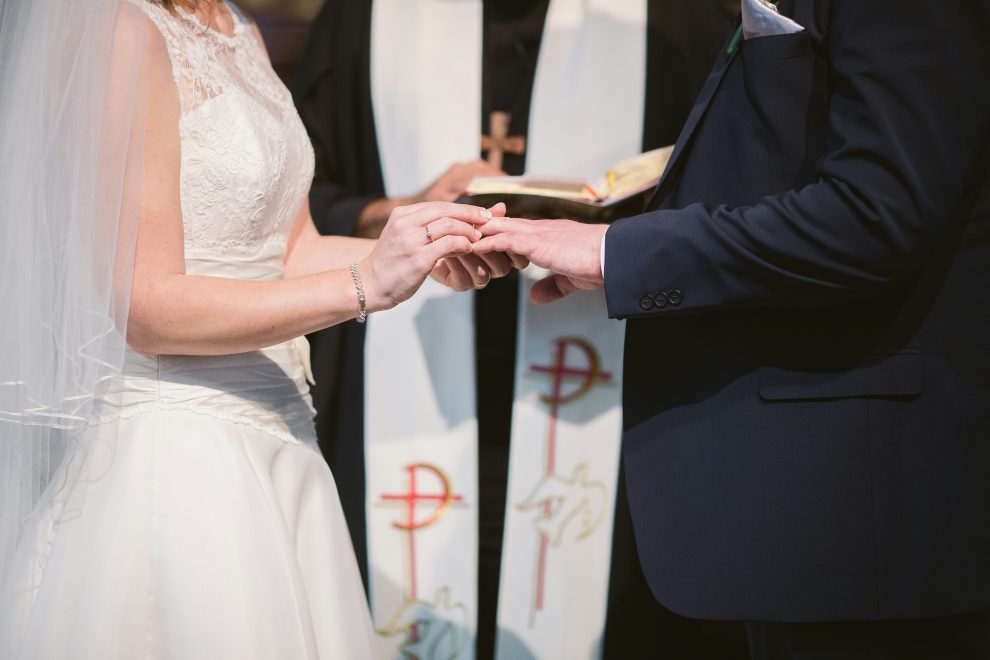
Catholic weddings can take one of two basic forms: a full wedding Mass, which includes the celebration of the Eucharist, or a simpler Rite of Marriage within a Liturgy of the Word, which does not. When both partners are Catholic, a Mass is the norm. When one partner isn’t Catholic, the simpler rite is often chosen so that the non-Catholic partner—who, as a non-Catholic, would not be permitted to receive communion—isn’t excluded from any part of the ceremony.
The wedding typically must take place in a Catholic church or chapel, though the local bishop may sometimes grant exceptions with a dispensation. Working with your priest, you’ll choose scripture readings, select music, and designate participants (such as readers or gift-bearers) from among your families and friends.
In most cases, a priest must officiate the ceremony itself, though if the Eucharist is not being celebrated, a deacon may officiate the wedding instead. In the United States, the priest or deacon will also sign the civil marriage license at the ceremony, so no separate civil ceremony is required.
A note of caution
As noted regularly throughout this article, every diocese—and to some extent every parish—has its own particular requirements and timelines. The steps above describe the general process, but the specifics of what’s required, how long preparation takes, and what forms need to be filed and fees paid can differ depending on where you live. When in doubt, your parish office is your best resource.
Image: