Almost from its beginnings, the U.S. movie industry has been associated with liberal politics. In the 1930s, most of Hollywood’s actors actively supported Franklin Roosevelt’s New Deal and his antifascist foreign policy; FDR returned the favor by addressing the 1940 Academy Awards ceremony. Later, Hollywood stars played prominent roles in the civil rights movement of the 1960s, both as celebrity attention-grabbers and deep-pocketed donors, and a few years later, many actors were prominent in the Vietnam antiwar movement.
However, Hollywood is also, first and foremost, a business, and a big one at that. So, during the Cold War in the 1950s, as the movie studios faced threats from Congress regarding individuals accused of left-wing political affiliation, the studios banished hundreds of actors, writers, directors, and other film professionals from employment. Even household names such as Charlie Chaplin and Edward G. Robinson were thrown under the Red Scare bus.
Until very recently, Hollywood’s liberal consensus, like that in the Democratic Party, seemed to include a public silence about the Israeli government’s oppressive policies toward Palestinian Arabs. But as the death toll from the Gaza war mounted, that consensus started to crack. Last September, more than 2,000 film professionals signed the Film Workers for Palestine pledge, promising not to work with institutions that are implicated in Israeli human-rights violations. The pledge is specifically modeled after one from 1980s filmmakers that played a part in delegitimizing white rule in South Africa.
Meanwhile, several Arab filmmakers have been busy trying to put the Palestinian story on the big screen. That work bore fruit last December, when three of the 15 movies on the shortlist for the Academy Awards’ Best International Feature told Palestinian stories from a Palestinian point of view.
All That’s Left of You (a Jordanian production) tells the story of one Palestinian family over three generations. It begins with their forced removal from their home and land in coastal Jaffa in 1948 and their resettlement as refugees in the West Bank city of Nablus. After the West Bank comes under Israeli occupation in the 1967 war, a son of the third generation joins the First Intifada in 1988, with tragic results.
Palestine 36, an Oscar submission from Palestine, dramatizes a mid-1930s rebellion of Palestinian Arabs against their British colonial rulers. In addition to the usual crimes of a colonial power, Britain was, at that time, allowing expropriations of Palestinian Arab lands to accommodate Jews fleeing fascist terror in Europe.
The third of the shortlisted Palestinian movies, The Voice of Hind Rajab—a true story set amid the still-current Gaza catastrophe—actually made it to the Oscars’ “final five.”
These three films played to rapturous receptions and won dozens of awards at 2025 film festivals from Tokyo to Venice. Their production was also supported by important Hollywood film artists. All That’s Left of You lists actors Javier Bardem and Mark Ruffalo as executive producers. Palestine 36 has an actual movie star (Jeremy Irons) playing one of the British colonial officials. And The Voice of Hind Rajab has the executive producer backing of such Hollywood heavyweights as Brad Pitt, Joaquin Phoenix, Rooney Mara, Spike Lee, and Michael Moore. Typically, movies with those credentials would at least get a deal with a well-connected U.S. distributor, be shown in America’s few remaining art-house theaters, and then land on a subscription streaming service.
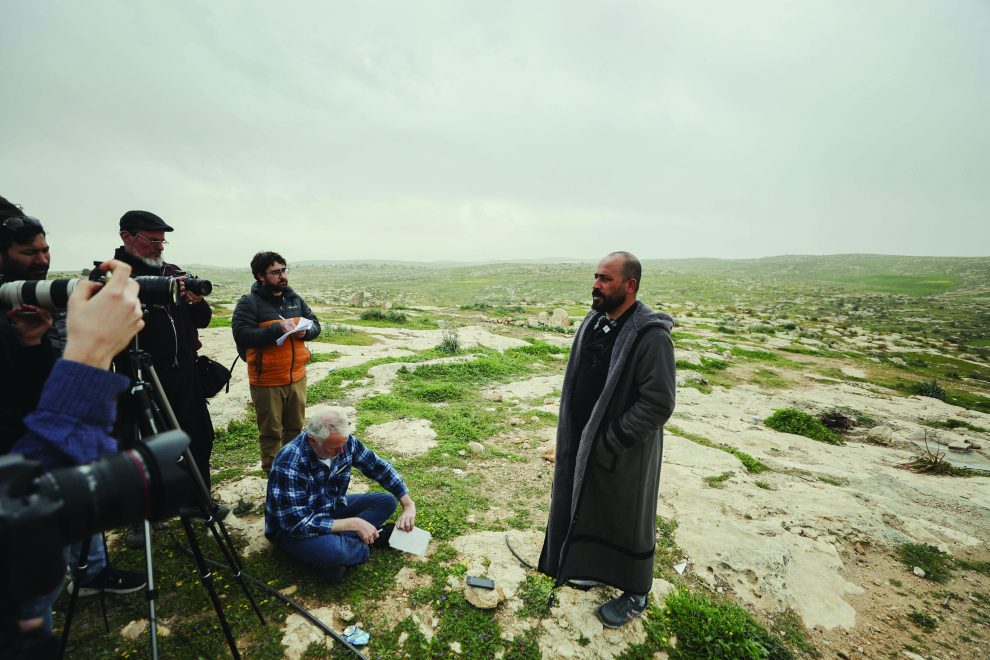
But this is where the business part of the movie business comes in. Despite international acclaim, none of these films have been picked up by a mainstream U.S. distributor. The Voice of Hind Rajab’s producers have resorted to self-distribution. This repeats the experience of last year’s “Best Documentary” Oscar winner, No Other Land, which depicts the violence and intimidation Israeli settlers and soldiers inflict on a West Bank village. No Other Land is still only self-distributed in the United States.
In the past two and a half years, at least 70,000 Palestinians, mostly civilians, have died in Israel’s professed war of retaliation for the October 7 attack. Most were killed with weapons supplied by the U.S. government and U.S. taxpayers.
At times, America’s film industry has produced works that moved public opinion. For example, The China Syndrome (1979) helped stop U.S. development of nuclear power. At a time when President Ronald Reagan had just vetoed U.S. sanctions of South Africa, Hollywood studios contributed to the rising global anti-apartheid movement with Cry Freedom (1987), a star-studded biopic of martyred Black South African activist, Steve Biko; they even created a made-for-TV movie about Black South Africa’s imprisoned leader, Mandela (1987). A little later, JFK (1991) actually led to legislation opening the files on a suspicious presidential assassination.
Today, however, if a film might make anyone question America’s continuing support for Israel’s wars, Hollywood bigwigs seem determined to keep it away from the viewing public.
This article also appears in the May 2026 issue of U.S. Catholic (Vol. 91, No. 5, pages 34-35). Click here to subscribe to the magazine.
Image: Palestinian filmmaker Hamdan Ballal, codirector of the documentary No Other Land, talks to the media about Israeli settler attacks on his village of Susya in Masafer Yatta. Mosab Shawer/MEI/MEI/SIPA/Newscom