Along the beach by the Mission Point Lighthouse facing the Grand Traverse Bay in northern Michigan, visitors’ shoes crunch over millions of shells that are on their way to becoming sand. They are so abundant they completely cover the beach surface. The lake water is incredibly clear, distant expanses reflecting a striking blue to the sky. If you didn’t know any better, the whole scene would feel picture-perfect.
But for anyone who is ecologically attuned, a deep unease brews just beneath the surface. The shells on the shore come from zebra and quagga mussels, originating from Eastern Europe and introduced to the Great Lakes in the 1980s. They did so well here that now vast stretches of lake bottom are carpeted with thick, bumpy mussel colonies, whose numbers are estimated to be over 4.5 trillion. They gobble up the plankton, hence the crystal-clear waters, but that means less food is available for native aquatic species, disrupting the entire food web. Populations of whitefish, yellow perch, and salmon are in sharp decline.
Zebra and quagga mussels fit the definition of invasive species—species that do not originate from the area but have adapted so well to a new place that they take over a landscape, potentially harming human health, economies, and ecosystems. In fact, in 2000, the International Union for the Conservation of Nature (IUCN) listed zebra mussels among “100 of the World’s Worst Invasive Alien Species”—and that was before quagga mussels outcompeted them in the Great Lakes.
But when scientists sat down to make that list, they also debated the inclusion of another troubling species—Homo sapiens. “Are humans an invasive species?” they asked one another. With that came a bigger question, “If so, what do we do about it?”
A complex label
Scientists at the convening agreed that humans rank at the top for their negative ecological impacts. Daniel Horan, a former Franciscan priest who teaches theology at St. Mary’s College in Notre Dame, Indiana, agrees. “Mountain top mining, clearcutting, damming, deep sea mining, offshore drilling, and—further back in Indigenous history—settler overhunting of buffalo. It’s kind of hard to think of us as not invading the rest of creation in a way,” Horan says. “When we become focused on domination and subjugation, as if we’re entitled to these other aspects of creation, the invasive species framework becomes a good metaphor.”
But technically, invasive species are aided by humans and recently introduced to a place. Humans, by contrast, do the introducing. And we have been around for a while in many parts of the planet. The IUCN convening ultimately did not include humans on the list.
The invasive species framework can be a helpful way of understanding humanity’s impacts on creation, especially when it comes to colonialism and our exploitation of other species. However, it doesn’t tell the whole story. From Pope Francis’ teachings on integral ecology to shared scientific knowledge, we understand that humanity is not separate from the rest of creation, but rather one member among many in an interdependent web—albeit a destructive member. Even if science or extreme ideologies were to conclude that Homo sapiens are an invasive species that should be eradicated, faith points to a different approach—that because humans are lovingly created and part of God’s redemptive purposes, there is hope for restoring right relationship between humanity and all creation.
“I don’t think the ‘invasive species’ label is an inherent trait of a specific species. It’s about behavior,” says Sasha Adkins, an environmental health lecturer at the University of Massachusetts Amherst and an adult convert to Catholicism. “Are humans—some humans—doing things that are damaging ecosystems? Yes.”
Citing the work of historian Yuval Noah Harari, Navajo writer Mark Charles points out after the cognitive revolution in Homo sapiens, about 70,000 years ago, wherever our species went, a mass extinction of other species followed, from Neanderthals to many of Australia’s large marsupial mammals. Harari went so far as to call humans “ecological serial killers.” From that perspective, Charles believes, humans could be thought of as invasive.
Teresa Rojo Tsosie, director of religious education at St. Jude parish in Tuba City, Arizona, part of the Navajo Nation, also thinks of the ways outsiders have invaded Native cultural spaces and commodified their traditions, such as the Disneyfication of Indigenous Hawai’ian cultures in the Moana movies. She joined others to create Wholemakers, a Catholic youth curriculum about integral ecology, to ensure Indigenous perspectives were respected in Catholic formation around ecological justice.
But for some scholars, considering any humans invasive is inaccurate and dangerous.
“The idea undermines human dignity,” says Celia Deane-Drummond, director of the Laudato Si’ Research Institute at the University of Oxford. Starting her career in plant physiology before branching into theology and ethics, Deane-Drummond has studied the evolution of virtues and vices among nonhuman species. It’s biologically and theologically inaccurate, she says, to think of humans as separately and uniquely bad.
“The possibilities for good and the possibilities for cruelty are exaggerated in human species, but are also there in liminal forms in other species,” Deane-Drummond says. “You can’t get rid of one species and think that everything will go back to normal. There is actually quite a lot of brutality even within the natural world.”
Adkins adds that the “invasive” language has been coopted by white supremacist groups to argue that entire ethnic groups don’t belong in a place, fueling acts of eco-fascism. One such act took place in 2019 in Christchurch, New Zealand, when a self-proclaimed “ecofascist” killed 51 people in a mosque. He claimed non-European immigrants were “invading” so-called “white nations.”
Adkins has also observed how efforts to reduce plastic waste often place the blame on BIPOC communities with fewer resources who have no choice but to utilize single-use plastics. It quickly gets dangerous, Adkins says, to focus on humans rather than systems as the problem.
The real ecological problem
Researchers warn that the planet is reaching critical tipping points, where human-induced climate change, environmental degradation, and species extinctions feed into a vicious, irreversible cycle. Other scientists use the term Anthropocene to name the ways that humans are becoming the dominant force over all of Earth’s systems.
The root issue, many people argue, isn’t that we don’t know how to fix these problems. Rather, we aren’t willing to act rightly on the knowledge we have. “Greed and other sins are the primary causes of environmental and social harm,” says Bill Jacobs, an integral ecologist and founder of the Saint Kateri Conservation Center in New York State, which connects Catholic land stewards with Indigenous perspectives.
At the same time, religions—particularly Christianity—have been part of the problem. In an influential 1967 essay, historian Lynn White Jr. interpreted the biblical creation story as humanity establishing dominance over nature through naming the animals and separating from nature when being formed uniquely in the image of God.
“Christianity,” wrote White, “not only established a dualism of man and nature but also insisted that it is God’s will that man exploit nature for his proper ends.” Some Catholic teachings fell in line with these interpretations. The 1493 papal bull Inter Caetera, a major component of what is now known as the doctrine of discovery, stated that any lands not inhabited by Christians could be conquered and taken from the people already living there for the purposes of spreading the faith and the “health of souls.”
“Colonialism, capitalism, racialized capitalisms . . . the church has been really complicit,” Adkins says.
Africana eco-theologian Jawanza Clark finds helpful the late theologian Sallie McFague’s redefinition of sin as the “failure to accept our place.” Exceeding God’s intended limits for humans as creatures—our ecological niche, you might say—is part of what makes certain human actions harmful. But Clark goes even further.
“The failure to maintain one’s proper place is not a universal human ailment . . . but it is one way to describe the vicious legacy of white supremacy in America and even throughout the world,” Clark writes in Reclaiming Stolen Earth (Orbis). “Whiteness is greed and selfishness in spatial terms, the hallmark of which has been the conquest of land and continued brutal dispossession of indigenous peoples from their portions of Earth.”
Deane-Drummond thinks the problem starts earlier than the colonial era. “There are deep-rooted philosophies that go back to Plato and Aristotle—a dualism that provides the excuse for maltreatment of other beings and each other,” she says. “The sin of power and greed creeps in and distorts all kinds of philosophies and makes them worse than they were originally intended.”
Reviving Catholic eco-theology
While the Catholic Church has been part of the problem, some Catholics are actively working to be part of the solution.
The late Pope Francis’ landmark encyclical, Laudato Si’ (On Care for Our Common Home), has made formerly peripheral theological perspectives more central within the Catholic Church. In the encyclical, Francis reframes humanity’s place within the rest of creation in terms of stewardship and kinship: “Yet it would also be mistaken to view other living beings as mere objects subjected to arbitrary human domination. When nature is viewed solely as a source of profit and gain, this has serious consequences for society . . . . Completely at odds with this model are the ideals of harmony, justice, fraternity and peace as proposed by Jesus.”
Horan hears echoes in Pope Francis’ teaching of St. Francis of Assisi, who spoke of Brother Sun, Sister Moon, and Mother Earth. “The kinship perspective aligns with what the natural sciences tell us,” Horan says. “We are part of creation—interwoven, dependent.”
For Horan, understanding humanity’s place within creation in terms of stewardship isn’t enough. “That metaphor presupposes a certain distance,” Horan says. “Stewards are employees, hired hands, managers. Kin, for better or worse, are tied together. You can have good or bad familial relationships, but they are still your family.”
While Laudato Si’ has provided a critical reframing, it’s not read as widely within the church as some Catholics would like. A year after the encyclical came out, a Georgetown University study found that 32 percent of U.S. Catholics had read or heard about it.
“It’s one of the best documents ever written—it’s so holistic—and yet many of our people don’t know anything about it,” says Sister Caroljean Willie, program director at the EarthConnection environmental center run by the Sisters of Charity in Cincinnati.
Before working at EarthConnection, Willie represented the Sisters of Charity at the United Nations. She remembers most clearly the annual Permanent Forum on Indigenous Issues. “Every year, people around the world would come, and every year, they said the same thing,” Willie says. “‘You talk about care for creation but you’re not talking to us. We’ve been caring for the Earth for thousands of years.’ ”
Broadening perspectives
For Willie and others, a better Catholic view of humanity’s role within creation has to include the views of many groups, particularly Indigenous people. “I recognize that we don’t have all the truth,” Willie says.
Taking up historian Harari’s premise that Homo sapiens caused mass extinctions everywhere we went, Navajo writer Charles points out that various cultures responded differently to the destruction. Western cultures took a bifurcated approach based on a sense of human separateness from nature. “The right says, ‘Exploit it, use it, and once it’s gone we colonize Mars,’ ” Charles says. “The left says, ‘Preserve it. We can’t touch it. We can’t be a part of it.’ ”
Indigenous people, Charles says, instead learned to live as integral members of the natural world. “We’re a part of this system, and to think the solution is either to extract ourself from it or treat it solely as a resource for our own benefit are two binaries that will not lead to an equilibrium, to a harmonious balance,” he says.
Pope Francis was a “shining light,” says Deane-Drummond, when it came to respecting Indigenous communities and transforming the church’s understanding of the human-nature relationship. Deane-Drummond sees deep resources within the faith to meet the current moment. “The basis of our decision-making needs to be done from a multispecies perspective,” she says, “considering not only our own flourishing but the flourishing of other creatures as well, indeed the whole Earth.”
But that priority shift must reach a systemic level, requiring collective decision-making and international collaboration. This is where spirituality can help. “Receptivity to the divine allows us to behave in ways beyond our natural capacity to do good,” Deane-Drummond says. “Ecological conversion is possible through that divine grace working in the human sphere. We need to work toward that—encouraging communities to spend time in prayer and be open to the work of the Holy Spirit in their lives. This enables that change to be possible.”
Relational repair
Eric Anglada, a Catholic Worker farmer in Wisconsin, experienced his own ecological conversion when listening to activist Jim Bear Jacobs tell stories of the land where the Mississippi and Minnesota rivers come together. It is a sacred place in the Dakota people’s origin stories but also a site of tremendous harm and trauma where an attempted genocide of the Dakota people took place following the Dakota-U.S. War of 1862.
“Wherever we are, the land holds stories,” Anglada says. “We are standing on top of these stories, and we need to learn them.” That experience set up Anglada and his wife for the work of repairing his community’s relationship with the land. In addition to practicing regenerative farming at the Saint Isidore Farm, Anglada works with Land Justice Futures to facilitate relationships between communities of Catholic sisters and Black and Indigenous groups so that the sisters can learn the stories of the land they steward. This includes the story of the doctrine of discovery as well as stories from people who have been pushed off or forcibly taken from their lands.
“Some sisters know the story [of the doctrine of discovery]; many do not. We are grappling with ways of re-storying or healing those stories,” Anglada says. “A key piece of that is learning from people who have been able to live with the land in good ways.”
Anglada doesn’t believe human presence is inherently bad for the land. But that has been the assumption of the white-led conservation movement, which has historically focused on preserving “pristine” land untouched by humans. In the case of America’s national parks, that often meant kicking Native people out of land on which they have lived for generations.
Instead, Land Justice Futures works to promote the Indigenous paradigm of human-creation integration. “We understand land justice as protecting the land, regenerating the land, and expanding governance and access to the land to those who have been historically dispossessed of the land,” Anglada says. The last element of the group’s work is key, he adds, because white people own 98 percent of agricultural land in the country.
Everyone benefits
Land Justice Futures has walked alongside 18 different communities of Catholic sisters in the work of relational repair, with a new cohort of communities beginning this year. As many Catholic communities come to inflection points, with aging members and financial strains, Anglada hopes his group can provide these communities with tools to make just decisions about the future of their land.
This doesn’t necessarily mean that sisters would hand over ownership of their properties, though it could. For the Sisters of St. Joseph in Brentwood, New York, it has meant showing up in solidarity with the local Shinnecock nations on various issues affecting the tribe and providing access to the Shinnecock Bay waters from their property so tribal members could start a kelp farm. “Black and Indigenous people stewarding more and more land is going to benefit everyone,” Anglada says. “We’re all going to be healed by this relinquishment of white control.”
For Clark, private property itself is a colonial concept that needs correction. “From an Indigenous perspective, it’s anathema that you would own portions of the Earth. The Earth is shared,” Clark says. Clark proposes “indigenizing” or “Africanizing” space, meaning we come to understand that “all spaces are sacred in the natural world. It’s where the ancestors reside.”
Clark and Anglada both stress that the healing process is about relationships, not transactions. “Ecological reparations is not the government passing out checks or passing out land,” Clark says. “It’s about human beings repairing the Earth and their relationship to it.”
It’s also not an individual pursuit, Clark says. “You can’t do this individually just by reducing the amount of plastic you use or having an electric vehicle, though that’s fine and good and excellent. We need to form communities where we’re indigenizing space as a collective.”
At the Laudato Si’ Research Institute, Deane-Drummond and her colleagues are working toward one small change at the collective level. They hope to add a “Feast of Creation” on the first Sunday in September to the church calendar, a liturgical reminder that humanity is embedded within the natural world. Three of the five continental Catholic episcopal conferences (in South America, Asia, and Africa) have already endorsed this move. “Ecological responsibility is not optional anymore, it’s the basis on which all life exists,” Deane-Drummond says. “It’s actually fundamental to our faith . . . fundamental to our own survival.”
Humans: The younger sibling
Whether or not humans are considered invasive, it’s clear that the human societies currently dominating the landscape need to change their ways, for the sake of all creation, including ourselves. Horan suggests another story that might help spur that change—the parable of the prodigal son.
In Luke’s story (15:11–32), the younger brother takes his portion of his father’s inheritance and squanders it. “If we think of the immediate family in the prodigal son story as the family of creation, humanity can be that prodigal son,” Horan says. “We invade spaces, contexts, and environments that are not exclusive to us, not meant to be exclusive to us, and take and take and take.”
Horan’s reading of this parable echoes some First Nations creation stories, where humanity’s place as created last among the creatures puts us in a humble, learning position of the younger sibling. In Braiding Sweetgrass: Indigenous Wisdom, Scientific Knowledge, and the Teachings of Plants (Milkweed Editions), Potawatomi botanist Robin Wall Kimmerer describes how this perspective flips Western hierarchies which place humans at the pinnacle of creation. “We say that humans have the least experience with how to live and thus the most to learn—we must look to our teachers among the other species for guidance,” Kimmerer writes.
Tsosie suggests starting simply. “We need to listen and help one another and be there for one another,” Tsosie says. “If we’re not paying attention to what’s going on around the Earth right now, it’s not going to change.”
This article also appears in the April 2026 issue of U.S. Catholic (Vol. 91, No. 4, pages 10-15). Click here to subscribe to the magazine.
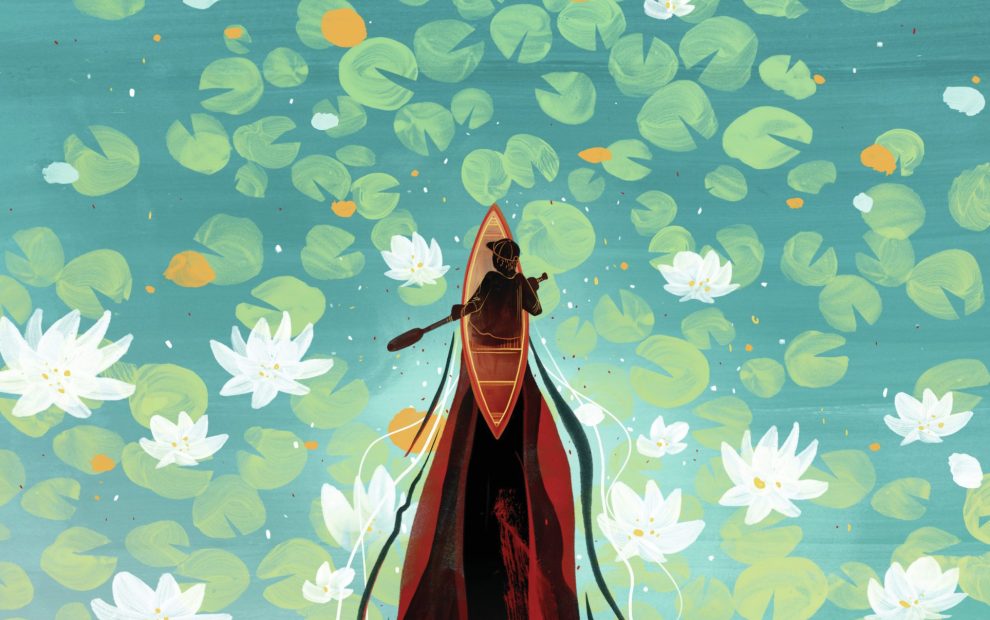
Image: Mary Haasdyk Vooys