I will never forget the deep joy I felt while I was a student at the University of Notre Dame, when four young women from Nigeria celebrated their graduation in 2023. Two were Christian, and two were Muslim, and all four had been victims of religiously-motivated violence before Notre Dame welcomed them to study at the university. Their graduation was a moment of pure celebration.
These four students were embraced not only by family members flown in from Nigeria but also by fellow students, faculty, and neighbors—countless individuals, mostly Americans, whose generosity made that glorious day possible.
That moment of celebration was the opposite of a spirit of discrimination. Yet according to the World Justice Project’s 2023 report, discrimination is getting worse globally. While the report names Afghanistan, Sudan, and Nicaragua as the nations with the worst record on discrimination, the United States is one of the two top offenders among high-income countries. The other is Hungary.
Discrimination happens when individuals or groups are subjected to unequal treatment on the basis of race, gender, disability, sexual orientation, or other characteristics. While the United States enshrines equal treatment under the law in its constitution, its reality has never lived up to this ideal. Even after the civil rights movement officially ended nearly a century of legalized segregation, which had followed more than 400 years of enslavement, many Black Americans still confront a justice system that disproportionately criminalizes them.
The struggle of minorities living under oppressive conditions remains one of the saddest realities in human history. Yet, crucial as it is to acknowledge the struggle and suffering of minorities, minority existence is not defined by pain alone. It is also shaped by unexpected kindness and hospitality—like what I witnessed at the Notre Dame graduation.
A single story, Chimamanda Ngozi Adichie cautioned in her 2009 Ted Talk, is always dangerous. So even as we rightly denounce every act of discrimination against minorities, we must also celebrate, and more enthusiastically, the countless stories of love, acceptance, and solidarity.
When I first arrived in the United States a few years ago, I expected to find a highly individualistic society populated by people concerned only with themselves. Instead, I continue to encounter individuals willing to sacrifice time and comfort for the sake of strangers and foreigners like me.
Being a minority carries with it an urgent responsibility, however, not merely to acknowledge the hospitality of the dominant culture, but to affirm one’s own God-given dignity and freedom and unapologetically celebrate one’s cultural uniqueness and beauty.
Because prosperity and privilege can easily blind us, and we live in a world where power is often misused, the voices of the disadvantaged are often ignored. Pope Leo XIV, in his apostolic exhortation Dilexi Te (On Love for the Poor), reminds us that the poor—not only those who lack economic means but also those who are socially excluded—serve as “silent teachers,” whose witness keeps society grounded in humility. “Lives can actually be turned around by the realization that the poor have much to teach us about the Gospel and its demands,” Leo writes.
Leo reminds us, too, that a society that seeks prosperity while ignoring those who suffer is an “unhealthy society.” A healthy society, by contrast, recognizes the full humanity of the disadvantaged and affords them the space to live freely in their uniqueness and difference.
The privileged have a responsibility not to look away from the struggles of disadvantaged people in societies all over the world. But even when the larger society refuses to listen or respect their full humanity, minorities have the responsibility to affirm their own dignity and worth. When they do so, they help create a society enriched by diversity and more deeply aware of what it means to be human.
Paulo Freire argued in Pedagogy of the Oppressed (Continuum) that “in seeking to regain their humanity,” the oppressed help liberate not only themselves but also the privileged and powerful members of their society, who remain implicated even when not complicit in systems of domination.
We must never forget that the U.S. civil rights movement, which transformed American society for the better, relied on the courage and initiative of marginalized Black communities. Martin Luther King Jr.’s dream of a society that judges people not “by the color of their skin but by the content of their character” remains alive in the commitment of countless Americans to a more just and free nation.
And we must remember that King and several other leaders of the movement were successful in part because they were empowered by a living church and a gospel-shaped vision of a world “in which men will live together as brothers,” as Charles Marsh highlights in his award-winning book, The Beloved Community: How Faith Shapes Social Justice, from the Civil Rights Movement to Today (Basic Books).
Therefore, far from being insensitive to the plight of those who struggle, this call to minorities to celebrate their own unique value is a reminder that God has not excused anyone, however disadvantaged, from the responsibility of making the world a better place. Scripture reminds us that our courage and our strength are in God, not in earthly powers. “The Lord is my strength and my might,” reads Psalm 118. And John 16 assures us that Christ has already conquered the world by the power of his redeeming love. Since we all have received this gift from the Holy Spirit, minority identity is not merely a story of endurance; it is also a vocation to leadership and witness that potentially transforms the world.
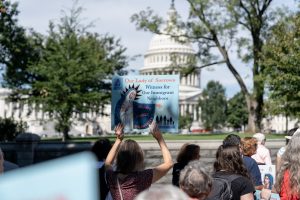
Finally, those who enjoy privilege must learn to listen more attentively to the poor and marginalized. Renee Nicole Good, who was murdered by ICE agents in Minneapolis in January 2026, will forever be remembered as a woman who lost her life advocating for undocumented people. She is, for me, a powerful example of the great courage and generosity of which Americans are capable. Yet her story serves as a reminder that true solidarity is often costly.
We all share the same dignity, and this means that anyone, regardless of status, is potentially God’s messenger, entrusted with urgent truths. When we learn from and listen to another, we become more fully, as Pope Leo prays, “a Church that sets no limits to love, that knows no enemies to fight but only men and women to love”—a church that the world desperately needs.
Image: Unsplash/MD Duran