At a time when calls for peace are met with political hostility, the words of Pope Leo XIV resound with particular urgency. During the prayer vigil for peace at St. Peter’s Basilica on April 11, he proclaimed: “Enough with the idolatry of self and money! Enough with the display of force! Enough with war! True strength is manifested in serving life.”
Leo has insisted that he will continue to speak out against war because, as he said aboard a recent papal flight, “too many innocent people are being killed” and “someone has to stand up and say there’s a better way.” He also warned that “the message of the gospel is not meant to be abused in the way that some people are doing,” reminding us that faith cannot be used to justify violence or division.
The question, then, presses itself with new urgency: What do we mean by peace? In a world marked by war, fragile ceasefires and deepening divisions, the word is invoked often, but not always understood.
As Pope Francis insists in Fratelli Tutti (On Fraternity and Social Friendship), peace is the construction of fraternity. It is the decision to see the other not as an enemy to be neutralized, but as a brother or sister whose good is inseparable from my own. Peace begins when we no longer ask how to defeat the other, but how to seek what is good for them. Without this transformation, ceasefires remain temporary, hatred smolders like embers beneath the ashes, and at the first wind, violence returns.
From the beginning, humanity has lived in the shadow of violence. The biblical memory of Cain and Abel is not only the story of one murder; it unveils a wound that runs through every age. The human family has always been tempted to protect itself through domination, to answer humiliation with vengeance, and to imagine that security can be built on fear.
Yet against that ancient logic stands the word of Jesus Christ: “Peace I leave with you; my peace I give to you”—a peace revealed not in power, but on the cross. For, as Paul proclaims in Ephesians: “For he is our peace; in his flesh he has made both groups into one and has broken down the dividing wall, that is, the hostility between us.” The peace Christ gives is not the result of domination or victory over the other, but of self-giving love: a peace that reconciles, that forgives, that restores communion by bearing, rather than returning, violence.
That kind of peace may seem naïve or idealistic today, especially when solutions to end wars appear distant and uncertain—when, after each escalation, we are told that it will not last long, that order will soon be restored, and yet conflicts in many places drag on for years.
We easily dismiss the power of mercy and peace as insufficient, as incapable of guaranteeing solutions or restoring broken trust. And yet we continue to place our confidence in violence, as if it could secure the very peace it repeatedly destroys.
What a contradiction: To reject what heals and trust what wounds
If we begin to think that being peacemakers is unrealistic, or that the peace Christ offers is ineffective, then perhaps we do not fully believe in him. Like Peter during Jesus’ passion, we may still be tempted to believe that the sword offers a stronger and more decisive solution.
On the one hand, it may seem scandalous to some that the Holy Father speaks of peace and the importance of dialogue. Yet the real scandal is that we are often satisfied with something far less, and that we continue to speak so easily the language of war—even invoking the name of God.
The gospel offers a harder path. In Luke 13:1–5, when Jesus is confronted with political bloodshed and public tragedy, he refuses the trap of easy blame. He does not deny guilt. He does not call evil good. But neither does he allow his listeners to reduce suffering to a simple contest between the innocent “us” and the guilty “them.” Instead, he says: Unless you change, unless you are converted, all of you are in danger.That is not a refusal of justice. It is a refusal of self-righteousness.
This is the point we most need today. Every conflict tempts us toward moral simplification. Each side tells a story in which its own violence is necessity and the other’s is barbarism. Yet terror against civilians is always evil. Collective punishment is always evil. Revenge dressed up as strategy remains revenge. When warfare exceeds the limits of proportion and the protection of noncombatants, it multiplies the very hatreds it claims to resolve.
The Christian contribution to this moment is to defend moral clarity. It must say, without hesitation, that no political cause, no national trauma, and no strategy can justify the destruction of innocent life. No political cause can justify the threat of large-scale devastation and the targeting of infrastructure essential to civilian life as protected under international law.
Christians must also insist that peace cannot be built through escalation and military force alone; even where self-defense is invoked, the temptation toward retaliation remains constant. For this reason, the path of diplomacy is not optional.
Yet diplomacy alone is not enough. Negotiations and agreements can pause violence, but cannot by themselves transform the fear, resentment, and injustice that sustain it. True peace demands that we confront the deeper structures that make violence seem inevitable. Those structures are found not only on battlefields, but in systems that humiliate entire peoples, in economies that normalize exclusion, and in political cultures that reward contempt.
Before bombs fall, words prepare the ground—words that dehumanize and divide, words that diminish the value of others.
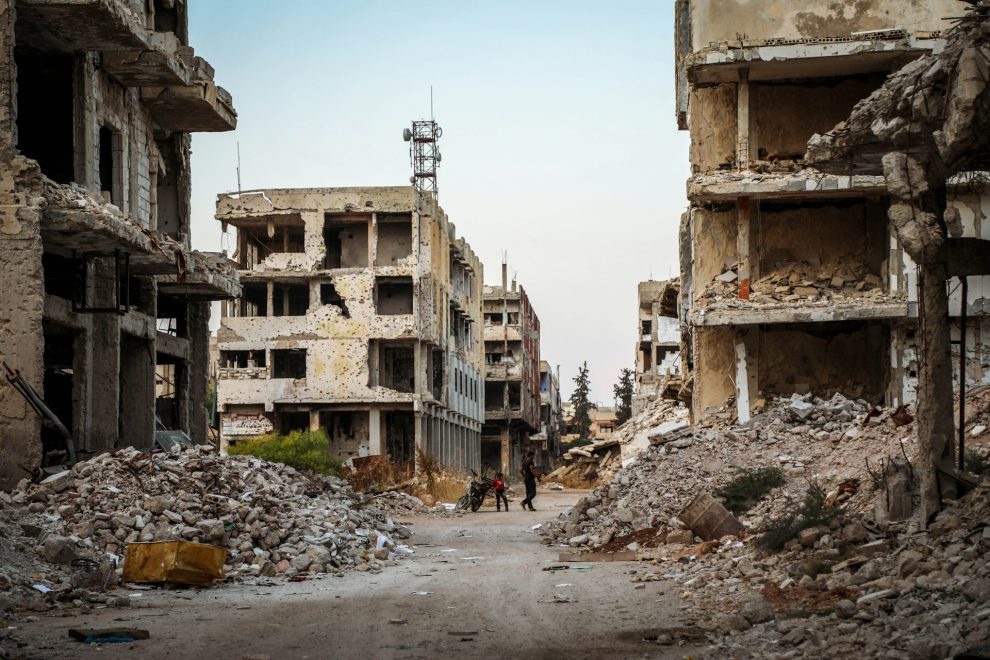
The Christian concern for every human being who bears the image of God is not an abstraction. Even in war, the dignity of every human person remains inviolable. The innocent can never be justified as targets. The child beneath the rubble is not a strategic detail. The refugee is not collateral reality. The civilian trapped by tyranny is not expendable, but a life to be protected and restored.
What does it mean to speak of peace now?
It means insisting that violence, far from resolving conflict, only deepens it. It means defending dialogue, even when it is slow and fragile. It means upholding international law, even when it is inconvenient. It means refusing the lie that some lives matter less than others. And it means asking not only how wars begin, but what sustains them.
Too often, conflicts are prolonged by systems of power and profit that benefit a few while many pay the price. Those sent to fight and die are told they do so for the sake of freedom, yet easily become instruments of interests not their own. The same forces that fuel war frequently stand to gain from its aftermath, profiting from both destruction and reconstruction, as if violence itself were a cycle to be managed rather than a tragedy to be ended.
And it means something more personal. The call of Jesus Christ in moments of catastrophe is for each of us. We are not innocent if our thinking is shaped by contempt, if our politics rely on dehumanization, or if we ignore the suffering of others. Conversion begins when we stop treating peace as someone else’s responsibility.
Ceasefires without trust cannot endure. War may impose pauses or redraw maps, but it cannot heal the human future. That is why encounter, dialogue and diplomacy—despite their cost and difficulty—remain the only path worth pursuing. Yet even these require something deeper: the good will of those who seek not domination, but communion. Peace is inseparable from the will to recognize the other as a child of the one God, whose desire is that all may be one, as Jesus Christ prayed on the night he was betrayed.
Blessed are the peacemakers!
Image: Unsplash/Mahmoud Sulaiman