In Orlando, Florida, in 2012, a wife and husband cultivated a healthy vegetable garden in their front yard. But the city of Orlando fined and prohibited them from doing so “because of the expectation that we live in a society where people will have nicely manicured lawns up front,” says Baylen Linnekin, a food lawyer and author of the book Biting the Hands That Feed Us (Island Press).
The couple was eventually allowed to grow food in their front yard. Yet this story remains an example of how deeply embedded lawn culture is in the United States.
There are around 40 million acres of grass lawns in the United States, an area roughly the size of Wisconsin. All these lawns consume nearly 9 billion gallons of water each day. Lawn care itself is a billion-dollar industry.
Erin Lothes, a Catholic environmental theologian and educator, says that “lawns, in some ways, can be a sign of conspicuous consumption.” In addition to the “extravagant expenses that go into maintaining a manicured, picture-perfect yard,” she says, lawns are drenched with chemicals to keep their emerald-green color. Certain forms of recreation—take golfing for example—“depend on vast amounts of lawn and disproportionately use water resources that are otherwise needed by the community,” she says.
That disproportionate use of resources “only enjoyed by a few doesn’t cohere with the universal destination of goods that Catholic social teaching prescribes,” Lothes says. The universal destination of goods teaches that the Earth’s resources are meant to provide for the needs of all human beings and the common good. In other words, the demand of the common good takes precedence over private ownership of goods.
Our outdoor spaces should be sites where “we encounter God and the diversity of the beauty of creation, and nurture it as stewards, not control it to a very limited and not very fertile place,” Lothes says.
Lawn culture represents a mindset of control, consumption, and individualism. Lawns reflect not only questions about sustainability and creation care, but they also raise issues about wealth and human dignity and the use of resources that could benefit the common good. Catholic social teaching offers Catholics a framework for rethinking the use of lawn space not only to protect the environment but to nurture the shared flourishing of all creation.
A chemically laden history
Although not the only culprit, grass lawns have contributed to the destruction of native plants. Most of the grasses used in lawns—bluegrass, ryegrass, and fescue—are non-native in North America. They came to the United States from Europe with white settlers and from Africa during the slave trade.
Before the 18th century, the word lawn meant an open space or glade in the woods, according to Virginia Scott Jenkins in her book The Lawn: A History of an American Obsession (Smithsonian Books). Few Americans had lawns before the Civil War—except the wealthy, like Thomas Jefferson, who used his money and labor from enslaved people to keep up a giant lawn.
But in the suburban boom after World War II, lawns with well-kept, closely mown grass popped up in most suburbs throughout the United States. They also emerged as a status symbol: If you had a lawn, you were wealthy enough to afford to care for that lawn.
Over time, this status symbol “translated into social expectations that result in pressure to conform to a single mode of aesthetics,” Lothes says—the monocrop. Grass today has been hybridized and developed so that it can be grown in almost any climate, even harsh and dry ones. This monoculture, and the many pesticides needed to maintain it, have significantly reduced biodiversity—the vast variety of living things on Earth, from plants to insects to animals.
“By the late ’80s, the average lawn owner was using a higher concentration of chemicals than farmers use,” Jenkins writes. Many of these lawn chemicals have links to cancer, birth defects, heart irregularities, miscarriages, and more.
American advertising led to the development of the domestic front lawn. The U.S. Golf Association poured money into grass hybridization and other lawn research during the 20th century as well, Jenkins writes.
Matthew Shepherd, director of outreach and education at Xerces Society for Invertebrate Conservation, has seen more of a movement lately of people reducing pesticide use, but he still notices lawn treatment trucks every spring that people pay to drench their lawn in chemicals. “Insecticides are often used for cosmetic reasons rather than for pest control reasons,” he says. “People apply a product so that the plant doesn’t look nibbled or doesn’t get discolored, whereas those things don’t necessarily mean that the plants aren’t healthy. They just don’t look quite as immaculate as we might want.”
Shepherd also points out how pesticides reduce biodiversity of insects who are fundamental to providing life to the rest of the food chain. “Biodiversity means the richness and abundant variety of life,” Shepherd says. Xerces Society also does conservation work with freshwater mussels, slugs, and snails.
Although invertebrates exist in “astonishing abundance,” they are not as abundant as they used to be, Shepherd says, because of chemicals and pollution. Xerces Society has an endangered species program, which includes monarch butterflies and the rusty patched bumble bee.
Xerces Society’s focus on conserving invertebrates stems from the recognition that “they are foundational to everything,” Shepherd says. Invertebrates pollinate flowers and plants, ensuring that there is shelter and food for many other types of animals.
A call to stewardship
One of the “most fundamental aspects of our faith, stated in the first article of the creed, is we believe in God the creator, and God has given us this Earth to steward,” Lothes says. In the Earth’s natural form, “there are no lawns. People have created lawns through control.”
Humanity’s obligation to nurture and steward enhances “God’s purpose of [creation] being fruitful and multiplying,” she says. A lawn does the opposite and “actually reduces the capacity of the Earth to be fruitful and multiply, because it’s diminishing the food sources for insects and pollinators that do in fact support our food supply.”
In the plains of Nebraska, Benjamin Vogt, an author and garden designer, sees unlawning, or reducing or eradicating lawn, as a work of justice. His nonprofit, Prairie Up, based in Lincoln, helps people create pocket prairies in their yard, which are small plots in a garden or yard full of native plants. Unlawning also means ending dependence on fertilizer, lawn mowers, and chemicals.
Whether or not we make changes to lawns now, “climate change will take care of many lawns for us,” Vogt says. Where he lives in Nebraska, this is already starting to be the case: “The water wars already begun to feed monoculture fields will mean less potable water to waste on lawns.”
In her book Soil: The Story of a Black Mother’s Garden (Simon & Schuster), author Camille Dungy writes about starting a pollinator garden in her northern Colorado backyard. After beginning with little knowledge about plants, she came to intimately know the plants she grew, and the creatures who started to visit.
“If, as the author Michael Pollan writes, ‘a lawn is nature under totalitarian rule,’ then my yard reveals a very different sort of possibility—one in which you never know exactly what or whom you’ll find,” Dungy writes in the book.
Having a poison-free yard, she writes, meant learning to live with untidiness and frustration, but also freedom and wonder. “Even in my suburban backyard things are wild in this world,” Dungy writes. “Why not use the rites and rituals and tools at our disposal to exercise control over the small things I can command? But also: Love your neighbor, I remind myself.”
Shared flourishing
Lothes is the executive director of Bethany Center Hudson Valley, a center for ecological spirituality and education and a mission of the Religious of Jesus and Mary, a congregation of Catholic sisters. Before coming to Bethany Center, Lothes worked for the Laudato Si’ Movement for four years and was an associate professor of theology.
Bethany Center Hudson Valley has 75 acres of forest and a lake next to a convent and school that the sisters have run for more than 100 years, Lothes says. Part of its goals are to invite people to live in a “harmonious balance” with creation through sustainable living that is “healthy, nonpolluting, that doesn’t generate trash and waste and the toxins that affect our health and the health of our ecosystems, because it’s all interconnected.”
The tree-lined drive up to the center has swaths of lawn on both sides. Lothes says Bethany Center hopes to convert and transform some of that lawn space into meadows.
In Laudato Si’ (On Care for Our Common Home), Pope Francis writes that biological corridors “along farm areas and urban areas preserve a pathway for creatures, for their habitat, for their feeding, for their migration,” Lothes says. Pocket prairies, native plant gardens, and more are examples of this in action.
St. Thomas Aquinas wrote that no single being can fully capture God’s goodness, so all the diversity of the world’s creatures are needed to give a hint of the “breadth and depth of God’s glory,” Lothes says. It’s one thing to ponder this in our hearts, but the next step is to “experience that with our hands” by participating in efforts to increase biodiversity as part of our shared flourishing.
An ecological community
At Seattle University, a Jesuit university in Washington State, the taqwšblu Vi Hilbert Ethnobotanical Garden abounds with native plants and signage identifying the plant names in Lushootseed, the traditional language of the region’s Indigenous peoples. The garden is named after Vi Hilbert, a respected elder of the Upper Skagit Tribe and a leader in revitalizing Lushootseed language and culture. Hilbert’s granddaughter, Jill LaPointe, now serves as senior director of Seattle University’s Indigenous Peoples Institute.
In 2006, a Seattle University anthropology professor, Rob Efird, collaborated with Vi Hilbert and the university’s grounds professionals to create the ethnobotanical garden as an outdoor classroom where students and visitors can learn about local Indigenous relationships with the land. Efird, who is not Indigenous but a settler descendent, explains that “ethno refers to culture, and botany refers to plants. An ethnobotanical garden is a place that profiles [a culture’s] relationships with plants and introduces people to both the relationships and the plants themselves.”
At the Vi Hilbert garden, Efird says, “we want to draw people’s attention to the intimate, respectful, and sustainable relationships that have flourished between Lushootseed-speaking Indigenous peoples and local plants.”
Efird would love to see similar spaces on more Jesuit or Catholic university campuses and welcomes inquiries from people looking to start them. However, he says that anyone interested in starting a similar garden needs to know that partnerships with local Indigenous people are vital. “We really did our homework about that and that’s a critical piece: to collaborate with and support Indigenous partners,” he says.
Because native plants are the basis of any ecosystem’s biodiversity, “We have more life going on—not just plant life, but nonplant life, insect life, bird life—than maybe anywhere else on campus,” Efird says.
Through the garden, Efird has seen students find their own ways of relating to plants “with whom they have previously had no relationship. Most Americans can only name 10 plants, and one of them is grass. A second is Christmas trees, which is not very specific. As the Indigenous botanist Robin Wall Kimmerer puts it, it’s all just green wallpaper.”
Knowing your nonhuman neighbors is part of belonging to an ecological community, Efird says. “You need to know their names and faces, and you need to behave properly towards them. This is an opportunity to initiate that relationship. It’s mutually satisfying, it’s not just good for the planet and ecosystem. It’s good for you; it’s good for us.”
Feeding the hungry
At St. Isidore’s Garden at Our Lady Queen of Peace parish in Virginia, parishioners grow a variety of produce, helping feed the parish’s food pantry. Julene Jarnot, a parishioner, began volunteering with the garden in 2022, and fell so in love with gardens that she started Catholic Garden Network in 2024, an online directory and forum of gardens at Catholic parishes, schools, universities, retreat centers, religious orders, houses of hospitality, and more.
Last year, St. Isidore’s tripled the amount of produce they grew, according to Jarnot. The food pantry serves around 900 families. “We do surveys from time to time, and the number one request is more fresh produce. Our garden doesn’t cover it all, but it matters,” she says.
St. Isidore’s recently added a pollinator-friendly native plant bed and a rose tree for Mary. “There’s a lot of power in a garden; it speaks to almost everyone on some level,” she says. “Gardens bring people together.” Microbes in the soil also improve mental health and well-being.
Catholic Garden Network grew out of Jarnot’s desire to help people connect with gardens in their dioceses. “I did some cold calling, reaching out to dioceses across the country,” she says. “It was clear that there are gardens out there, but no one really knew even in their own diocese which gardens existed.”
Now, the directory features more than 70 gardens representing 20 states and counting at catholicgarden.org, which span geographic location and rural, suburban, and urban environments. In the online community forum, workers in the gardens can “share stories, solve challenges together, support one another, and not feel alone,” Jarnot says. One of the gardens in the network recently received a $20,000 grant, an opportunity which they would not have known about if not for Catholic Garden Network.
Jarnot says Catholic Garden Network’s mission is rooted in sustainability, food justice, environmental stewardship, and spiritual well-being, drawing from Catholic social teaching’s belief in the dignity of every person and concern for all life on Earth. For Jarnot, “It’s not necessarily entirely getting rid of a lawn, it’s decreasing it, maybe with a garden.”
A new vision
In the Bible, the prophets are clear in “communicating that the health of land and the health of people go together,” says Norman Wirzba, a professor of divinity at Duke University and the director of research for Duke’s Office of Climate and Sustainability. “The fact that you have orphans and widows goes hand-in-hand with their denunciation of the wreckage of the land.”
Corporate profits and the billion-dollar lawn industry have, for the most part, succeeded in convincing Americans that “they should have lawns and that they should look like carpets,” Wirzba says. “And you’ve got to kill the insects to communicate that you are the boss.”
This kind of thinking, Wirzba says, presumes that human beings are the only creatures that matter, and that they are exceptional so can do whatever they want with impunity.
“One of the things that we’re learning, especially in this period called the Anthropocene, is that we cannot do things with impunity, because the world is talking back to us,” Wirzba says. “It’s telling us that the choices we’ve made are getting us into a lot of pain.”
Instead of focusing on how to escape the horrors of climate change and tossing up our hands in despair, Wirzba says to focus on how we are participating with God’s healing ways here and now. “Nobody wants to invite God to a toxic dump,” he says. “So we are called to the work of repair, the work of healing.”
These small acts extend beyond the yard. As Dungy writes in Soil, “Whether a plot in a yard or pots in a window, every politically engaged person should have a garden. By politically engaged, I mean everyone with a vested interest in the direction the people on this planet take in relationship to others.”
Unlawning, reducing lawn, and making decisions that foster the life and health of even the smallest creatures and plants—all of this creates a shared sense of flourishing and helps Catholics break cycles of consumption and exploitation. It’s a way of “giving life a chance,” Vogt says, “and learning to speak the language of that life again.”
This article also appears in the April 2026 issue of U.S. Catholic (Vol. 91, No. 4, pages 30-33). Click here to subscribe to the magazine.
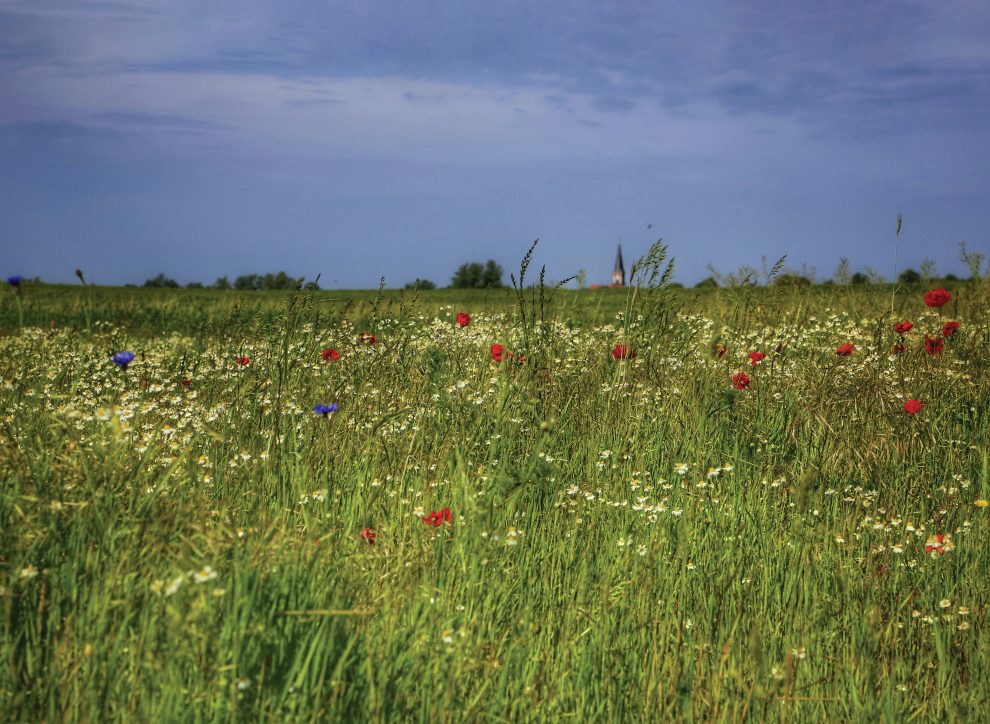
Image: Unsplash/Bernd Dittrich