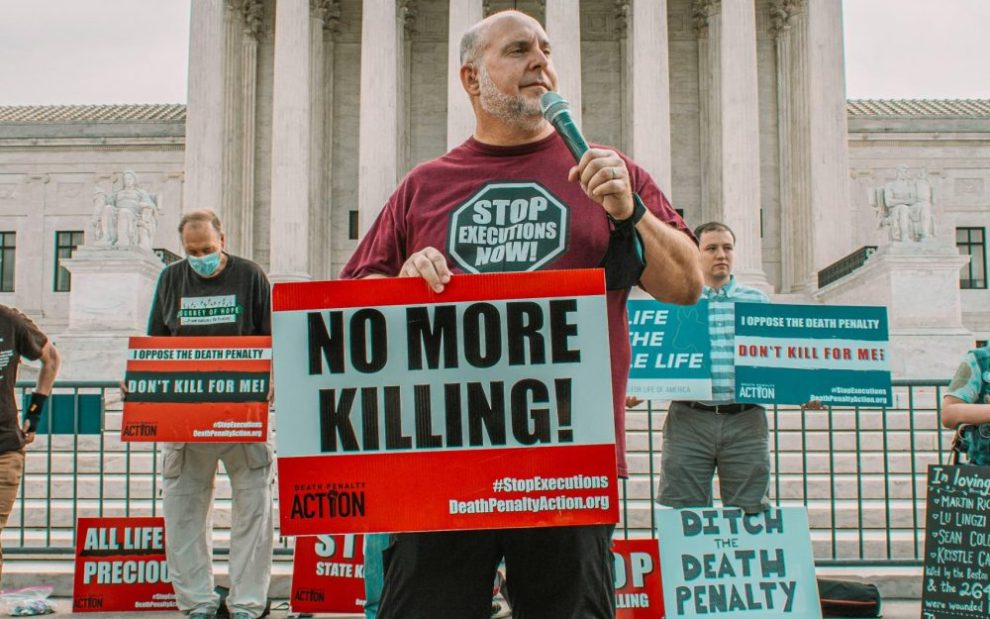
On the second story of a community college art museum in Kansas, a motley gathering of anti-death penalty advocates gathered to hear things one doesn’t hear often: A Republican legislator calling the pro-life movement “really just pro-baby,” a Catholic ministry leader wryly referring to a former U.S. attorney general as “hell bent” on executions, and a room-full of Democratic legislators asking the aforementioned Republican why his colleagues won’t let death penalty repeal leave committee.
Held in Overland Park on Nov. 22, the Kansas Coalition Against the Death Penalty’s (KCADP) 2025 conference placed the death penalty squarely in the realm of pro-life issues while appealing to a consistent life ethic. Although repeal was a part of the Democratic Party platform for 20 years, and has long been considered a progressive issue, the conference entitled “Repeal to Heal: Death Penalty Repeal Advances the Culture of Life” included among its panelists Republican Kansas State Rep. Bill Sutton and Nan Tolson, the executive director of Texas Conservatives Concerned About the Death Penalty (CCATDP). Rounding out the panel was Krisanne Vaillancourt Murphy, executive director of Catholic Mobilizing Network (CMN).
Collaborating with conservatives is hardly a novelty for KCADP, which has been organizing since 1989 in a predominantly Republican state. Board Chair Donna Schneweis said that almost “immediately” the coalition realized it could get nowhere with voters or politicians without a broad-based coalition.
“The organization as a whole has had to learn how to operate in that dynamic,” Schneweis says. “It has been an opportunity to show a path forward toward dialogue and collaboration on issues.”
Despite President Donald Trump’s urging that both the federal and state governments pursue execution more aggressively, support for the death penalty is at its lowest among Americans since 1972. And since Pope Francis’ 2018 amendment to the Catechism of the Catholic Church stating that the death penalty was “morally inadmissible” and that the church “works for its abolition worldwide,” the American church has become increasingly coherent in its anti-death penalty stance.
In recent months, Catholic bishops in three conservative states have explicitly addressed the death penalty as a life issue. In Tennessee, all three of the state’s Catholic bishops made a joint appeal on Nov. 10 to end the death penalty there, and in a Dec. 2 letter, Florida’s Catholic bishops called on Gov. Ron DeSantis to stay two executions scheduled for that month. The Bishop of Wichita, Kan. published a Nov. 19 reflection on “our opposition to the death penalty” in his diocesan paper, and the newspaper of the Archdiocese of Kansas City, Kan. ran a Nov. 7 column by the executive director of the Kansas Catholic Conference entitled “Eliminating the death penalty in Kansas is pro-life.”
Although American Catholics are still severely polarized, with one recent analysis estimating that less than 1 percent of Catholics simultaneously affirm the church’s teaching on abortion, the death penalty and euthanasia, conversations about a consistent life ethic are becoming an effective way to engage people across the aisle on death penalty repeal.
Tolson says her work in Texas depends on appealing to the pro-life identities of conservatives.
“We connect it directly to abortion,” she says. “We have found that the pro-life argument is most successful across the board. That’s why we really lean into that messaging, because it works.”
Her organization is part of the national Conservatives Concerned About the Death Penalty, which has official chapters in Oklahoma as well as Texas. It has its roots in Montana, however, and has founding members in Kansas, Georgia, Kentucky and Michigan. It is also a member of a national coalition announced on Dec. 3 called the U.S. Campaign to End the Death Penalty which boasts membership ranging from CMN to the Oklahoma City chapter of Black Lives Matter.
Vaillancourt Murphy outlined the development of church teaching on the death penalty. She shared research showing that younger Catholics are increasingly inclined to view the death penalty as a life issue in conflict with Catholic social teaching, and emphasized how out of step the administration is with public sentiment around capital punishment.
However, increasing awareness of the death penalty as a life issue requires profound dialogue closely aligned with the church’s vision of synodality. At CMN, Vaillancourt Murphy often finds herself talking with people who are “vehemently opposed to what we do,” she says, while Tolson emphasized that the first step is never to change people’s minds, but to create a “safe-space to talk about the death penalty with like-minded people.” Sutton concurred, saying that when talking to a Catholic politician about repeal, it’s important to start by asking how they see life issues.
Acknowledging the challenge of “coming up against deeply-rooted beliefs about the death penalty,” Tolson says her approach is “focused on planting the seed and finding common ground”—a methodology reminiscent both of synodality and Cardinal Joseph Bernardin’s 1996 plea to American Catholics that we “reconstitute the conditions for addressing our differences constructively” by finding a “common ground centered on faith in Jesus.”
“We are trying to expose people to these new ways of thinking, and letting them come to their conclusions on their own,” Tolson says. “When we come from that posture, we’ve been very successful.”
Listening deeply is essential to CMN’s work as well, not just in terms of converting hearts towards repeal, but as a part of restorative justice—the paradigm CMN advocates for as a replacement for the revenge-based paradigm of capital punishment.
“People have a lot of strong feelings about harm, and maybe some righteous anger that comes when bad things have happened,” Vaillancourt Murphy says. “I want to say to those individuals, I hear what you’re saying, you’re seeking accountability. I hear that, and I see that and I want that too.”
She adds that CMN wants to “engage anyone in this conversation and in this journey towards restoration. One of the approaches that can be most helpful in today’s polarized environment is to see everyone and listen deeply and seek understanding, and then to say that ‘these are things that we stand on—no matter the harms that someone has caused or suffered, we want to honor their dignity.'”
The profound listening and dialogue required to bring ideological opponents together on common ground, or to practice restorative justice, however, does not require parties to compromise their closest-held values. Indeed, in addition to saying “these are the things we stand on,” Vaillancourt Murphy says it’s important to be “clear-eyed” about threats to human dignity wherever they exist.
“What we believe as Catholics is the essence of life, that God has come to heal and restore and offer us mercy and life,” she says. “That’s what we know to be true about our faith, and certainly the sanctity of life demands the protection of life from every stage and age.”
Sanctity of life is the “story that the church keeps telling in all its witnesses and expressions. We will never tire of that message,” she says.
As for Tolson, her ability to engage and patiently pursue common ground similarly follows from her own unshakeable convictions. “I do believe that all life has value from natural conception to natural death and that the value of life is not conditional on how someone chooses to live it,” she says. “We are created in God’s image, we’re all his children and because of that truth we have an obligation to treat each other with respect and honor the inherent dignity of every human being.”
For Tolson, “Anyway you slice it, the death penalty is wrong.”
Recent developments point to a growing consensus that the death penalty is indeed wrong, with more organizations and the church itself learning to talk about it from various angles, connecting repeal to closely-held values. The language and tactics coming out of the repeal advocacy space might offer powerful lessons for other areas of Catholic social teaching. Could other issues considered partisan or politically inconvenient—like climate action—be de-polarized both within the church and in civil life by connecting them to the common ground, or what people care most about?
If so, history suggests such progress will begin by getting motley crews together in community college art museums, having tough conversations, and learning to listen to those we think we can’t agree with.
Image: Unsplash/Maria Oswalt