Dorothy Day was 8 when her family moved into a tenement flat over a tavern on Chicago’s South Side. It was a big step down for the Day family. They had been practically wiped out by the big 1906 San Francisco earthquake.
John Day, a journalist, had lost his home and was without a job. The curtains Dorothy’s mother, Grace, made from remnants were hung from fishing rods. Fruit crates served as book cases. Nail kegs became kitchen stools.
Dorothy was so ashamed of her home that, returning from school, she would enter the door of a better, more impressive building so that her schoolmates wouldn’t know the kind of circumstances she was living in. Her mother suffered blinding headaches and went through several miscarriages. Dorothy’s understanding of the shame people feel when they aren’t making it surely dates from this time.
It was in this period of her life that Dorothy began to overcome the anti-Catholic prejudices that her father had often expressed. Dorothy would recall the impact of searching one day for a friend and discovering her friend’s mother, Mrs. Barrett, praying on her knees at the side of her bed. Without dismay or embarrassment, she looked up at Dorothy, told her where to find her daughter, and returned to her prayer

“I felt a burst of love toward Mrs. Barrett that I have never forgotten, a feeling of gratitude and happiness that warmed my heart,” Dorothy wrote in her autobiography, The Long Loneliness. This brief event was, when Dorothy looked back on it, a significant factor in her later conversion to Christianity and her joining the Catholic Church.
John Day finally got a job as sports editor of a Chicago paper called The Inter Ocean. The Day family moved into a large and comfortable house on the city’s North Side.
The great events in Dorothy’s life at this time had mainly to do with books. Though her father was a man with many prejudices, he was a reader and book lover, and this as well as his journalistic bent rubbed off on his eldest daughter.
In the library of the house, Dorothy first read Victor Hugo’s Les Miserables, Charles Dickens’ Bleak House and Little Dorritt, and other books that stirred her awareness of injustice in the world and also offered images of sanctity. These books she would read again and again for the rest of her life. There were other books, too, the sort her father regarded as “trash.” (Dorothy hid behind a bookcase a copy of Swinburn’s poem, “Tristan,” with its drawing of lovers lying in the grass.)
Books were very much Dorothy’s companions and often mentors throughout her life. She would have appreciated Erasmus’ confessional boast: “When I have money I buy books, and if anything is left over I buy food and clothes.”
Perhaps the book that had the most impact on her in her mid-teens was Upton Sinclair’s The Jungle. Unlike books about social injustice by Dickens and Hugo, here was a story set in the present—not in Europe, but in her own Chicago, in the city’s stockyards and slaughterhouses. Sinclair’s hero was a Lithuanian immigrant, the only member of his family not utterly destroyed by squalor and injustice. He finally commits himself to struggle for a just social order by joining the Socialist Party.
Sinclair’s vivid description of filth and violence in the meat industry so shocked its readers that the book is given credit for congressional passage of tough meat-inspection laws. Sinclair, however, had hoped to stimulate more profound social change. “I aimed at the public’s heart,” he said, “and by accident hit it in the stomach.”
But he did reach Dorothy Day’s heart. She had responsibility for much of the care of the newest addition to the family, John Jr., and, stirred by Sinclair’s novel, she began to push his baby carriage further and further southwest, not far from the parts of the city she had once been so glad to leave behind. “I walked for miles, exploring interminable gray streets, fascinating in their dreary sameness, past tavern after tavern, where I envisioned such scenes as the Polish wedding party in Sinclair’s story,” she said.
As would be typical of Dorothy for the rest of her life, she found a kind of beauty in the midst of urban desolation.
“There were tiny gardens and vegetable patches in the yards. Often there were rows of corn, stunted but still recognizable, a few tomato plants, and always the vegetables bordered by flowers,” she said. Drab streets were transformed by pungent odors: geranium and tomato plants, garlic, olive oil, roasting coffee, bread and rolls in bakery ovens. “Here,” she said, “was enough beauty to satisfy me.”
Only 15 years old, she looked at the world with wide-open eyes and a vulnerable heart many of us might envy. Pondering the lives of the people living in these hard-pressed neighborhoods, yet rich in so many ways, she had a vivid sense of who she would become.
“From that time on my life was to be linked to theirs, their interests would be mine: I had received a call, a vocation, a direction in life,” she said.
Dorothy was an intense, sensitive, quiet young woman and a first-rate student. For her Greek class she translated the New Testament into English. She did so well at Waller High School that at age 16 she was awarded a scholarship to go to the University of Illinois at Urbana.
Moving to Urbana in September 1914 meant many things, not least that she was no longer living under the same roof with her father, few of whose views she agreed with. The two were often at daggers’ points.
She was resolved not to ask her father for financial help once she was at the university. Inspired by reading and her long walks on the South Side, she was determined to support herself by her own labor. “I was mindful of girls who worked in stores and factories through their youth and afterward married men who were slaves in the same factories. The Marxist slogan, ‘Workers of the world, unite! You have nothing to lose but your chains,’ seemed to me a most stirring battle cry,” she said.
Her view was now clearly radical—charity wasn’t enough. It wasn’t enough just to assist the victims of social injustice; what was needed was work to get rid of the social evils themselves. There were day nurseries for children. “But why,” she asked, “didn’t fathers get money enough to take care of their families so that mothers didn’t have to work?”
“Where,” she wondered, “were the saints to try to change the social order, not just to minister to slaves but to do away with slavery?”
For two years she supported herself with manual work in Urbana—mainly washing, ironing, and caring for children—while attending those university classes she was interested in. Then at age 18 she decided she had had enough of classrooms and moved to New York City to get into real life.
It had become clear to Dorothy while a student that she wanted to be a journalist, but, without a degree and still in her teens, finding a newspaper job was no easy thing. None of the city’s mainstream papers offered her a job. Finally she went to New York’s one socialist paper, The Call, and there she got a job, starting at $5 a week. She had moved from reading about radical-change movements to direct participation.
Along this path, Dorothy developed her lifelong connection with the poor, the down-and-out, and all those who were on or near the social garbage heap.
The other key event in her life was her religious conversion. It came about more slowly and followed a more tortuous road.
Along the way was an unhappy love affair that ended with an abortion, a short-lived marriage with an anarchist, and publication of her autobiographical novel, The Eleventh Virgin.
Later, in her venerable years—having done so much good in the world, having saved so many lives, and having brought so many to religious faith—many came to regard Dorothy as a saint. Of course the last thing anyone struggling for sanctity wants to lay claim to is a halo.
“Don’t call me a saint,” she occasionally said. “I don’t want to be dismissed so easily.”
Perhaps another reason for Dorothy’s resistance to admiration was that she believed people would think quite differently about her if they knew the whole truth of her pre-Catholic life and the fact that she had caused the death of her own unborn child.
Nothing horrified Dorothy more about her own past than the abortion. This memory was so painful to her that the event was only implied in the vaguest way in her later Catholic autobiographical writing. There was even a period in her life when she made an effort to track down and destroy as many copies of The Eleventh Virgin as she could find.
She once told her friend Robert Coles about a time when she brought this book-burning effort of hers to the attention of a priest who was hearing her confession.
The priest laughed. “He said, ‘My, my.’ I thought he was going to tell me to stop being so silly and mixed up in my priorities,” she said. “I will remember to my last day here on God’s earth what that priest said: ‘You can’t have much faith in God if you’re taking the life he has given you and using it that way.’ I didn’t say a word in reply. He added, ‘God is the one who forgives us, if we ask him; and it sounds like you don’t even want forgiveness—just to get rid of the books.’”
One consequence of the abortion was that Dorothy felt that the damage done to her womb by the surgical procedure made any future conception impossible. She would never bear another child.
But several years later, in 1926, while living on Staten Island with her common-law, anarchist husband, Forster Batterham, she did become pregnant. The event seemed to her a genuine miracle, and something perhaps even more than that: a revelation of the mercy and forgiveness of God. She was overwhelmed with the desire that her child, once born, would have the religious faith that most inspired and challenged Dorothy herself.
She wanted her child to be baptized in the Catholic Church. But this was no easy matter. There were many obstacles. The most difficult was the passionate antipathy of her husband for every form of religion, but most of all the Catholic Church.
Like Dorothy, Forster had a deep sense of the injustice in the world, and it seemed to him that the Catholic Church was not only silent in the face of injustice but often collaborated in it. When a nun began to visit Dorothy to instruct her in the Catholic faith, Forster would leave, banging the door.
Dorothy and Forster’s daughter, Tamar, was born in July of 1927. Dorothy herself wasn’t baptized until December 28, after a final hard break with Forster that had everything to do with the religious chasm that had opened ever wider between them.
While struggling, as a single parent, to earn a living as a freelance writer, it took Dorothy another five years to solve the most difficult quandary of her life: to find a way to bring together her radical convictions about an unjust social order and her religious faith. Practically all radicals were atheists, while practically all Catholics seemed to think very little about social injustice and what they should do about it.
Dorothy occasionally wrote for two Catholic magazines that had a concern for social issues, Commonweal and America. It was for these two publications that she covered a communist-inspired “Hunger March” that walked from New York City to Washington, D.C. and which, along the way, was the object of much panic journalism and police brutality. Finally, by court order, the marchers, all jobless men and women, were allowed into Washington to bring their petitions for jobs, health care, and unemployment benefits.
Dorothy stood on the sidelines watching the ragged procession carry its banners through “the tree-flanked streets of Washington, . . . joy and pride in the courage of this band of men and women mounting in my heart.” They made her feel how insignificant and puny had been her work since becoming a Catholic, “self-centered and lacking in a sense of community.”
She felt that surely Christ had a great love for these people, even if they regarded themselves as unbelievers and wouldn’t be caught dead in church.
It happened to be December 8, the Feast of the Immaculate Conception. Dorothy went to the unfinished Shrine of the Immaculate Conception near Catholic University and prayed in the crypt.
“There I offered up a special prayer, a prayer which came with tears and anguish, that some way would open up for me to use what talents I possessed for my fellow workers, for the poor,” she said.
The next day, returning to New York City, she met Peter Maurin, the French immigrant who spiritually was a descendant of Saint Francis of Assisi. Between Peter’s visionary ideas and Dorothy’s down-to-earth talents as a journalist, a newspaper called The Catholic Worker was born.
Almost immediately after the first issue of The Catholic Worker was published in 1933, it became part of a movement that today is represented by many houses of hospitality and other communities scattered across the United States and existing in other countries. The Catholic Worker movement has become well known for offering an example of radical Christian living that centers on hospitality but which also protests violence and injustice. Many in the Catholic Worker movement, not least of all Dorothy herself, have gone to prison for acts of civil disobedience.
This article originally appeared in the July/August 1995 issue of Salt of the Earth magazine.
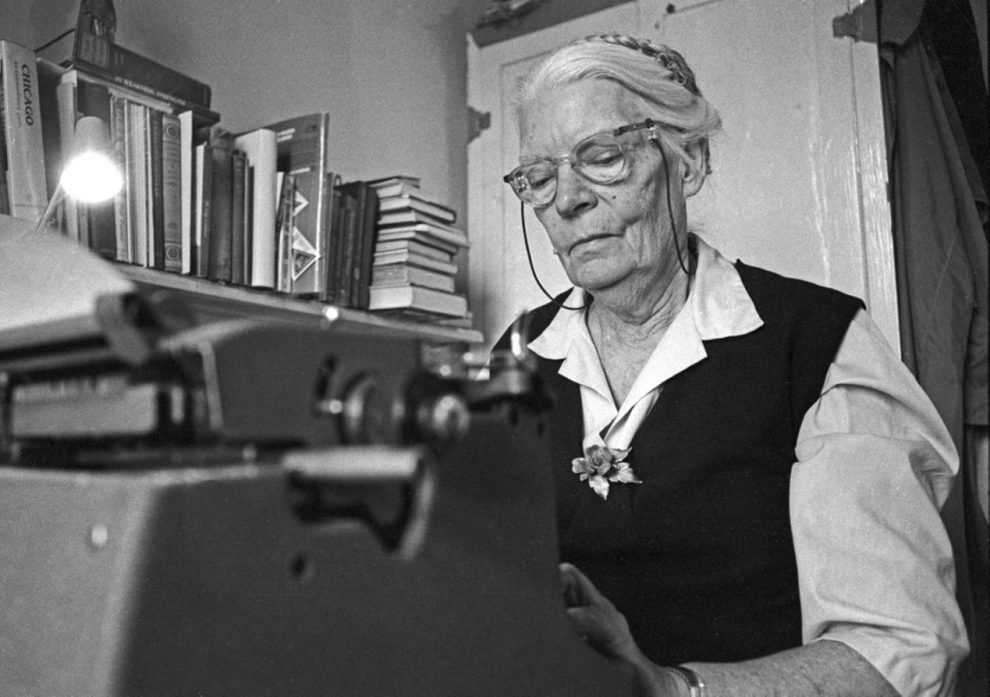
Image: Bob Fitch photography archive, © Stanford University Libraries