

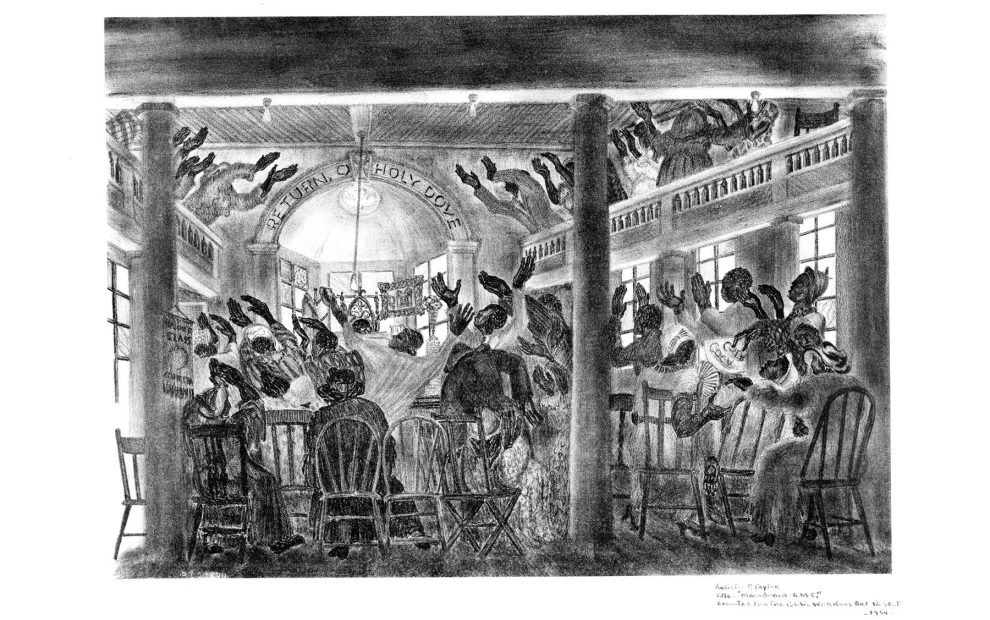
“O sing to the Lord a new song; sing to the Lord, all the earth.” • Psalm 96:1
Melisma
Melisma is a vocal technique that involves sliding through various notes while holding on to one syllable. Think of Whitney Houston singing “I Will Always Love You.”
For many Catholics, the scene is familiar: a priest proclaiming the gospel, families shuffling into their seats, and the congregation raptly attentive to God’s mercy as they confess their sins during the Confiteor, the penitential prayer at the beginning of Mass.
At Lyke House, however, a predominantly Black Catholic parish in Atlanta, the richness of the Black musical tradition grants the service a distinct flavor. The Kyrie Eleison is accompanied by shouts, cheers, and enthusiastic clapping. Its delivery might also sound different to some Catholics; the singers utilize melisma, a vocal technique that involves sliding through various notes while holding on to one syllable. It serves to strengthen the listener’s emotional response while demonstrating the virtuosity of the singer. And, when compared to the simpler chants with which many Catholics are more familiar, it can appear more elaborate or less formal.
Lyke House’s praise is at all times reverent, but it is never somber or morose. Instead, the vitality and dynamism of Black music is emphasized to proclaim the glory and majesty of God.
The musical delivery on display in this parish, which utilizes at least two independent lines of melody through musical instruments, male and female singers, melisma, and improvisation, is called polyphony, a style of music where multiple instruments each have their own melody and play in harmony with one another. But the musical layering at Lyke House—multiple melodic lines, call-and-response, improvisation, and independent instrumental lines—is rooted in West African and Afro-diasporic musical traditions, distinct from but analogous to the Western choral polyphony of the Renaissance.
The Lyke House liturgy illuminates a key truth about Catholic liturgy; the church’s global identity has always relied on diverse cultural expressions of worship. The history of Black polyphony, with its layers of melody, improvisation, and emotional expression, is a good example of the gifts that Black Catholics bring to the church as a whole.
From West Africa to the Americas
Black Americans are the inheritors of an incredible musical tradition rooted in the oratorical and polyphonic musical traditions of West Africa. Many West African societies preserved tribal history, religious traditions, dances, marriage and funeral rites, and other important social matters in their music, which was archived and remembered by griots, people who dedicated their lives to memorizing their cultural traditions.

Lyke House
Lyke House has a vibrant YouTube page, and many of their Masses can be seen there. The following video is of the specific place in the Mass mentioned in the story.
These same strategies and traditions enabled Black Americans to play outsized roles in the development of American musical traditions, including gospel, blues, bluegrass, country, rock ’n’ roll, jazz, doowop, disco, pop, soul, hip-hop, and R&B. It’s hard to find any form of music today that has not been influenced by the creativity of African-American musicians, with the exception of some traditional forms of music such as Mongolian throat singing or classical Western compositions.
Music was important to enslaved Black people not only because of its ties to their suppressed traditions, but also because it allowed them to share information and ideas when many were illiterate.
Indeed, through the development of their unique theologies, Black Christian congregations asserted that singing is an integral form of Christian worship. It is an elastic method of understanding faith, and, in fact, music can be more effective than written theology when investigating certain questions.
The Black musical tradition allows worshippers to experience their faith emotionally instead of through logical theological formulations. It gives descriptive power to feelings like jealousy, rage, ecstasy, and courage. Singing allows both listener and musician to continually access deeper and more robust spiritual insights while embracing wonder and mystery. Music and words act together.
In Black Christian music, musicians demonstrate the importance of using both text and sound to express theological perspectives. Purely abstract notions of God’s existence do not fully capture God’s majesty and beauty.
For example, take the Black spiritual “’Tis the Old Ship of Zion.” This hymn has only three simple verses: “’Tis the Old Ship of Zion,” “It has landed many a thousand,” and “King Jesus is the captain,” with a simple refrain of “Get on board, get on board.”
The song is simple, yet together the music and lyrics convey the theological importance of standing firm in one’s faith, recognize the communal nature of belief, and emphasize the role of Jesus in navigating life’s challenges and disappointments.
Its refrain is perhaps the most powerful part of the hymn, because it is a call to action in the face of hesitancy when believers struggle with their faith in God. The hymn invites its listeners to trust in the unshakeable power and love of Jesus.
A talented singer such as G. E. Patterson, a renowned gospel baritone, is able to communicate these themes in a manner which is almost onomatopoeic and richly entertaining. He emphasizes the rumbles in his voice, a tactic that invites comparison to an old, battered ship amidst stormy seas. This metaphor is aided by the pauses he uses in between verses, which are akin to a ship docking to allow more passengers to enter.
G. E. Patterson
Renowned gospel singer G. E. Patterson sings “ ’Tis the Old Ship of Zion,” a traditional Black spiritual.
Of course, the Black musical tradition is not the only one that expresses abstract ideas and concepts through musical expression. Classical composers also use sound to convey meaning. This tactic is found in classical Western compositions as well. For example, in Mozart’s opera Don Giovanni, the static nature of the eponymous figure’s arias embellishes his vacuous, manipulative, and violent nature. While Don Giovanni sings lyrics explicitly describing his desire for lusty sex, stealing, and cruelty, the melodies underlying these words are equally important to understanding the mendacity of his character.
A communal sound
In the Book of Exodus, the Israelites come together to offer ecstatic and fervent praise to God after Pharaoh’s army is destroyed beneath the crashing waves of the Red Sea. The writer describes a scene of joyous celebration, writing, “Then the prophet Miriam, Aaron’s sister, took a tambourine in her hand, and all the women went out after her with tambourines and with dancing” (Exod. 15:20).
Miriam’s expression of joy at her newfound freedom is a powerful and relatable emotion. With her effusive tambourine playing and whirling chants of praise, she shows the rich connection between music, the human heart, and the drive for justice.
Another important theological aspect of the Black musical tradition is that, like the story of Miriam, it happens in community. Andrew Barnes Jamieson, a Yale Divinity School and Institute of Sacred Music student studying piano performance and gospel music, says that he views Black sacred music as a “democratic, communal process that heavily emphasizes rhythm.”
While humans engage in many aspects of life together—worship, marriage, war, or political life—our emotions are our own, and we often remain isolated from others. Hymnody is special, because it can unite people around common emotions, images, and symbols.
Mozart
An aria from Don Giovanni illlustrates how Mozart uses music to show the title character’s true personality.
“The performance of polyphonic music serves as a healing act,” says Reginald Payne, a doctoral student concentrating on ethnomusicology at Yale University. “It can also promote spiritual enrichment by removing the burden of isolation so many people experience.”
Markus Rathey, a professor at the Yale School of Music, Institute of Sacred Music, and Divinity School, agrees that music’s emotional power allows it to bring people together. “Music reflects and creates community in a way unlike any other art form, which is aided by its unparalleled ability to provoke an emotional response,” he says.
Polyphony across cultures
W. E. B. Du Bois studied in Germany, where he experienced the incredible intelligence and creativity of German musicians and composers. At the same time, he saw in German music an affirmation of his own tradition, and he concluded that both Black Christian hymnody and German orchestral music crossed frequently perceived boundaries between structural adherence and spontaneous human expression to shape congregational worship. This, he argued, reflects both traditions’ corporate understanding of praise.
“Polyphonic singing is a collective form of meditative prayer,” says Izzy Barbato, an opera singer and a specialist in early modern music and the works of J. S. Bach. She also notes the power of music—in this case, specifically German polyphonic music—to form connections between people, viewing her vocation as a performer of sacred music as one that promotes communal healing and emotional catharsis.
“In polyphonic works like those of Bach, an independent bass line and soprano line that seemingly have nothing in common work together,” she says. “The unique sound helps to form a connection with other people.”
J. S. Bach
Bach provides an example of polyphony in Western classical music, where the two melody lines seem to have nothing in common and yet work together.
The technical aspects of polyphony can also deepen any theological themes that reside within musical lyrics. For example, German conductor Carlos Kleiber remains one of the most notable musicians of the 20th century for his distinctive exposition of emotionality within music. He used rhythm, timing, and tempo changes to immerse the audience in a technique called rubato, which plays with tempo to create expressive phrasing.
Similar to Kleiber, Black musicians such as Bishop Richard White, a prominent gospel singer, also prioritized the audience’s emotional experience through deep emotive expression that sometimes contravened technical perfection or strict adherence to the lyrics of a given hymn. He would often strain his voice while singing, leading to deeply expressive squawks and howls that immersed the audience in an ecstatic spiritual sensation.
White would also sometimes add short phrases to a hymn to encourage people to sing along (“I know y’all know this song”), to engage the audience (in a hymn where you appeared in four-part succession, he increased the number of times this word was said to include the audience), or to increase the fervor of the spiritual resonance (“Look at this right here!”).
The ties that bind
This communal power of music touches something even deeper. Music allows humans to touch one another intimately and deeply, eliciting tears, goosebumps, and the thumping of the heart. As a result, the sensation of music is similar to the experience of falling in love. For the Greeks, eros—the term used to describe the phenomenon of romantic love—represents the desire for something that one lacks.
Carlos Kleiber
German conductor Kleiber used rhythm, timing, and tempo changes to immerse the audience in a technique called rubato, which plays with tempo to create expressive phrasing.
The desire for unity expressed by music is likewise provocative for its physical and emotional embrace of touch, the power of which remains an eternal truth embraced by cultures around the globe. In scripture, the Good Samaritan reaches out to touch the battered body of the Judean. In the Great Plains of the United States, the Sioux tribe used to “count coup,” or touch their enemies with sticks to prove bravery without violence.
Even today, many of us can recall such a feeling of connection—a cheek pinch from a grandmother at a birthday party, an enthused high-five from a teammate during a game, or a handshake with a friend you did not yet know you would make. The outstretched hand was the beginning of the encounter.
Music is this outstretched palm by which bonds of friendship can result. With it, creative and dynamic energies for universal fellowship begin within the human heart. Unlike other forms of art such as literature and portraiture, our consumption of music is embodied and transports us into the sensations the musician details, whether patriotism, religious devotion, rage, anguish, or confusion.
This insight and participation with the heart of the stranger is powerful for its potential in aiding human fraternity, for as Pope Francis wrote in his final encyclical, Dilexit Nos (On Human and Divine Love):
The heart is also the locus of sincerity, where deceit and disguise have no place. It usually indicates our true intentions, what we really think, believe and desire, the “secrets” that we tell no one: in a word, the naked truth about ourselves. It is the part of us that is neither appearance or illusion, but is instead authentic, real, entirely “who we are.”
The Black musical tradition makes this truth vivid.
The Bible seems to be more concerned with the nature of the heart than with any other trait. For instance, Moses is described as “very humble, more so than anyone else on the face of the earth,” and King David carries the famous appellation as being after God’s own heart. God knew that Moses and King David, despite their many faults and failures, had the strength necessary to protect those who were most in need of help. As a result, Moses’ burning heart granted the Israelites fortitude as they wandered through the waste of the desert, and King David’s fiery leadership ensured the successful return of the Ark to the Temple of Jerusalem as well as the stability of the monarchy, despite a series of insurrections.
If Pope Francis is correct that the human heart is who we truly are, unvarnished and absent any artificial barriers, the beauty of music resides in its ability to express and share emotions that originate in the heart with our friends and neighbors.
Within music, text and tonality combine—metaphors are emphasized through wails, and rhymes become undulated by a heavy bass line. Expressions of emotional conviction are strengthened by the toolbox of the musician: melody, rhythm, and harmony, which partner with the brilliance of a well-written text, as well as metaphor, alliteration, anaphora, and simile.
The work ahead
Richard White
Black musicians such as Bishop Richard White, a prominent gospel singer, also prioritized the audience’s emotional experience through deep emotive expression that sometimes contravened technical perfection or strict adherence to the lyrics of a given hymn.
W. E. B. Du Bois opened each chapter of his book The Souls of Black Folk with notated music, what he called “Sorrow Songs.”
“And so by fateful chance the Negro folk-song—the rhythmic cry of the slave—stands to-day not simply as the sole American music, but as the most beautiful expression of human experience born this side the seas,” he wrote. “It still remains as the singular spiritual heritage of the nation and the greatest gift of the Negro people.”
Du Bois firmly believed that the Black artistic tradition held treasures for all humankind. He wrote in The Crisis magazine, “It is the bounden duty of Black America to begin this great work of the creation of Beauty, of the preservation of Beauty, of the realization of Beauty, and we must use in this work all the methods that men have used before.”
Du Bois felt that Black Americans’ unique perspective, inspired by both the West and Africa, gave them a distinct perspective on the world from which all people could benefit. Musicians such as Sam Cooke, Little Richard, and Chuck Berry agreed. They were able to further the civil rights movement through their performances, which were attended by huge integrated throngs of young adults.
These spontaneous encounters often led to different racial groups dancing and drinking together, even as Jim Crow and racial resentment brooded over these fleeting interactions. The gatherings were themselves remnants from the earlier era of Christian revivals, which had been integrated as far back as the 1850s. They also led to interracial exchanges of ideas and musical composition that influenced the communities from which icons like Elvis Presley and the country musician Hank Williams would one day emerge.
Black Americans have contributed disproportionately to the songs and winds of freedom that have blown throughout the world, and this is a legacy in which all Americans should take pride.
Sorrow Songs
W. E. B. Du Bois opened each chapter of his book The Souls of Black Folk with notated music, what he called “Sorrow Songs.” This YouTube playlist includes versions of many of them.
Even more important, however, is that through humanity’s participation in the gift of music and its encounter with the human heart, we embody the affirmation in 1 John 4:16: “So we have known and believe the love that God has for us. God is love, and those who abide in love abide in God, and God abides in them.”
We abide in God’s love through vulnerability and empathy for the other, and this is often achieved through music. In this time of increasing political divisiveness and deepening feelings of anguish, we are in desperate need of this neighborly love, which resides quietly yet resolutely in Miriam’s tambourine, ever ready to sing its cry of freedom.
Miriam and the Black Catholic musical tradition demonstrate that music can help social justice movements and serve as a source of wonder, inspiration, and hope that can promote social change and reformation towards the first and final end of humanity—beatitude. For in music, we choose to make ourselves neighbors.
This article also appears in the February 2026 issue of U.S. Catholic (Vol. 91, No. 2, pages 26-30). Click here to subscribe to the magazine.
Image: Prentiss Taylor, Macedonia A.M.E., 1934, Schomburg Center for Research in Black Culture, Art and Artifacts Division, The New York Public Library Digital Collections





Add comment