

For our Sounding Board column, U.S. Catholic asks authors to argue one side of a many-sided issue of importance to Catholics around the country. We also invite readers to submit their responses to these opinion essays—whether agreement or disagreement—in the survey that follows.
On September 10, 2025, a gunman opened fire at a Turning Point USA event on the campus of Utah Valley University, killing conservative activist Charlie Kirk. The shooter’s digital footprint revealed an all-too-familiar pattern, one echoingthe Christchurch mosque shooter in New Zealand (who livestreamed his attack and referenced meme culture), the Buffalo supermarket shooter (radicalized on 4chan), and countless others whose manifestos read like collections of internet in-jokes: years of immersion in gamer culture, meme communities, and ideological echo chambers that had gradually radicalized them.
The Turning Point USA shooter’s bullets, for example, were each carved with a barely sensical message drawn from various internet subcultures. These were not calling cards of some kind of well-formed ideology, but internet memes and forum in-jokes—shibboleths that signaled to those in the same online communities that this shooter was one of them.
This kind of nihilistic, tribalistic behavior should shock us into accepting that we’ve been all wrong about what the internet is. We long ago moved beyond the point where we could call the internet a “tool,” as most advice about from Catholic sources calls it. Such an approach makes simple human prudence the center of ethical discernment. Even Pope Francis once emphasized that the “internet is a gift of God” while cautioning against its misuse. The Dicastery for the Doctrine of the Faith, in its AI guidelines, Antiqua et Nova, takes this same approach, focusing its moral advice on human misuse of technologies.

On the contrary, however, the internet is not a thing but a place, an entire world driven by forces that are not defined by any given person, but by a cascade of emergent cultural, technological, and economic effects. Catholic social teaching has always insisted that systems, cultures, and structures can embody sin or grace, forming their members toward certain attitudes. We don’t say “capitalism is just a tool”; we analyze it as a moral reality that shapes people.
The online world deserves the same serious engagement. It’s a society with its own economy, public squares, subcultures, and systematic injustices. You cannot use it responsibly any more than you can use the pre-internet United States responsibly—you can only navigate it, resist it, or be formed by it.
My own journey into the newly emerged, early 2000s online world started off in the usual places—watching grainy digital videos on FunnyJunk.com, reading how to beat a certain gym leader in Pokemon at GameFAQs, and posting to my friends’ MySpace pages—but then, even before social media had really become the force it is now, sites such as Reddit, 4chan, and numerous other forums began to take up most of the internet. These weren’t simple communication tools like telephones or catalogues or postal services: They were their own spaces full of people that seemed to exist outside of the real world, with their own cultures, language, and rules. To be welcome you had to learn them; you had to integrate yourself into the culture and become someone different. Usually, that meant becoming someone a little bit worse.
If you’re lucky enough not to remember pre-2010s 4chan, suffice it to say it was already bad: free-floating use of every slur imaginable (and constant invention of new ones); hostile pranks that would brick unsuspecting peoples’ computers at a bare minimum, if not occasionally cause actual bodily harm; graphic photos and videos that are best left undescribed—and this was before algorithms took hold and content could be computationally fit to any given user’s worst temptations. This was a culture that emerged not through any outside interference, but from the brute facts of anonymity, boredom, and loneliness.

With the advent of algorithms curating social media feeds and the discovery that there was an untapped market in these niches, that pipeline that I experienced through pure happenstance is now an engineered one. Every social media site is now structured to shuttle people out of the relatively banal Times Square of the online city into niches that are increasingly tailored to each person and alienated from that person’s own embodied life, monetizing every step of the way. Luck—my bad luck of briefly falling into this world, or others’ good luck at never noticing it—is no longer a factor. The internet is designed to send some people there.
Just as this online world has begun to perfect these toxic pipelines through machine learning, it has also become nearly impossible to avoid. School materials are increasingly only available online. Workspaces require a web connection to do something as simple as punch a timecard. Statistics show that most young Americans’ romantic relationships start over dating apps. The COVID pandemic hit in 2020, and we all sheltered online to weather it—then we never left.
Online isn’t just a world—for many, it is now the world, one through which most of our lives are mediated. In 1981, Jean Baudrillard described the “precession of simulacra,” where representations replace reality until we can no longer distinguish between them. I imagine even he would be surprised at how prescient that idea was of the internet era.
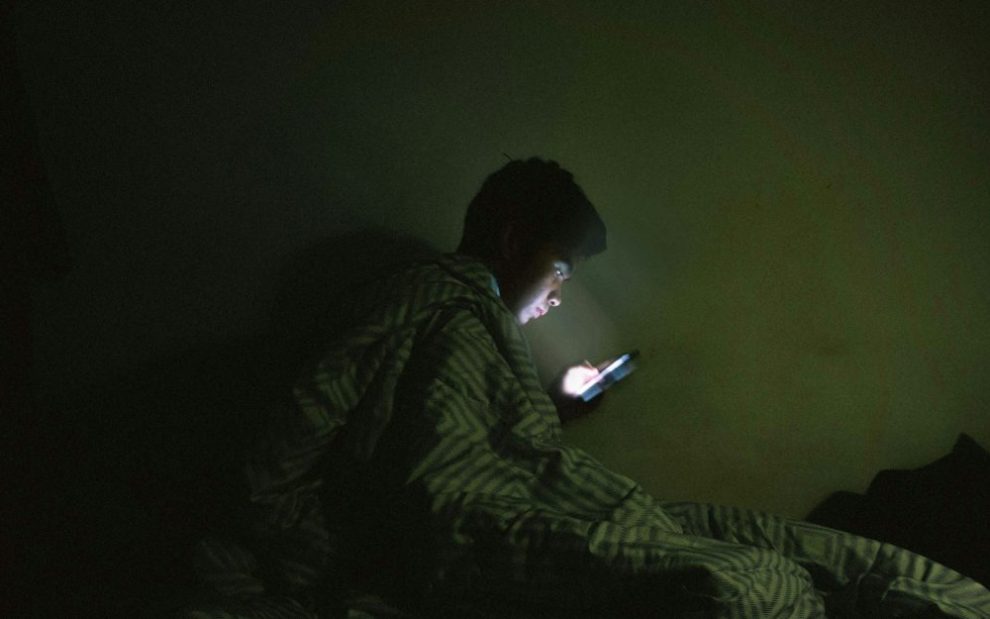
In this light, the constant wielding of this internet-as-tool framework is not just misguided, it’s actively harmful. It assumes users possess meaningful autonomy in their digital engagement, but algorithmic feeds don’t work this way. Users open an app with one intention and find themselves, 40 minutes later, having essentially lost time, strung along through memes and discourses and videos that they were never looking for. The platform has exercised agency over them, not vice versa.
Perhaps most damningly, this approach fails to recognize the formative power of being online: Unlike a hammer or a telephone, this world actually shapes a person just like the real one does, delimiting the acceptable from the forbidden, the possible from the impossible.
How can we avoid continuing to fall into these traps? If we can shift paradigms and start genuinely understanding the internet as a place, a society, Catholic tradition already offers us some helpful strategies.
Some have been tempted to follow the simplest option: for the church to name that certain digital environments may constitute near occasions of sin from which some of the faithful should simply abstain, much like alcoholic might avoid bars or gambling addicts casinos. Pope Francis all but promoted this idea for the Jubilee Year in 2025, offering an indulgence for those who “fast from the internet and social media.”
But this approach falls into the same trap: It’s an individualistic solution to a collective problem, advice that might work for those with the privilege of opting out—those whose work doesn’t require constant connectivity, whose communities exist primarily offline, who have the willpower and resources to resist. For everyone else, it’s just another way of saying “do better,” dressed up in the language of avoiding sin.
A more serious, complete response must be communal rather than merely individual. The church today doesn’t need better tips for navigating toxic digital spaces. Instead, it requires the courage to build alternatives: promoting platforms and designs that refuse algorithmic amplification, infinite scroll, and other addictive design patterns.
These platforms already exist—the newsletter platform Substack, for example, does not feature infinite scroll or a centralized feed and enables direct subscription fees instead of monetizing content through ads while still enabling direct, social user interactions. Dedicated private chatrooms such as Discord or even Slack also foster communal conversation without emphasizing addictive, machine-driven engagement. By prioritizing these kinds of platforms—over and against the Xs and Facebooks of the world—the church can emphasize a model of online community that values human, intentional formation of its culture.
Ultimately, as it was in my early internet days, promoting positive online culture and avoiding the internet’s toxic subcultures will come down to some amount of personal responsibility. But with the structural incentives currently in place, can we really put the blame on any individual’s shoulders for allowing this toxicity to fester? Instead, let’s first try what Peter Maurin once suggested: making online a “society where it is easier for people to be good.”
Image: Unsplash/Dipqi Ghozali









Add comment