

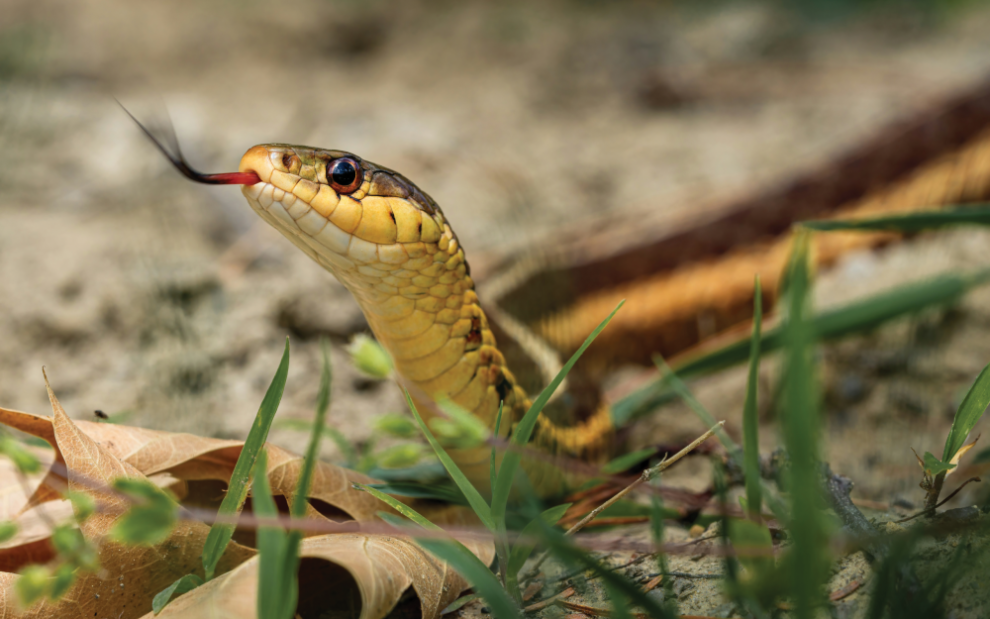
I like snakes, which is a good thing, since I’ve encountered a lot of them, often in unexpected places. Most memorable was the black rat snake that got into our bathroom and coiled majestically around the toilet. There was also the rat snake that chased a mouse through the kitchen and the garter snake that took up residence in my mother’s car. And long ago, when I was a kid, I pulled a scallion in the garden and found an adorable little rough green snake hiding in its hollow stem. I’m not sure whether the snake or I was more alarmed.
I have stories, too, about venomous snakes, such as the pair of copperheads that made themselves at home in our greenhouse, the rattlesnake that got trapped in the breezeway, or all the cottonmouths we were always running into in our favorite swimming hole.
Except, they probably weren’t all cottonmouths. After decades of telling tales of perilous snaky adventures, I joined a Facebook group for wildlife identification and learned that many of those supposed cottonmouths were likely nonvenomous brown or banded water snakes. Additionally, contrary to folklore, cottonmouths are rarely aggressive.
Realizing you’ve spent years not only believing but imparting false information can be humbling—even if it’s just about reptile identification. And when changing one’s mind involves relinquishing ego, holding onto fantasy feels easier. If I have trouble letting go of my dramatic tales about deadly water snakes, how much harder is it to let go of false beliefs that are woven into foundational myths about whole cultures?

What myths are we holding onto that make us feel better about ourselves? In the United States, we have myths about our nation’s founding that obscure the hideous truths about white supremacy and cast European colonizers as noble and heroic. Patriarchal structures perpetuate myths about male domination as romantic. We may hold onto false stories about science, history, and even our own lives rather than go through the arduous process of aligning ourselves with the truth.
The season of Advent is usually, in our contemporary culture, a time for embracing comfort. Yet the scripture readings for Advent are anything but comfortable. John the Baptist speaks of Jesus coming to gather the wheat but burn the chaff in unquenchable fire. “All flesh is grass,” says the Book of Isaiah, “their constancy is like the flower of the field. The grass withers; the flower fades, when the breath of the Lord blows upon it.” Such images of disruption and judgment suggest apocalypse.
But apocalypse, contrary to our common assumptions, doesn’t necessarily mean the end of the world. Etymologically, the word simply means unveiling or revelation. Nevertheless, if we’ve built our entire identities on edifices of falsehood, a season of unveiling can feel as destructive as the world’s end.
The Advent readings are also filled with promises of renewal. “The wilderness and the dry land shall be glad; the desert shall rejoice and blossom” (Isa. 35:1). This promise of renewal is connected with a promise of reversal: the proud laid low, the humble exalted. This, too, can feel like the end of the world, if we’ve benefited from those structures of injustice. But you can’t have the peaceable kingdom without such leveling. For the lion to lie down by the lamb, an entire ecosystem of predation and domination has to be abolished.

This might mean something as simple as letting go of inaccurate information about the natural world. My stories about dramatic encounters with cottonmouths might seem harmless, but they perpetuate ideas that can put snakes’ lives at risk. And if you think snakes’ lives don’t hold value what prejudices went into forming that assumption?
“They will not hurt or destroy on all my holy mountain,” Isaiah says (11:9). May we rend the veils of fiction that prevent us from building the peaceable kingdom.
This article also appears in the December 2025 issue of U.S. Catholic (Vol. 90, No. 12, page 38). Click here to subscribe to the magazine.
Image: Unsplash.com/Skyler Ewing





Add comment