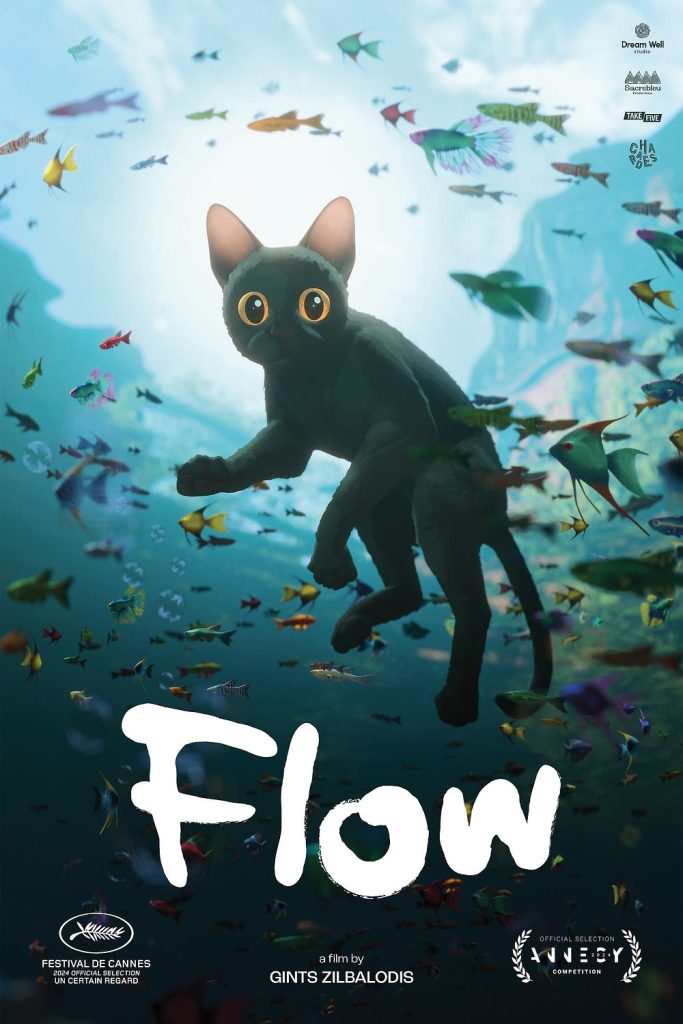
Flow
Directed by Gints Zilbalodis (Dream Well Studio, 2024)
There were parts of Flow that made me cuddle my 3-month-old black kitten a little tighter. The main character, a tiny black cat, moves and acts exactly like a real cat, whether it’s pouncing on a lightbeam or flattening itself in fright when meeting a strange dog. The animation, by creator Gints Zilbalodis, is both dreamy and hyperrealistic, making it hard to watch the tiny cat find itself in peril after peril, including several near drownings and being swept away in a hungry bird’s talons.
The film, which has no dialogue (unless you count “meow” or the grunts of a capybara), takes place after a flood forces the little cat out of the empty house in which it lives. It finds itself on a boat with a motley crew of other animals, including the aforementioned capybara, a lemur, a rambunctious Labrador retriever, and a secretarybird. The plot echoes both ancient flooding mythologies such as Noah’s ark and more recent climate disasters such as the flooding in North Carolina.
The title of the movie is apt: The animals are forced to go with the flow, swept downstream by the unexpected flood to locations unknown. As they continue to encounter other animal survivors—some friendly, some not—they must choose how to act together in this new world. As viewers, we are swept along with them, with no sense of what will happen next. Will the cat and its friends survive? Where are they going? Will the waters recede? What will their new life look like?
At the end of the film, I was left with more questions than answers about the world in which the animals found themselves (to say what these questions are would involve giving away the climax of the film). Perhaps that is the point: We might never understand exactly why the world as we know it is ending or how to stop it. What we can control is whether we face the end alone or in a community, even one made of the most unlikely of companions.
Flow is now available to stream on Max.
This article also appears in the March 2025 issue of U.S. Catholic (Vol. 90, No. 3, pages 10-15). Click here to subscribe to the magazine.
Image: Sideshow/Janus Films