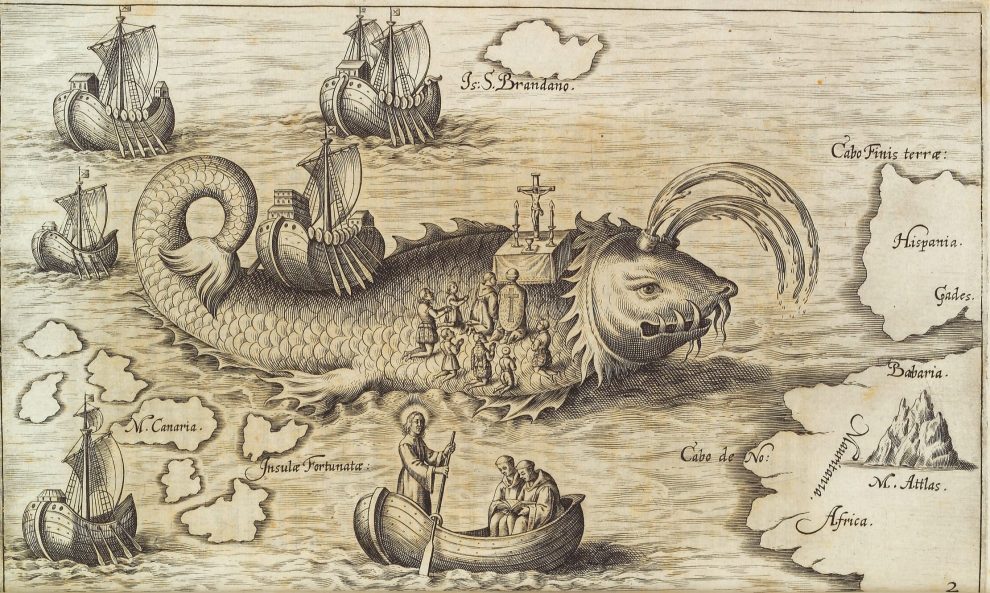
“We have nothing to fear, for God is our helper. . . . Spread the sail and let God do as he wishes with his servants and their boat.” With these words, St. Brendan the Navigator, a sixth-century Irish abbot, encouraged his companions to set sail in search of the Promised Land of the Saints, said to lie beyond the uncharted Western Ocean.
The patron saint of sailors and travelers, Brendan’s feast day is May 16—and perhaps coincidentally, my acquaintance with him began during a May 2011 visit with my wife to Dingle, Ireland. When we asked our host about the canvas-covered boats we’d noticed, he told us that Dingle residents call these boats naomh—the Irish word for saint—because the ancient saints traveled in such vessels (though theirs were covered with animal hides). Brendan himself, said our host, sailed from nearby Brandon Creek.
The next day, my wife and I sat on a green hillside looking down at Brandon Creek flowing out into the Atlantic Ocean. We knew that if anyone sailed straight across the Atlantic from there, they would arrive in what is now North America. But in the sixth century, Brendan and his companions sailed into uncharted waters, trusting that beyond the uncertainty lay wonders yet unseen.
The story of that remarkable journey survives in a famous medieval text, The Voyage of Brendan. The tale begins when a friend tells Brendan about the Land of Promise—and Brendan feels an irresistible call to go there. Seventeen of his fellow monks join him, and during the next seven years at sea, the saint and his companions behold wonder after wonder. They eventually do reach the Land of Promise, but then, a mysterious figure commands them to return to Ireland.
Brendan’s voyage is an allegory, emphasizing God’s care for everyone who risks a journey of faith. The seven-year voyage is framed in sacred time: The brothers observe the liturgy of the hours, and they celebrate Mass, following the liturgical calendar. The tale of Brendan’s voyage reminds us that all our days are also set within the sacred calendar’s nurturing rhythm.
God’s presence with the ocean-going pilgrims is revealed in another way: Animals repeatedly rescue them from peril. Desperate for provisions, the crew lands on an island where a dog leads them to refreshments. On another island, great flocks of birds praise God by warbling the psalms. When a sea monster attacks the boat, another monster fights to save the monks. The immense whale Jasconius offers his back as an island resting place. Jasconius even floats on his back while singing psalms, emphasizing the spiritual kinship between humans and other creatures.
The Voyage of Brendan was a bestseller in the Middle Ages, and its influence endured through the centuries. In Into the Wardrobe (Jossey-Bass), David Downing notes that Brendan helped inspire The Voyage of the Dawn Treader by C. S. Lewis.
While the medieval story is clearly allegorical, might it also recount a historical voyage? In fact, Brendan’s sea journey can be correlated with stages of a geographical Atlantic crossing: The island with many sheep could be the Faroes; the island with monks, Iceland; and the mountain that spewed flames, volcanically active Iceland. The mountain of crystal could be an iceberg, and the fruitful land of plenty could be Newfoundland (the Vikings named it Vinland because of its wild grapes and berries).
In the past, most academics argued that such a voyage was impossible. Then, in 1976, Tim Severin and several companions sailed a 30-foot, leather-hulled currach like Brendan’s all the way from Ireland to Newfoundland, following places mentioned in Brendan’s voyage. The trip was demanding and sometimes dangerous, but Severin’s expedition proved the Irish saint could in fact have been the first European to reach the Americas.
Whether Brendan reached the Western Hemisphere or not, his voyage reminds us that following Christ is an adventure requiring both courage and faith. When I was a pastor, I had a sign in my church office: Faith involves risk. Recently, I read a news story that made me realize anew the very real risk we take if we follow Brendan’s example into the unknown. I was also awestruck by the way God truly does work together all things for good (Rom. 8:28).
The article told how Evelio Menjivar-Ayala and his family escaped a massacre in El Salvador. Brendan was pulled into the unknown by an urgent sense of divine calling; Menjivar-Ayala leapt into the unknown, pushed forward by the very real urgency of life-and-death danger. Instead of Brendan’s currach, Menjivar-Ayala’s journey was in the trunk of a car. When he finally found a way to cross the border into the United States, he didn’t face whales or monsters along the way—but his faith in God empowered him to endure the heat, the claustrophobia, the constant danger. And God was with him, just as God was with Brendan and his companions. Menjivar-Ayala applied for asylum, learned English, worked odd jobs while nurturing a deep faith, and was eventually ordained to the priesthood. Pope Leo XIV appointed him this year to be Bishop of Wheeling-Charleston, West Virginia, where he advocates for the poor, workers, and immigrants. His willingness to risk the unknown, just as Brendan did, led him to God’s purpose for his life.
You are not likely to launch a small boat into an uncharted ocean, and you may never have to flee your homeland—but we all face moments when faith involves risk. It could be a career change, a health crisis, the loss of a loved one, or a stand against injustice. Faith does not promise comfort or security.
When challenges come along, I often feel myself pulled in contrary directions: Should I choose familiarity or risk change? Look away or speak a hard truth? Pursue a calling with financial benefits or one with less tangible rewards? At such moments, I ask Brendan to pray for me. Then I try to do what he urged his fellow adventurers to do: spread the sail, trust God to be my helmsman, and venture into the unknown.
Faith’s great model is Abraham, another journeyer called by God to leave his familiar life and find his way to a strange land. The Book of Hebrews reminds us that faith concerns “things not seen” (11:1), and many saints through the centuries have answered God’s call to leave their lives of comfort, trusting the Spirit to lead them to an unknown destination.
Like Brendan and his companions, we too are often called to follow the Spirit, even when it means letting go of what is familiar. When we do so, we can trust Brendan’s promise to his crew: “We have nothing to fear, for God is our helper . . . our navigator and helmsman. God shall guide us.”
This article also appears in the November 2026 issue of U.S. Catholic (Vol. 91, No. 11, pages 42-43). Click here to subscribe to the magazine.
Image: St. Brendan holding Mass on the back of a whale, 1621, engraving, Rare Book Division, The New York Public Library