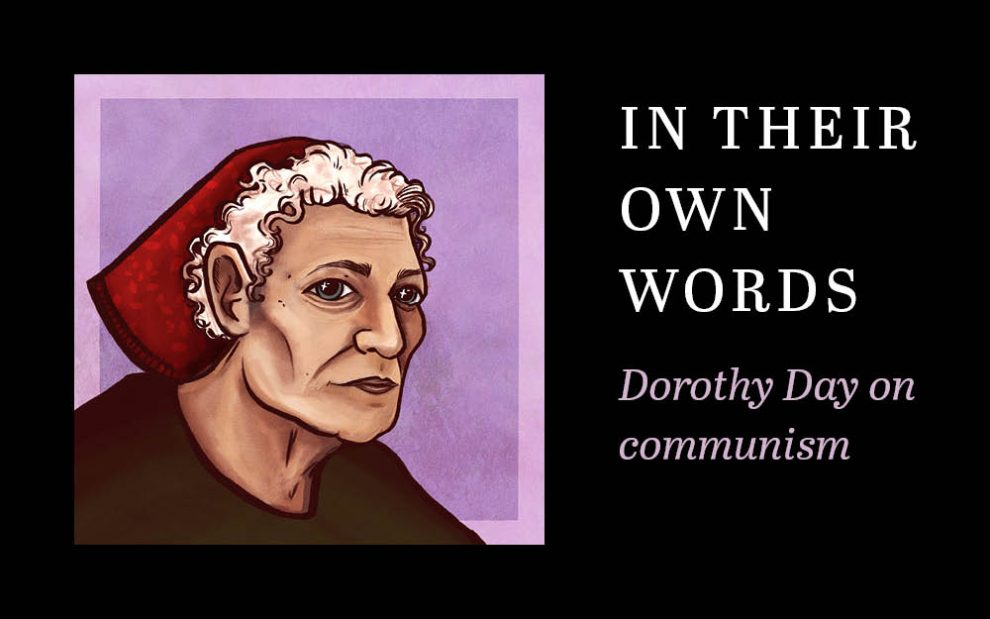
As a young woman, Catholic Worker cofounder Dorothy Day wrote for various communist publications and belonged to numerous socialist and anarchist associations. While never a card-carrying member of the Communist Party, she sometimes identified herself as a communist. After her conversion to the Catholic Church at 30 years old in 1927, Day renounced communism, but what she actually meant by this is the subject of vigorous debate a century later as the cause for her sainthood is being considered in Rome.
Eight years before her conversion, Day was one of more than 6,000 labor activists, immigrants, and others rounded up and jailed in the federal government’s first Red Scare crackdown in 1919. “These were the days of the Palmer red raids when no one was safe,” Day later wrote. “Those were times of persecution for all radicals.”
Two decades later, Day was still under government scrutiny. Declassified FBI files reveal Director J. Edgar Hoover’s concerns: “Dorothy Day is a very erratic and irresponsible person. She has engaged in activities which strongly suggest that she is consciously or unconsciously being used by communist groups.” He also reported the suspicion that “Dorothy Day is a Russian who came to the United States and visited Chicago, Illinois, in the spring of 1939, where she attempted to interest people in Communist activities” and recommended her for “custodial detention” in the event of a national emergency.
After the Archbishop of New York John O’Connor launched the process toward Day’s canonization in 1997, he explained that “Dorothy Day often seemed friendly to political groups hostile to the Church, for example, communists, socialists, and anarchists.” But to understand Day, he insisted, “it is necessary to divide her political stances in two spheres: pre- and post-conversion.” More recently, theologian and Catholic Worker Larry Chapp likewise defended Day from such sordid associations; “once she became Catholic, she completely disavowed her relationships that she had with Marxists and she opposed socialism.”
While Day’s conversion was very real, her own writings reveal something more of growth and a continuity with her past than the total before-and-after fracture as often recorded in the lives of the saints. “I have said, sometimes flippantly,” Day wrote in her 1938 memoir, From Union Square to Rome (Preservation of the Faith Press), that the “mass of bourgeois smug Christians who denied Christ in His poor made me turn to the Communists, and it was the Communists and working with them that made me turn to God.”
Day’s conversion was not an easy one for her. “I had become convinced that I would become a Catholic, and yet I felt I was betraying the class to which I belonged, the workers, the poor of the world, the class which Christ most loved and spent His life with,” she wrote.
It was five years later, after praying at the National Shrine of the Immaculate Conception in Washington, D.C., “with tears and with anguish, that some way would open up for me to use what talents I possessed for my fellow workers, for the poor” that Day met Peter Maurin, with whom she would found the Catholic Worker.
The movement began with a newspaper, The Catholic Worker, whose first issue was distributed at a rally in New York’s Union Square on International Workers’ Day, May 1, 1933. In an editorial addressed to unemployed workers, Day explained the paper’s purpose: “to call their attention to the fact that the Catholic Church has a social program—to let them know that there are men of God who are working not only for their spiritual, but for their material welfare… Is it not possible to be radical and not atheist? Is it not possible to protest, to expose, to complain, to point out abuses and demand reforms without desiring the overthrow of religion?”
Not everyone accepted Day’s trustworthiness, and conflicting ulterior motives were proposed. Many have suspected the Catholic Worker to be a Communist plot to infiltrate the Catholic Church. The popular “radio priest” of the day, Father Charles Coughlin, warned his audience: “Despite all references to the saints, the Popes, and the encyclicals, its (The Catholic Worker’s) attitude… was enough to make one wonder if the thing were not downright Communism camouflaged in Catholic paint.”
Some radicals thought that the Catholic Worker Movement was infiltrating from the other side, poisoning the Left with Catholic propaganda. Mike Gold, one of Day’s friends from before her conversion, in an editorial in the Communist Party’s Daily Worker at the time called the Catholic Worker “a Trojan horse for the Vatican in the progressive movement, a stalking horse, window dressing.”
In subsequent waves of the Red Scare, Day showed solidarity with her comrades. In 1949, “much to the horror of many of our Catholic fellow workers,” Day wrote a letter of protest on behalf of 11 Communists who had been convicted of conspiracy and been refused bail. “First of all,” Day wrote in her column that November, “let it be remembered that I speak as an ex-Communist and one who has not testified before Congressional Committees, nor written works on the Communist conspiracy. I can say with warmth that I loved the people I worked with and learned much from them. They helped me to find God in His poor, in His abandoned ones, as I had not found Him in Christian churches.”
In a later Red Scare, in 1971, Day again showed her solidarity when Angela Davis, a Black Communist activist and academic, was on trial on trumped murder charges. “Angela Davis is a Communist,” Day wrote in her column in The Catholic Worker, “in this case and it is a name for vilification nowadays, though the early Christians, working for the common good became communists in a very literal sense.”
“Since Christ is our brother,” she explained, “Angela Davis is our sister, and we love and esteem her as such.”
Even late in her life, Day sometimes did not find in the church the love and solidarity that she had found with her Communist friends. Referring especially to certain Catholic bishops, Day remembered Jesus’ warning, “our worst enemies are those of our own household.”
“He who loves his brother and works for justice is working for Christ even though he deny Him; that is, deny Him as he sees Him in the nominal Christian,” Day recognized. “Perhaps they accept Him on the Cross where He took our sins upon Himself. What a grace to recognize Him so!”
In Their Own Words is a web column from U.S. Catholic. In these essays, academics and other experts provide short, evidence-based explanations of prominent Catholic figures’ views on an array of topics of interest to the church and offer resources for finding further accurate information.