“I found it!”
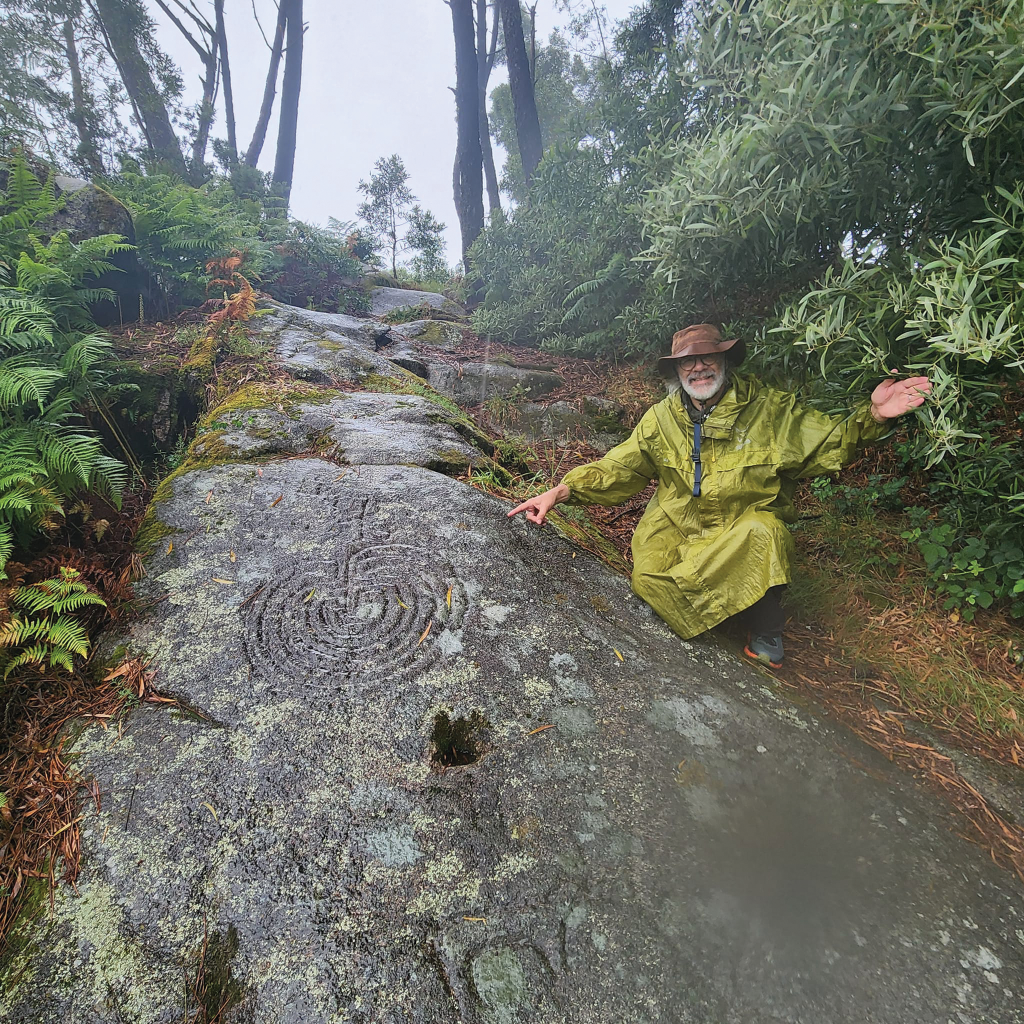
My heart jumped at those words. It was June 2024, and we were a band of rain-soaked, footsore Camino pilgrims near Armenteira, Spain, searching for one of the world’s oldest labyrinth drawings. A fallen sign reading petroglifos pointed us up a bracken-covered slope. We climbed until at last we spotted a stone surface where a labyrinth pattern had been chiseled in the late Stone Age, more than 4,000 years ago. We were looking at what experts call a “Classic 7 Circuit” labyrinth, a form that may be the progenitor of a pattern mysteriously repeating over a span of thousands of years in ancient Europe, Africa, India, Indonesia, and North America, across scattered cultures with no known connections.
Labyrinths have guided and inspired me for decades, and this encounter with their ancient prototype felt like touching their source. Yet my own experience is only a speck compared to the growing number of people around the world who are walking this same sacred path seeking healing, connection, and illumination.
What has drawn so many people, across centuries and cultures, into this winding path? The simplest answer is that the divine Spirit meets the human soul in the labyrinth. God is touching a growing number of lives through the sacred circling path.
A divine imprint
The labyrinth has found a place in Christian faith, but its roots also spread more broadly: It resembles patterns found elsewhere in the natural world. It spirals like a spinning galaxy, meanders like life-giving rivers, and mirrors the tiny circling paths on human fingerprints. The same Spirit that circle-formed the natural world greets us inside each labyrinth. In her book Walking a Sacred Path (Riverhead Books), labyrinth authority Lauren Artress describes these ancient designs as “divine imprints, universal patterns birthed through the human psyche.”
Athena Dugan—artist and labyrinth builder—expresses a common feeling that the labyrinth is part of her. “For years, I found myself instinctively drawing spirals and winding paths without knowing what they were,” she says. “A friend looked at my sketchbook and said, ‘You realize you’re drawing labyrinths?’ When I finally walked a labyrinth for the first time, it felt like stepping into a pattern I had already been carrying inside of me.”
Dugan is a councilmember of Veriditas, an organization that trains and supports labyrinth facilitators around the world. Veriditas believes that engaging with labyrinths is a way to promote a more peaceful and connected world, a “pathway to personal and community enrichment, healing, and growth.”
Despite their instinctive familiarity, labyrinths are often misunderstood. People frequently assume that a labyrinth is the same as a maze. While these walking paths may look similar, their purposes are quite different. A maze is a puzzle, with dead ends meant to confuse the walker. A labyrinth, by contrast, is a path for walking meditation, with a single route that leads to the center. It reminds us, as J. R. R. Tolkien’s Gandalf says: “Not all who wander are lost.”
Many paths to lead us home
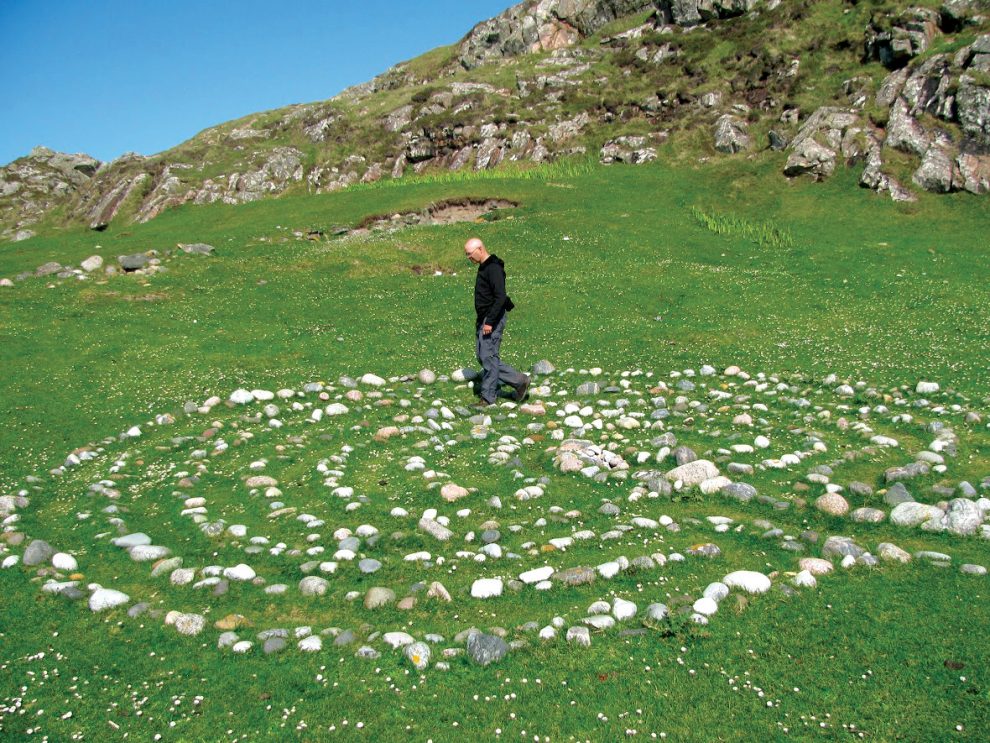
Labyrinths appear in many settings and forms. You might find one in a church, synagogue, school, hospital, park, forest, or lawn. Permanent labyrinths may be constructed from bricks, tiles, cement, turf, hedges, or recycled glass. Organic labyrinths tend to evolve as walkers add to the design or leave tokens.
Temporary labyrinths—created for short-term use—also wear many guises. Indoor versions painted on canvas can be rolled up and stored, while simple tape lines can provide an inexpensive, easily made path. Labyrinths can even double as charity projects, with lines formed from donated food cans. Beach artists create sand designs. In 2025, I created a nighttime labyrinth at the Wild Goose Festival in Harmony, North Carolina. On a warm summer night, participants walked between lines of twinkling tealight candles beneath a starlit sky.
Some labyrinths let your fingers do the walking. Handheld versions are accessible to many people and can be used anytime at home or work. These finger labyrinths appear in many forms—simple printed designs, wooden carvings, and ceramics. I have a coffee mug created by potter Stephanie Krist with a labyrinth pattern; it provides me with a daily ritual as I trace the path while getting my caffeine fix. This same intimate, tactile engagement with the labyrinth drew Charlotte Wyncopp of Plano, Illinois, into her work as a labyrinth practitioner and finger-labyrinth artist. “The finger labyrinth was the ancient form of a fidget,” she says.
The labyrinth movement
The labyrinth plays a significant role in the minotaur myth of Crete, mosaics in imperial Rome contained its shape, and medieval cathedrals created inlaid versions on their floors. Today, the labyrinth has journeyed far from those ancient origins, but it continues to inspire humanity around the world. In fact, in the late 20th century, it inspired a movement all its own.
The burgeoning labyrinth movement sprang from the meeting of one specific labyrinth in Chartres and one person, Lauren Artress. In 1987, Artress was canon pastor of San Francisco’s Grace Cathedral, where the tragedy of caring for AIDS victims impelled her to seek new ways to foster dialogue and healing. Author Jean Huston, a philosopher-psychologist who worked in cross-cultural and mythic spiritual studies, showed Artress a labyrinth made of tape on a floor and suggested it might be useful in her work. That experience inspired Artress to visit Chartres, France.
Chartres Cathedral is a majestic presence set high on a hill. “To walk through the huge doors into this dark and wondrous monument was one of the highlights of my life,” Artress says. As she stepped onto the circuit, walked by untold numbers of pilgrims over the past 800 years, she says, “I feel we touched the Holy Spirit.”
Returning to Grace Cathedral, she oversaw construction of the first permanent labyrinth installed in the Western Hemisphere in 600 years. Then, in 1996, she founded the nonprofit organization Veriditas. (The 12th-century mystic Hildegard of Bingen spoke of veriditas as “green power,” Spirit-inspired spiritual and physical health and growth.) Over the past three decades, Artress and Veriditas have made great strides toward the mission to “pepper the planet with labyrinths.”
The Spirit’s presence in the path
A labyrinth is a place to encounter the Spirit. Whether we are in a large hedge labyrinth that takes an hour to walk or running a finger over a miniature labyrinth held in the palm of the hand, God longs to meet us on this timeless winding path.
Labyrinth facilitators and walkers span many faiths—and none—but all affirm the form’s transformative effect. People like me who create labyrinths all seem to agree: Our efforts don’t create the blessing; we simply delineate a space that nourishes those who walk it.
Catholics and other Christians may recognize the presence at the center of the labyrinth as Christ. “I have had people tell me numerous times that they feel loved and closer to God after a labyrinth walk,” says Rev. Dr. John Edward Harris, a Veriditas-certified labyrinth facilitator.
This sense of a divine encounter within the labyrinth can lead us back to our heart’s home. Dugan, who is also a Veriditas-certified labyrinth facilitator, puts it like this: “The labyrinth doesn’t give you spirituality; it helps you notice the Spirit already within you. When someone walks, something begins to awaken. Their attention drifts inward, their breath deepens, and they start to hear the part of the soul that’s been calling for connection.”
The labyrinth simultaneously engages body, mind, and soul; the circling path speaks the soul’s wordless language. “It doesn’t just engage a part of the human experience; it welcomes all of who and what we are,” says Rev. Dr. Tim TenClay, who sits on the boards of two major labyrinth organizations. Brother Stefan Andre Waligur, founder of the Community of Peace in Louisa, Virginia, agrees: “Having a labyrinth has opened my heart wider to include the wordless, the body, and movement as a way to pray and encounter the divine.”
Last year, as a pastor of the United Church of Christ, I decided to do something different at the beginning of Lent: On Ash Wednesday, I imposed ashes at the center of a candlelit labyrinth. As people walked slowly around the circuits, I noticed a woman who seemed especially engaged in the experience. Her eyes and feet moved in quiet sync along the flickering path; her hands lifted a rosary to her lips; and her whispered devotions drew glints of tears to her eyes. When she exited the circle, she asked if she could walk it again. She said she was experiencing a deep sense of peace as the sacred path gathered her whole being into prayer.
Rituals in a labyrinth can invite sacred presence into ordinary space. At the Northern Arizona Celtic Festival—known for large, boisterous crowds—the temporary labyrinth I created became a circle of quiet contemplation. One couple chose to be married within the labyrinth, walking slowly together to the center, where I sealed their vows. A year or two later, facing a serious medical issue, the same couple returned for prayer and anointing in the festival labyrinth. Then, after overcoming that challenge, they came back again on an anniversary to renew their vows.
The labyrinth and the divine feminine
Labyrinths have archetypal feminine connections: The rounded form of the labyrinth suggests a womb, and in the ancient Greek myth of Theseus, the thread of Ariadne becomes key to navigating the labyrinth’s path.
As medieval Christians discovered the power of the labyrinth, they sometimes equated Mary with Ariadne, because Mary holds the thread of faith that connects Christians to Jesus and keeps us from losing our way. The symbolism of the Chartres labyrinth (and the entire Cathedral as well) venerates Mother Mary. When Artress first walked the Chartres labyrinth, she says, “I received the embrace of Mary,” the one who models humanity’s “yes” to God. The circle path can represent Mary’s loving and healing arms. The enclosed sacred space may also bring to mind Mary’s womb, where the divine entered and redeemed the world. As we walk a labyrinth, we might choose to think of ourselves as safely nourished within a holy space. There, we can disconnect from external chaos, reflect, grow, and emerge with a new sense of renewal.
Betty Lopez Towey, an advanced-trained facilitator and Veriditas faculty member, participates in annual celebrations of the Blessed Mother on the Feast of the Assumption, held for 20 years at Silver Bay Retreat Center in Lake George, New York. She feels a special joy celebrating Mass on Mary’s feast day at the center’s full-size, Chartres-style labyrinth, with its ancient design that honors Mary.
The labyrinth as a guide
While offering connection with the sacred, labyrinths also mirror our life journey—our individual pilgrimages as we travel from birth through childhood and maturity and into elderhood. Entering a labyrinth restricts our view of the broader world, forcing us to surrender to the present moment. Because there are no dead ends, no puzzles to be solved, no risk of making a wrong turn, walkers are encouraged simply to trust the process. The winding path teaches patience.
Labyrinth walks often follow a three-part pattern—releasing the past, receiving illumination, and returning with a gift to share—and this rhythm of leaving, arriving, and returning echoes the stages of pilgrimage. Drawing on this three-part pattern, labyrinth facilitators sometimes invite people facing tough decisions to walk the labyrinth while imagining that its twists and turns symbolize their lives. As walkers move through the labyrinth, they recall significant past events; at the center, they seek God’s guidance; then, as they make the return circles to the exit, they imagine what lies ahead. This exercise can be helpful for making important life choices.
A powerful tool for healing
The labyrinth’s richest gift may be that of holistic healing. One of the most active labyrinth builders and teachers today, Lars Howlett, says that Artress reported she knew of no better tool for grief work than the labyrinth. Howlett can personally testify to emotional healing on the winding path. “I created my first temporary labyrinth out of driftwood for my wedding in 2005,” he says, “but my wife drifted away, and we separated three years later. Heartbroken, I moved to Half Moon Bay, California, and there I created a stone labyrinth by the beach as a ritual of healing and to find myself again. I walked through all types of weather and emotions, learning to trust my life path no matter the twists and turns to find myself again.”
Wyncopp knows that a healing labyrinth does not have to be full-sized; her finger labyrinths can also be therapeutic. She sells them at county fairs, meeting many people who have never thought about labyrinths, big or small. Recently, at the Sandwich County Fair in DeKalb, Illinois, a mother and her 10-year-old son chatted with Wyncopp. As the mother talked about the challenges of raising her boy—due to a neurological condition, he was unable to focus for even a short time—the boy picked up one of the finger labyrinths and carefully traced its path. Then he picked up a more complex labyrinth and traced its course. As the mother and Wyncopp continued talking for another 20 minutes, they noticed that the chronically distracted boy was transfixed by the hand labyrinths.
“Are you still playing with those?” the mother asked.
“Mom,” he replied, “this is the first time I’ve felt like my body and brain are working together and not fighting each other.”
On her Facebook page, Wyncopp reports that she too relies on the wisdom of the labyrinth in her own life’s crises. “The labyrinth is a tool that reminds us that we don’t have to live in our calendars or agendas,” she says. “Exist in the now. Just trust the path and take another step forward and you will make it to the end.” Healing comes in its own time.
Healings gifted through the labyrinth can be powerful signs of God’s compassion, as Lopez Towey knows from firsthand experience. In 2024 and 2025, Lopez Towey partnered with Frontline Association, an organization that works with first responders—firefighters, paramedics, and police officers—creating space at Silver Bay Retreat Center for them to process the traumatic events they have encountered. Using the retreat center’s labyrinth, Lopez Towey offers a healing space where troubled first responders can engage in ritual and encounter God’s grace.
Joe Gorman, one of the retreat participants—a retired New York City fireman and police officer—recalls how “things got dark” for him as he struggled with night terrors and flashbacks. “It took real courage for me to face my trauma,” he says, but encouraged by Lopez Towey’s comforting presence and careful preparation, he entered the labyrinth. The results astonished him: “I couldn’t explain what I was seeing and feeling, but I was loving it. . . . I came in one person and came out a different person. It swung open the door of my heart, and my growth since then is tremendous.”
It may seem odd, in a world filled with very concrete troubles, for people to spend time literally walking in circles—but the changes the labyrinth brings within one person can ripple outward to help others. At a recent online event, TenClay invited participants in a Zoom gathering to trace their finger labyrinths at home and imagine how to create beauty in a world fraught with violence and injustice. Beauty itself can be a form of healing, and participants in this online workshop engaged their imaginations while tracing their finger labyrinths, seeking ways to create beauty in their own spheres of influence.
TenClay’s personal life shows how inner work with the labyrinth can support change in the outer world. Over the past 26 years, he has served as a pastor in both the United States and Italy, working with people from all walks of life, including men who survived being sold in open-air slave markets and women who were trafficked through Africa into Europe. Throughout this stressful ministry, “the labyrinth has been my consistent friend that I could return to time after time for rest, recovery, and healing,” he says.
Like many seekers, I too have found the labyrinth to be a healing source of joy and wonder. Again and again, its winding path leads me toward my heart’s true home. It speaks powerfully to the needs of my own life, as well as those of the larger world.
In an age marked by loss, violence, and isolation, we need practices that help us move through grief with honesty and courage. We also need practices that strengthen us for the work of bringing the hope and peace of Christ into our communities. As a thin place between this world and the spiritual one, the labyrinth opens a path toward transformation, inviting us to deepen our faith, tend our own healing, and cultivate the wisdom and courage needed to help heal a wounded world.
This article also appears in the August 2026 issue of U.S. Catholic (Vol. 91, No. 8, pages 18-21). Click here to subscribe to the magazine.
All images courtesy of Kenneth McIntosh