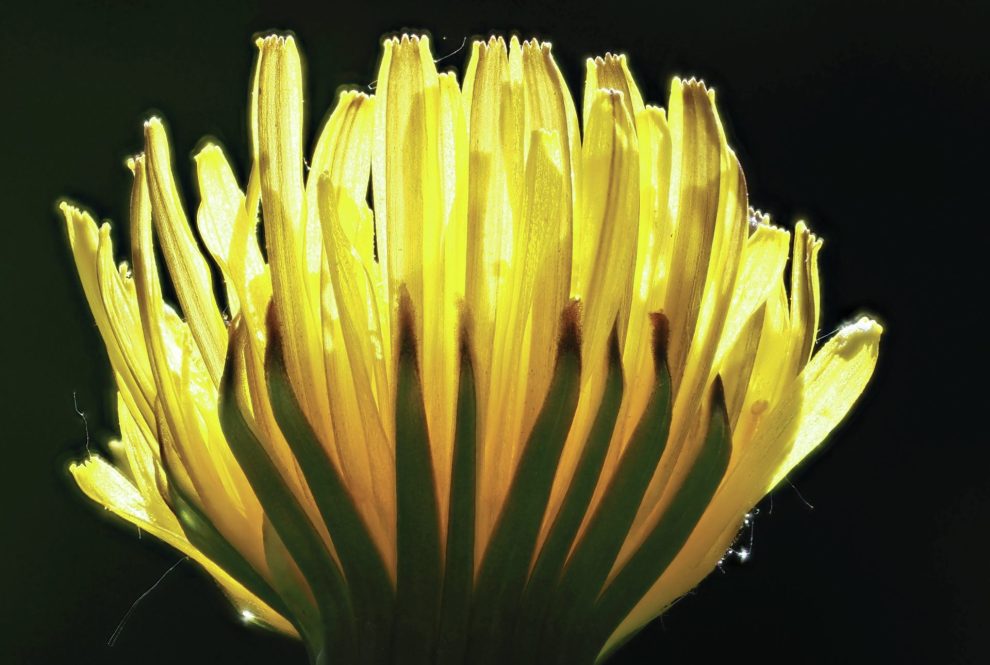
My father’s tremendous affection for human beings did not extend to humanity’s capitalist messaging, and television commercials especially provoked his scorn. In my last exchange with him, a few hours before he died, we made fun of a commercial advertising weed killer. The commercial’s assumed premise, that everyone must hate dandelions and want to kill them, was one we roundly rejected.
Such an implicit assumption is called an enthymeme, an argument that omits a premise, leaving the audience to supply it automatically. This works in advertising, because the audience is invited to partake in the storytelling—unless they reject the premise.
While working on marketing initiatives here at U.S. Catholic, I have come to realize that my own tastes are far from a gauge of universality. In the case of dandelions, I think everyone should reject weed killer. But other likes and dislikes are subjective. I don’t feel at home in a hyper-feminine aesthetic, but others do. I like spicy food, but I can’t expect everyone to want to bite into a cayenne pepper.
Honoring such differences is essential to empathy. We usually understand empathy as shared experiences and feelings. But the flip side of empathy is recognizing that others have had experiences very different from our own, and we can’t understand them simply by shoehorning in our assumed perspective.
This aspect of empathy is known as self-other distinction. It’s important because it keeps us from imposing our own thoughts and feelings inaccurately on others. For example, for a person who’s never experienced fear of heights to be empathetic toward someone who has, they have to acknowledge this difference.
We often use the metaphor of walking in someone’s shoes to talk about empathy. But there are some shoes we will never walk in. Our eagerness to assume understanding is likely driven, often, by a desire to help. But also, I think we’re sometimes uneasy with the vast mystery of a universe filled with beings we can never fully understand.
This diversity makes for a more interesting world, however. And when we look for God’s imprints, the signs that point to the possibility of a creator, each facet of difference reveals a different aspect of infinite being. It puts me in mind of Gerard Manley Hopkins’ poem “Pied Beauty”:
All things counter, original, spare, strange;
Whatever is fickle, freckled (who knows how?)
With swift, slow; sweet, sour; adazzle, dim;
He fathers-forth whose beauty is past change. . . .
Our “pied beauty” is so much more intriguing than a cookie-cutter, formulaic approach to the world. It makes sense that we would resent marketing rhetoric that presumes sameness, looping us all into a doomed pursuit of wealth, popularity, and perpetual youth. Just as weed killer forces biodiversity into a flat and deathly monoculture, this capitalist approach attempts to flatten humanity so all that’s left of us is purchasing power.
Throughout history, various movements have sought to suppress those people who don’t fit in narrow, approved boxes. Such movements always arise out of fear, and end in horror. How much richer life is when, instead of recoiling in the face of the unfamiliar, we cultivate curiosity, humility, and affection. How much better and braver we are when we build communities rooted in wonder and generosity, not in fear.
This article also appears in the June 2026 issue of U.S. Catholic (Vol. 91, No. 6, page 9). Click here to subscribe to the magazine.
Image: Unsplash