During World War II, Marcel Marceau helped smuggle scores of Jewish children from Nazi-occupied France to safety across the border in Switzerland. A member of a Jewish relief unit within the French Resistance, Marceau used his skills as a mime to calm and distract the children as they hid on the train. The story is dramatized in a new off-Broadway play by Marshall Paillet and Ethan Slater. Marcel on the Train follows Marceau and four preteens—played by adult actors—on an anxiety-filled train ride in search of safety. Evil and violence threaten to engulf them, but with imagination and humor, hope for the future is possible.
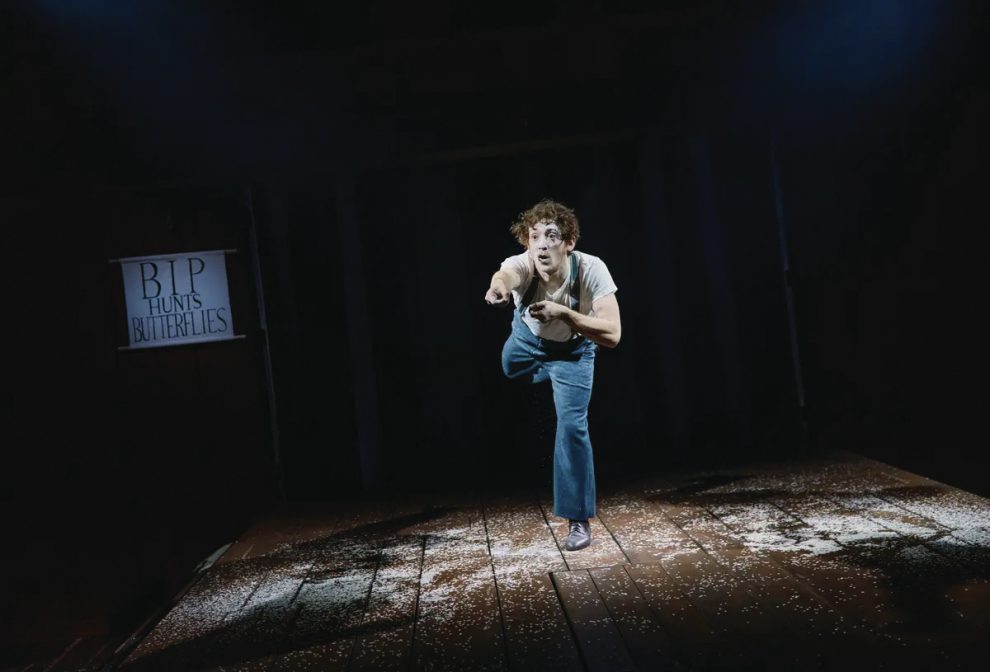
Before seeing the play this spring, I knew little of Marceau and had no particular interest in mimes. As a child, I loved the circus but always bristled at the clowns. And I had always perceived mimes as being like clowns. Their silent, physical humor just did not entertain me in the way the acrobats or animals did. But as Slater recreated Marceau’s use of light and shadows to chase butterflies in a train car, I was captivated. The mime’s immediate goal was to distract and quiet everyone as they hid from the Nazis, but with silence as his medium, he also sparked imagination and reawakened hope—both in the scared children on the train and in the audience in the theater.
In a speech to filmmakers during the Jubilee year, Pope Leo XIV said, “In the darkness and silence, vision becomes sharper, the heart opens up and the mind becomes receptive to things not yet imagined.” Film and theater have the power to awaken our imagination. “Art must not shy away from the mystery of frailty,” the pope said; “it must engage with it and know how to remain before it.” We need to embrace and foster our imagination; without it, we get trapped in the immediacy of now. Imagination helps us open our minds and hearts to what is possible and motivates us to work for what once seemed impossible.
Imagination and hope are particularly important as we prepare for Pentecost. The gift of the Holy Spirit comes with immense responsibility. The first Christians were tasked with venturing beyond their fear and finitude to announce the reign of God, and to preach the love of God in a world marked by injustice, cruelty, and division. Today, we are asked to open our hearts and minds to embark on the same journey. The gift and task of discipleship is to live into the liminal—already, but not yet—of the kingdom of God. This is only possible with imagination and hope.
The relevance of Marcel on the Train is apparent and sad. As a French Nazi officer knocked on the train car door demanding to see everyone’s papers, I was uncomfortably aware of how many of my neighbors live in constant fear of this today—irrespective of their immigration status. Acts of antisemitism and hate are also on the rise. Yet imagination helps us envision an alternative to what is before us and avoid despair. In the mime’s use of silence, light, and shadows, comes a reminder—with imagination comes hope.
Today, people in Minneapolis and other communities, safeguarding the dignity of their neighbors, show us that same spirit of imagination and hope. And in their creative resistance and solidarity, they embody the spirit of Pentecost.
This article also appears in the May 2026 issue of U.S. Catholic (Vol. 91, No. 5, page 40). Click here to subscribe to the magazine.
Image: Ethan Slater in Marcel on the Train. Photo courtesy of Emilio Madrid.