
Leonel Palacios had a dream.
He left El Salvador in 2011, when he was 18, after his brother was murdered by members of Mara Salvatrucha, or MS-13, one of the most vicious gangs in the world. Afraid that he would also be killed, he fled to Mexico with little more than the $26 an uncle had given him, where he lived and worked in different cities in Chiapas, Mexico’s southernmost state. He lived in Mexico for 12 years, obtained permanent residency, and had a son. He wanted to earn more to support him, but, he says, “There is not much money [in Mexico].” In 2023, he decided to enter the United States. His dream, he says, “was to live there for a few years, earn enough money to buy land and build a house in Chiapas.” Back then, there was a process by which he could enter the United States legally.
Beginning in January 2023, migrants in Mexico who were seeking asylum in the United States were able to use a phone app called CBP One (CBP: Customs and Border Protection) to request an appointment that would determine if they were eligible to enter the United States. (Advocates in Mexico refer to asylum-seekers as migrants, so I’m doing the same here. Technically, migrants may leave their home country for economic or other reasons. Asylum-seekers leave because of danger or threats.)
Applicants had to be living in northern or central Mexico and had to check the app daily. The wait for an appointment usually stretched to several months, but it worked well until Trump canceled the program in January 2025. The app was replaced by CBP Home, which encourages people to self-deport.
Palacios moved to Mexico City in late May 2023 and requested the appointment on July 27. Amazingly, he had an appointment eight days later, and by August was in California. “I was excited but nervous,” he says. “I was accustomed to living in Mexico.”
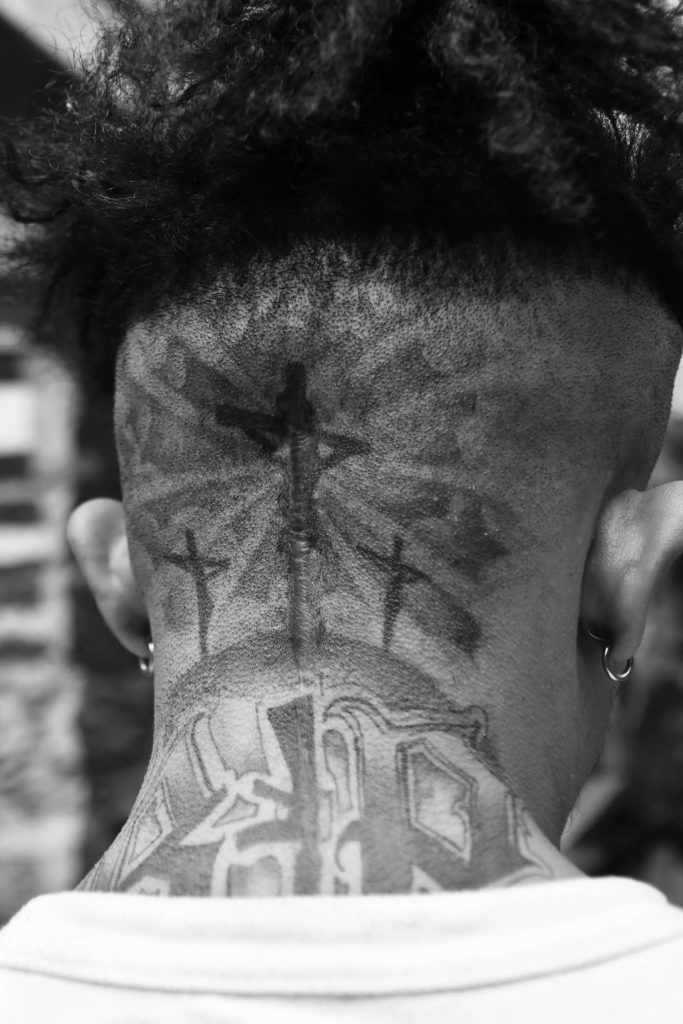
As required, he reported to immigration court, where he told them he had a credible fear of returning to El Salvador. (Credible fear means a person would be in danger if they returned to their home country.) In addition to the Mara Salvatrucha gang murdering his brother, they killed his father in 2019 and his sister was desaparecida in 2021. In other words, she left home one day and never returned. No ransom was ever asked, and she was never seen alive again. Palacios has three crosses tattooed on the back of his neck to honor his family members, and the dates of their murders and disappearance are on his arms.
The judge asked him for proof of the murders. “They wanted something in a newspaper or other news,” he says, “but I had no one who could send me proof. I went to court five times, and then I did not go, because I had no proof.” He was afraid he’d be deported immediately if he went. But he wouldn’t let go of his dream of building a house, so he stayed in the country. His luck held for two years.
He quickly found work, but it was almost impossible to save money. There were weeks when he earned as much as $700 or $800, but the work wasn’t steady. “Sometimes I worked 40 hours a week,” he says, “sometimes only 16, and sometimes there was no work. The little I saved I always spent because of the times I had no work. Sadly, I could not save much.” There were times he lived on the street so he could save money and send a little to his son. He bought a car so he could get to a second job.
One day in late October 2025, Palacios stopped to buy antifreeze for the car. After adding it to the radiator, he went to a bathroom to wash his hands. When he stepped outside, police were waiting for him. “They said I was a thief,” he says. “They took me to the station, took my fingerprints.” After eight hours, he was told he could leave. ICE was waiting for him outside. He was taken to a detention center where he called a friend and asked her to get his car. When she went, it was gone. “Because I went to wash my hands, [the police] grabbed me and I lost everything in my car,” he says.
He was deported on November 4. “I left with shoes, a T-shirt, pants, and four dollars,” he says. Although he’s a permanent resident of Mexico, he was deported to El Salvador. The papers he was given when he was deported listed him as a gang member—almost certainly because of his tattoos—and he was jailed for 20 days. When he was finally released, he quickly left the country.
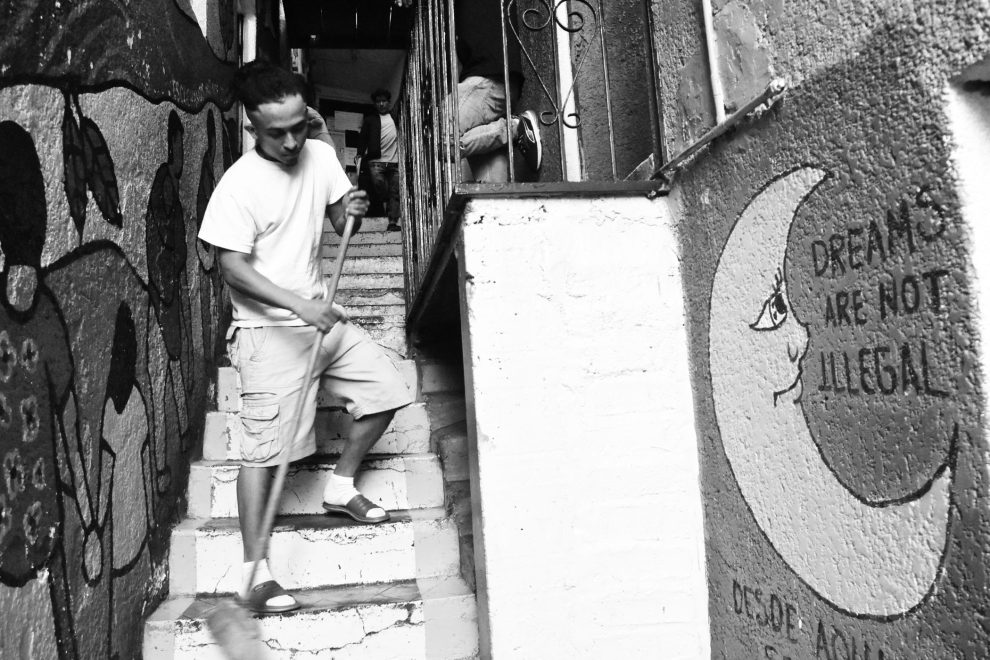
Palacios arrived at Casa Tochán, a shelter for migrant men in Mexico City, in mid-December 2025. He helps any way he can—sweeping floors, carrying in supplies. “I like to work,” he says. He also spends time writing rap songs. “It is about what has happened to me. The songs are sad.” He found work as a security guard, working 12 hours a day, 6 days a week, earning $5,500 pesos ($325 USD) every two weeks. He decided to try to return to the United States.
“I do not think it is possible,” he says, “but I have to try. I know it is not easy to cross.” I ask if he’d pay a coyote (a smuggler) to get him across. He laughs. “I do not have money. I do not have help. To go alone is very dangerous. They will kill you in the desert.”
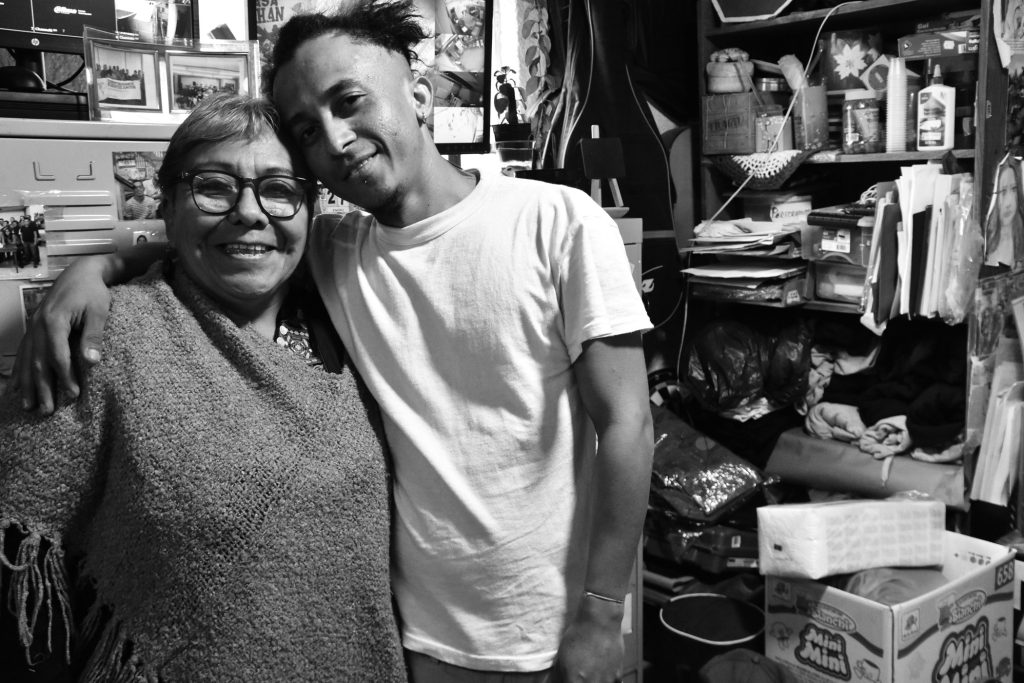
Gabriela Hernández is the founder and director of Tochán (Nahuatl for “Our House”). I was very concerned when Palacios told me he planned on crossing the border, so I asked her what she’d tell someone who wanted to try. She looked aghast. “I would tell them ‘No,’ ” she says, “because they will be kidnapped or killed.”
She says kidnappers call a family member demanding ransom. “If they do not respond immediately, they will kill you. Three young men arrived yesterday from the north, and they said the police there are not so bad. It is the narcos.” The narcos are the ones kidnapping migrants.
The last time I speak with Palacios, I question his decision to try to cross the border into the United States. He is adamant. Although unable to save enough to buy land when he was first there, he believes he can save enough this time. “If I have work in the United States, I can earn enough in one year to buy land and build a house,” he says. “If I stay in México, it will take me three years. I want to cross again. If I do not make it the first time, then another time and another time.”
I ask if he’s afraid. He thinks and then says, “Yes and no. But I have to try.”
This article also appears in the May 2026 issue of U.S. Catholic (Vol. 91, No. 5, pages 16-19). Click here to subscribe to the magazine.
All photos by Joseph Sorrentino