In a spring afternoon in 2005, after receiving my master’s degree in counseling from the Franciscan University of Steubenville, I had an important stop to make on the way home. That stop was not the campus chapel or some other conventionally holy place, but a tattoo parlor in Boardman, Ohio, where I planned to have an artist tattoo the Immaculate Heart of Mary on my left foot.
Yes, what you’ve heard is true: Foot tattoos are very painful. If you have one, you know. Yet that is where it felt most appropriate to emblazon this ancient symbol of Our Lady. The 3-inch purple heart with a sword piercing it would forever remind me that Our Lady had already gotten me through so much in my 26 years of life. Her intercession led me out of the dark valley of active addiction and trauma-based mental illness into a new life where I earned an advanced degree and where my experience could be a way of offering hope to others. I wanted the permanent, visual reminder that Our Lady would always walk with me. The idea of a feminine guide gives me comfort, too, given my history and the world in which I find myself.
I often say that my tattoos, like the Immaculate Heart of Mary on my foot, serve as visual symbols of my faith. The process of planning and getting a tattoo is a spiritual practice, and each of the 10 or so tattoos on my body has deep spiritual meaning. The inspiration for a tattoo typically starts as a whisper in my heart, especially if a symbol really speaks to me. I usually sit with that inspiration for a few weeks or even months, looking at design options, sometimes creating my own. When I can say, “I want this on my body as a permanent reminder of what the images or words represent,” I know that it’s time.
My tattoos are like Post-It notes that I create, in collaboration with a tattoo artist, to put on my physical body. They help me stay grounded in the rich healing resources available to me through my spiritual beliefs. Sometimes, in the harried frustrations and pace of modern life, I forget what I have learned or how far I have come in my healing because of my faith. Looking at an icon or an inspirational message can have a similar effect, but there is power in choosing to put these reminders on my body, with the intention that they will remain there permanently.
The Catholic Church does not forbid tattoos. Prohibitions on tattoos in the book of Leviticus are not viewed as applicable to Christians, any more than other prohibitions on diet or dress from ancient Jewish law are. Indeed, there is a long history of tattoos within Christianity, especially in the pilgrim tradition. The oldest known tattoo shop in the world, Razzouk Tattoo in Jerusalem, operated by a Coptic Christian family, has been tattooing pilgrims in the Holy Land for 700 consecutive years. Their most popular design to mark pilgrimage is the Jerusalem cross.
During a 2018 press conference, Pope Francis urged priests not to be afraid of tattoos, noting that they can be a basis for dialogue, especially in young people. If a Catholic gets a tattoo, it should be approached with intention, honor to the body, and respect for others. In other words, no hate speech or symbols, and nothing about the procedure must put one’s health in danger.
Like with many spiritual practices, intention is key. The word “intention” originates in the Latin word intendere, meaning “to aim at,” and it is worthwhile to ask ourselves what we are aiming at when getting a tattoo, if we are feeling called to do so as a spiritual practice. Mine is to be reminded of a spiritual teaching and its value in my life.
Two of my specifically Catholic tattoos are inspired by St. Hildegard of Bingen. I’d like to think this 11th-century mystic and doctor of the church would appreciate tattoos, since much of her ministry focused on healing and expressive arts. When a person came to her for healing, her assessment included a question to the effect of, “What is cutting off the greening power of God, the viriditas, in your life?”
After learning more about Hildegard on a retreat in Bingen, Germany in 2016, I was so moved by this question that I decided to get Viriditas tattooed on my upper back, in green letters underneath a flower surrounded by the sun. I can see it whenever I use a mirror to look at the back of my hair. It’s also a reminder that St. Hildegard has my back.
My second Hildegard tattoo, inspired by the phrase vis medicatrix naturae (“the healing power of the natural state”) that defined much of her teaching, appears in the same green script on my lower left arm, on the vein known as the heart line. I see that tattoo every day: when I practice physical yoga, wash dishes, or do chores around the house. It reminds me that healing is available at any time when I embrace the fullness of myself and don’t try to be anyone else.
Not all my tattoos are related to Catholicism, yet all reflect my spiritual practice that has become increasingly interfaith and ecumenical. My right wrist, where I used to wear a set of malas (prayer beads) to assist me in praying two of my favorite prayers from the traditions of India, now bears those prayers in Sanskrit script in the handwriting of my friend and yoga sister.
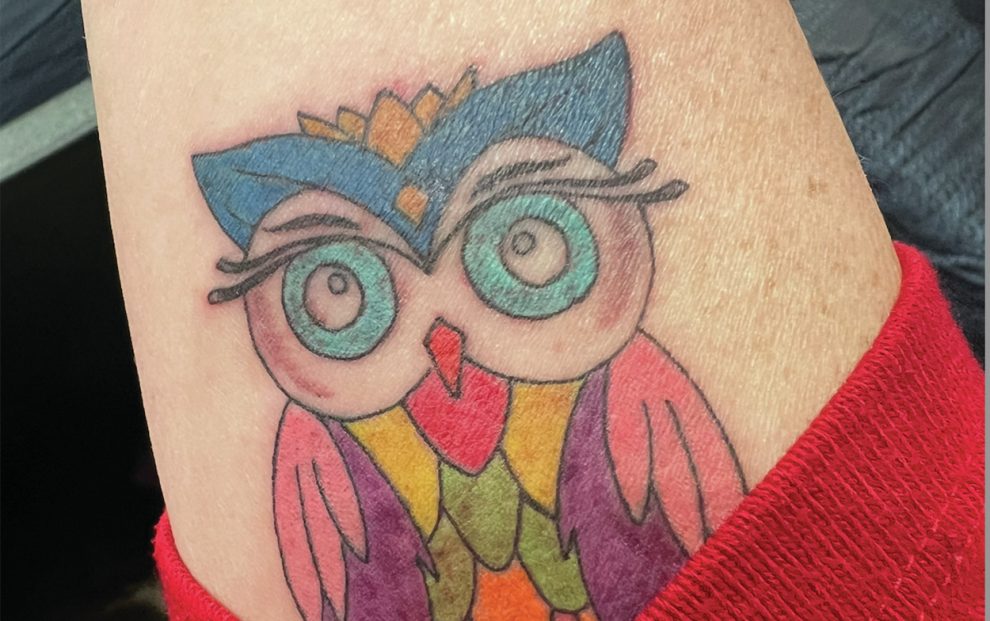
On the same side, further up on the lower arm, I have a small owl composed like a mosaic of rainbow tiles. Owls are special to me, as they have a way of showing up in my life whenever I need the reminder to trust my inner wisdom. My friend and long-time collaborator has a similar connection to owls. We’d both decided to get different tattoos celebrating our love of these creatures and the wisdom they represent and were able to get them together from the same artist.
If you already have tattoos, it might be interesting to ask yourself how you feel about them being on your body at this time in your life. If you have several, are any your favorite? If so, is there a special reason for this? Do you have any that you regret? If regret exists, explore it and see if you need to acknowledge any grief about where you were in your life when you got that tattoo. Can you transform the image by redesigning it to reflect the changes since then? As with any spiritual practice, being present with the process can deepen your connection to the divine.
Are you thinking of getting a tattoo?
Admittedly, tattoos are not everyone’s cup of tea. A statue or other pictorial reminder in your living space may serve you just fine. Yet if you are drawn to get a tattoo, I encourage you to be intentional about it. Ask yourself, what is my aim in seeking this art? Is it to be reminded of something sacred? To honor a loved one who has passed? To celebrate a milestone, or something you have overcome?
Ask around your area or read reviews and choose your artist wisely. Many are very spiritually dialed in and will appreciate what you are seeking. I encourage you to spend time in a creative process before going to the studio. That process might include praying or meditating on the tattoo and its message. You may share your inspiration for the tattoo with loved ones or a spiritual director. Your process could include making your own art inspired by the tattoo’s intention or writing about the tattoo’s message. Let the process be a spiritual practice.
This article also appears in the April 2026 issue of U.S. Catholic (Vol. 91, No. 4, pages 44-45). Click here to subscribe to the magazine.
Image: Courtesy of Jamie Marich