Pope Leo XIV has been speaking forcefully and persistently against the United States’ military actions in Iran, addressing not just war in the abstract, but the specific actions of the Donald Trump administration. And now a report from The Free Press has revealed that in January, Under Secretary of War for Policy Elbridge Colby summoned Cardinal Christophe Pierre, then the Vatican’s ambassador to the United States, to the Pentagon. Behind closed doors, Colby threatened the ambassador, reminding him of the power of the U.S. army, and telling him that the church “had better take its side.” As part of his threat, he invoked the Avignon papacy.
The tale of the Avignon popes of the fourteenth century is instructive for this moment—though not, perhaps, for the reasons Colby had in mind. If anything, referencing that epoch in the church’s history highlights Leo’s integrity and pastoral leadership.
When church power was temporal power
In the 1370s, St. Catherine of Siena dictated several letters to Pope Gregory XI, counseling him to be a true pastor to his people. She advised him to learn from Christ crucified, to appoint virtuous cardinals, and to pluck out the “bad priests and rulers.” The primary theme in her letters, however, is her insistence that Gregory return to Rome instead of lingering in the opulent courts of Avignon. “Do not wait for time,” she instructed him, “since time does not wait for you.” She implored him not to be “timorous,” and not to “believe the devil.”
Avignon is a French city which was then part of the Kingdom of Arles and under the jurisdiction of the Holy Roman Empire. In the era between 1309 and 1376, that was where the popes resided, following a series of squabbles between popes and temporal rulers.
At that time, the Papal States comprised a significant chunk of Italy. Popes wielded immense political power, commanded armies, amassed vast wealth, and interfered in matters of governance far outside the scope of ecclesial jurisdiction as understood today. So these conflicts were not just ideological but geopolitical and military. Popes and kings didn’t just exchange pointed remarks. They waged war on each other, often using the various powers at their disposal to leverage matters for their own benefit.
Pope Boniface contra King Philip
Prior to the Avignon papacy Pope Boniface VIII, who reigned from 1294 to 1303, famously expanded papal powers well into the political sphere. As well as codifying canon law and initiating the first Jubilee Year (possibly because he looked forward to revenue from pilgrimages), he promulgated the papal bull Unam Sanctum, which states, among other things, that temporal rulers owe obedience to the pope due to the superiority of the spiritual over the worldly order.
This expansion of papal powers was one reason why Dante Alighieri, a fervent proponent of separation of church and state, assigned Boniface to hell. The pope had not yet died when Dante wrote the Divine Comedy, but the poet made it clear where he thought Boniface was headed.
Boniface’s escalating clashes with King Philip IV of France (sometimes called “Philip the Fair”—because of his appearance, not his character) culminated in Philip sending an army to attack the papal palace. Boniface responded by excommunicating Philip, after which the king’s ministers arrested and physically assaulted the elderly pope. They let him go free after a few days, but within a month he died, likely as a result of that trauma.
The “Babylonian captivity”
The conclave gathered to elect a new pope, but Philip put pressure on them to elect Archbishop of Bordeaux as Boniface’s successor. He took the name of Clement V, and refused to move to Rome–which at that time was known as a rather shabby, inelegant place, especially compared with the glamorous French courts.
In 1309 Clement moved the entire papal court to Avignon, and for the next 67 years, the Vatican governed the church from there, not from Rome. Catholics sometimes refer to this period in church history as the “Babylonian captivity,” referencing the Israelites’ time as slaves to the Babylonian empire. Some might argue that it was a captivity the church brought on itself, given institutional rulers’ neglect of the gospel teachings of Jesus.
The Avignon papacy was a time of immense corruption, opulence, and scandal. The French courts pressured church leaders to organize and operate in the manner of temporal courts, and prelates grew rich collecting tithes and benefices. So, unsurprisingly, an array of reform movements sprang up during that time. Most of these, including the Waldensians, the Hussites, and the Fraticelli, were condemned by the church.
The Avignon popes also attempted to crack down on the “spiritual Franciscans,” who sought to keep their order true to the simplicity and poverty of its founder, and who were prophetic critics of ecclesial opulence. John XXII even excommunicated the Franciscan philosopher William of Ockham who, along with the order’s minister general Michael of Cesena, fled Avignon by night, to take refuge with the Holy Roman Emperor in Bavaria.
So, no wonder Catherine thought the pope needed to go back in Rome. It wasn’t just that the papacy belonged there, as the traditional bishopric of Peter. The papal court in Avignon had become a site of intrigue and opulence where accumulation of wealth and power took precedence over the mission of the church to preach the gospel, maintain the sacraments, and follow the example of Jesus and the apostles.
Popes and antipopes
Gregory was the last of the seven Avignon popes, but even though he eventually returned to Rome, St. Catherine’s later communication with him suggests that she still considered him timid and worldly.
And even after Gregory returned, intrigue continued. Gregory died and was replaced by Urban VI, the last pope in history not chosen from the college of cardinals. An abrasive man, Urban did not get along well with the cardinals or with the French. Eventually a faction of French cardinals elected a priest and military commander as a rival pope, Clement VII, who set up his own papal court back in Avignon. This rift between legitimate popes and antipopes, known as the Western Schism, carried on until 1417.
Catherine of Siena was one of many reformers throughout the church’s history who strove to keep the church true to its mission. Perhaps she succeeded, where other reformers of the time provoked papal ire, because of the tone of her letters, in which she frequently praises the pope and abases herself.
But, as the subsequent history of popes and antipopes demonstrates, returning to Rome was not enough to solve the problem of a weak, worldly religious leader more interested in earthly comfort than in standing with the oppressed, opposing injustice, and tending to his sheep. Today, the papal states and papal armies are no more. Pope Leo governs a small sovereign state in Vatican City, commands no armed forces, and—like his predecessor— allies with the vulnerable, not with powerful worldly oppressors. Catholics today would be horrified and outraged if any of our popes behaved the way Boniface or Urban did. Yet the question of where ecclesial power ends and temporal power begins remained tumultuous, to this day.
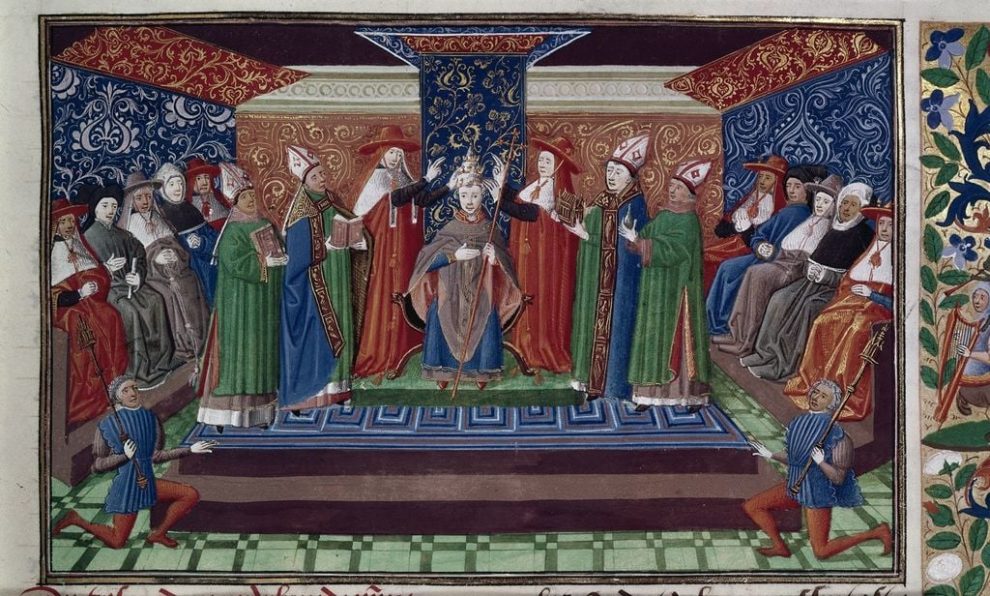
Image: The Coronation of St. Boniface (from the BL Harley Manuscript)