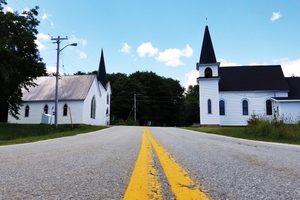
On October 5, 2025, the Diocese of Charlotte opened the Chapel of the Little Flower in Mooresville, North Carolina—a small structure with a large significance for the church in the United States. The chapel, which seats 350 people and cost the Diocese of Charlotte $700,000, is a new venue for the traditional Latin Mass. The diocese proclaimed it as an oasis of harmony and unity, with Charlotte Bishop Michael T. Martin offering the new chapel as part of a path to navigate ongoing divisions.
The chapel’s opening marked part of the ongoing diocesan implementation of Traditionis Custodes (On the Use of the Roman Liturgy Prior to the Reform of 1970), Pope Francis’ 2021 instruction that placed limits on the traditional Latin Mass in dioceses. Martin wants Latin Mass adherents to view the chapel as a shrine, a place to visit occasionally while still participating in parish celebrations of the post-Vatican II Mass, sometimes called the novus ordo—the Mass implemented by Pope Paul VI. This is the form of Mass celebrated in most parishes around the world. Unlike the traditional Latin Mass, it uses the vernacular language in its liturgy. There are also several liturgical differences; among them, the priest faces the congregation.
In Traditionis Custodes, Pope Francis put strict limits on the Latin rite. He stated that its adherents should not disparage the post-Vatican II liturgy and that bishops should not allow new traditional Latin groups to be established. “The liturgical books promulgated by Saint Paul VI and Saint John Paul II, in conformity with the decrees of Vatican Council II, are the unique expression of the lex orandi of the Roman Rite,” wrote Francis.
In more off-the-cuff moments with reporters, Francis made clear his views: The obsession with the traditional Latin Mass and rejection of the newer liturgy is, he said, a “nostalgic disease.”
Still, the rite continues in some American dioceses, and the situation in Charlotte is symptomatic of a broader dispute across the church in the United States.
Liturgical discontent
Martin’s attempt at compromise is not popular in some quarters of Charlotte. The diocese boasts some 546,000 Catholics spread across the metro area and the western portion of the state. As the Catholic population grew this century, devotees of the traditional Latin Mass gained a foothold. They found a supporter in former Bishop Peter Jugis. He established a seminary sympathetic to the traditional Latin liturgy and encouraged young priests from outside the diocese, many versed in the traditional Latin Mass, to staff expanding parishes.
Toward the end of his tenure, and in response to Pope Francis’ apostolic letter, Jugis put controls on the growth of this liturgy, limiting the celebration of the old rite to four parishes in the diocese. But Martin, who was installed in May 2024, soon let it be known those limitations didn’t go far enough. In May 2025, he announced that he would restrict the celebration of the traditional Latin Mass to a single centrally located chapel, renovated for these purposes, and appoint a diocesan priest as chaplain.
Just a few days after this announcement, a leaked early draft of a diocesan document revising liturgical rules was published on Rorate Caeli, an anonymous blog that promotes a so-called return to post-Vatican II Catholicism. The document critiqued an array of practices that violate liturgical rubrics, including some that are popular in parishes that celebrate the traditional Latin Mass, such as the priest facing the altar instead of the congregation, the recitation after Mass of the prayer to St. Michael the Archangel, and even the use of Latin itself.
“I find it disturbing that so many pastors and celebrants are inclined to force an unknown language on their congregation when the Lord’s mission is to engage the lost,” Martin wrote in the document draft.
The document, though it was not yet in its final form, provoked consternation among pro-traditional Latin Mass Catholics, not just in Charlotte, but across the nation, with Rorate Caeli calling the bishop’s approach “anti-liturgical,” despite Martin’s emphasis on rubrics, and the conservative publication First Things calling him “out of touch.”
“I don’t think it’s a serious proposal,” says Chase Jackson, a parishioner at Our Lady of Grace in Greensboro, a parish that celebrated the traditional Latin Mass. After Martin’s letter was made public, Latin Mass supporters now believe “that he would prefer that it go away completely,” says Jackson. The Mooresville site is 75 miles away, making it difficult for Jackson and his young family to attend regularly.
A bigger conflict
The implications of this dispute go beyond Charlotte, which remains a center of a debate roiling sectors of the church in the United States. The implications also go well beyond a mere dispute over liturgical preferences. As Massimo Faggioli argued in an essay for Commonweal, “Catholic traditionalism has more than the reversal of liturgical reform on its agenda. The fight against Vatican II has morphed into a fight against synodality and related topics.”
In Charlotte, the prevalence of the traditional Latin Mass in the diocese has long been a cause of division among clergy and laypeople, says Father John Hoover, a long-time Charlotte priest. The conflict has permeated parishes. Some parishioners who grew up with the post-Vatican II liturgy and like it say they have been left out by the prevalence of the traditional Latin Mass in the Diocese of Charlotte.
Hoover, 80, a priest for nearly five decades, served as celebrant for a group of parishioners from St. Elizabeth of the Hill Country church in Boone, located in the western reaches of the diocese. The traditional Latin Mass was implemented there more than five years ago.
A group of some 50 parishioners, many formed in the post-Vatican II church and liturgy, objected and began gathering elsewhere for a Vatican II-style Mass. The group disbanded early this year as Hoover, who lives near Charlotte and is facing health issues, was unable to make the three-hour roundtrip to Boone.
Karen James, a leader of the breakaway Boone community, says that the new bishop has been unable to persuade her to return to St. Elizabeth of the Hill Country church.
“Everything we were dealing with is still here,” she says about her group’s unsuccessful effort to make the parish support Vatican II liturgy. “We felt with the new bishop that things would change, and they haven’t,” she says. Some accommodation was made: The traditional Latin Mass is now offered solely at the parish’s mission church, and some members of the breakaway group have returned to the parish.
However, Father Brendan Buckler, the pastor at St. Elizabeth’s, has also changed other aspects of parish life. The parish church was built in a post-Vatican II style, with an open window to highlight a view of the North Carolina mountains. That view has been covered over. An ecumenical outreach by the parish, including a cooperative Easter service with other Christian denominations in town and a shared regular meal, was ended. Piano music was forbidden during Mass.
Fractured community
James converted to Catholicism when preparing for marriage to her Catholic husband nearly 60 years ago, a time when the post-Vatican II church vision was being implemented.
“It’s hard for me. I converted to the Vatican II Mass. I don’t find I am in a loving place where people care about me,” she says.
“There’s lots of pain and suffering,” says another parishioner, who requested anonymity, citing the level of division in the parish. This parishioner notes that older churchgoers, who came to love the post-Vatican II church, have been left out and that, at least in Boone, the traditional Latin Mass has failed to attract younger parishioners to take their place. Some supportive of the post-Vatican II liturgy say that the prevalence of the Latin Mass in rural and small-town parishes causes them a hardship in attending the Mass they prefer.
The divisions have created ruptures among Charlotte diocesan clergy.
“For 20 years we had no priestly fraternity,” says Hoover, noting the stark divisions in the diocese between many younger priests, supportive of the traditional Latin Mass, and older clergy formed in the wake of Vatican II.
Benedictine Father Anthony Ruff, a liturgist and associate professor of theology at St. John’s University in Collegeville, Minnesota, notes that the conflict in Charlotte is reflective of wider tensions. Vatican II intended to phase out the traditional Latin Mass and replace it with a reformed rite under the leadership of Pope Paul VI, he says. But Pope John Paul II and Pope Benedict XVI allowed for exceptions.
While Pope Francis discouraged the Latin Mass, it continues in many American dioceses. In some regions, such as Charlotte, traditional Latin Mass attendance is relatively high, with its adherents pointing to its popularity among young families.
But other figures suggest otherwise. The Diocese of Brooklyn, New York, in October announced the end of the traditional Latin Mass in one parish, citing low attendance and a lack of clergy to perform the rite. The Latin Mass gained a foothold in the Archdiocese of Detroit, as its adherents—mostly from the suburbs—adopted sparsely attended churches in the city. The traditional Latin Mass was offered in 17 Detroit area parishes; that has now been cut to four. The Diocese of Knoxville, Tennessee has mandated an end to traditional Latin liturgies by Advent.
What’s next in the liturgy wars?
Pew Research estimated that fewer than two percent of American Catholics attend the traditional Latin Mass. While their numbers are relatively small, adherents remain vocal on social media, sometimes mixing their spirituality message with support for various culture war issues.
“To return completely to Vatican II now would be rather difficult, since a whole liturgical subculture has become established since the mid-1980s,” Ruff says.
Bishop Martin is facing difficult decisions, he says, and compromise for now might be necessary.
“The tensions in the Diocese of Charlotte make one wonder whether the church needs to compromise on Vatican II’s teachings for the sake of peace,” Ruff says.
Or, he says, the bishop could implement “a pastorally effective path” through “clarifying teaching implementing Pope Francis’ goal of eventual full acceptance of Vatican II.”
Everyone involved is now looking to Pope Leo XIV, the Chicago-born pontiff who surely knows how the divisions over liturgy are roiling the church in the United States.
In an interview with Crux, the online Catholic news site, Leo suggested that traditional Latin Mass adherents embrace the contemporary liturgy said in Latin, an approach now embraced by the Diocese of Knoxville. But that accommodation does not go far enough for many advocates, who say that language is but one element that is essential to the ancient rite.
The liturgy wars in Charlotte and elsewhere are signs of widespread fragmentation, and not just on the matter of worship and liturgical culture. The older rite once served the purpose of unity, with Catholics of many different cultures and nations all celebrating the same liturgy, in the same language. What it’s going to take to live into that unity now remains to be seen, but if the situation in Charlotte is any indication, merely mandating one liturgy or another won’t suffice.
Image: Unsplash/Erica Viana