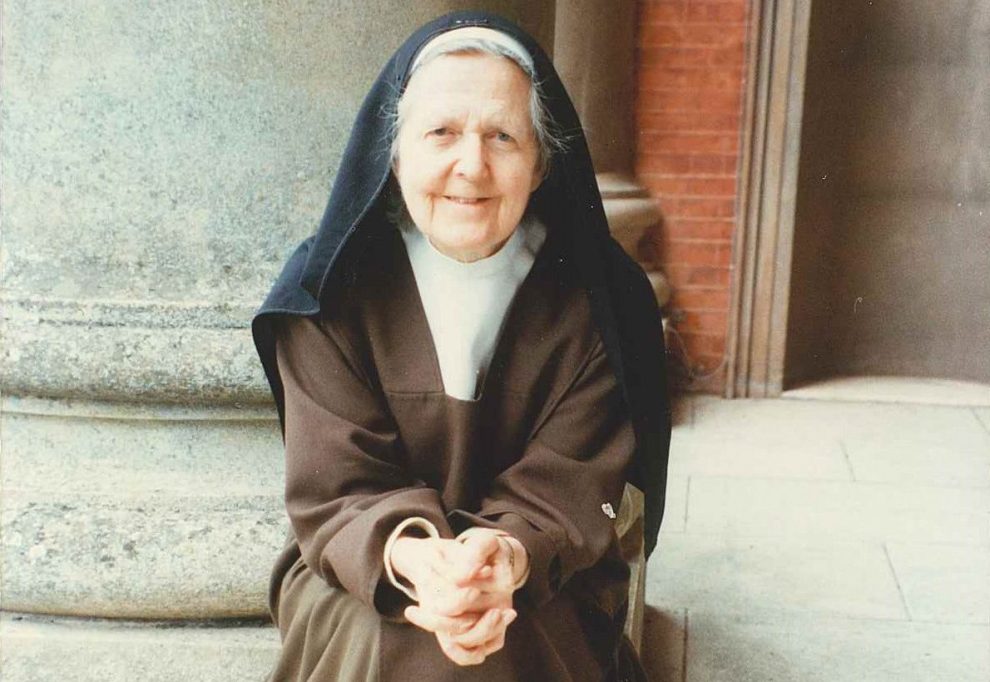
I was nervous before I met Ruth Burrows for the first time at the Quidenham Carmelite Monastery. Here I was, about to encounter one of the greatest spiritual writers of our times. In her best-selling books, she boldly challenged widely held expectations and concerns about the spiritual life. She relentlessly urged her readers to have a genuine trust in Jesus, no matter how bleak their interior atmosphere.
I was about to meet a woman who had also played a groundbreaking and sometimes controversial role in reforming Carmelite monastic life in England after the Second Vatican Council. She courageously rethought and refashioned the essentials of enclosed Carmelite life, insisting on the importance of everything that makes for integral human development. I felt sure that Burrows, with her remarkable ability to penetrate to the essence of things, would see straight through my attempts to appear holy and basically on top of things; I feared she would see the reality of my unimpressive prayer life, my whack-a-mole relationship with sin, and my fundamental fear in the face of life’s unpredictability.
I needn’t have worried. Within minutes of meeting Burrows, I was reminded of the spiritual wisdom that runs throughout her writings: Our interior shabbiness and powerlessness are no obstacle to spiritual growth but rather the blessed context of that growth. We simply need to go to God with empty hands and let ourselves be loved.
Burrows, who died in 2023 at age 100, learned from her own life the wisdom she shared through her books. From her earliest days, she was vividly conscious of the fragility of being human. As she wrote in the opening line of her autobiography, Before the Living God (Burns & Oates), “I was born into this world with a tortured sensitivity.” She found herself devoid of the kind of inner security that makes trusting in God and the goodness of life come naturally to others.
When she was 17, Burrows experienced a moment of grace during a school retreat in which she was awakened to the reality of God and the possibility of an intimate relationship with the divine. She knew she was called to respond to this grace by becoming an enclosed nun. However, she tells us in Love Unknown (Continuum) that throughout her early years as a Carmelite nun, “I felt I was a sham, pretending to be something I was not. I lacked a natural religious sense and feared I was an agnostic if not an atheist at heart.”
Spiritual desolation
Through her persistent meditation on the gospels and the writings of St. Thérèse of Lisieux, Burrows came to realize that her interior desolation was the very place where Jesus made his home and lived out his complete openness to God’s ever-inundating love. Her task, she discovered, was not to try to escape or beautify her lackluster inner world but rather to accept it and to surrender it to the living God. And this, she further realized, is the reality for everyone. “Mine is but the common experience,” she says in Before the Living God, “but the common experience understood.”
Burrows teaches us that whenever and wherever we run up against our inner limitations, we also encounter the potential to discover Jesus’ openness to God’s love. Take, for instance, those seasons when we experience only blankness and boredom during our times of prayer. We can quickly become convinced that we’re doing prayer wrong—or that God is unimpressed and ignoring us. In Letters on Prayer(Sheed & Ward), however, Burrows insists that “prayer is essentially what God does in us and not what we do.” Her emphasis is on receptivity, not on achievement. Prayer means being held by the Holy Spirit here and now in Jesus’ eternal yes to God’s outpoured love.
When prayer is understood like this, we see that the nothingness we sometimes experience when we pray is no indication of what is really happening below the surface; human feelings simply can’t gauge the divine reality that is at work. In the face of barrenness, then, we must refuse to worry or be discouraged. All we need to do is consistently show up, using whatever method of prayer we find helpful as we resolutely and trustingly expose our deepest being to the inundation of God’s love.
The messiness of our interior landscape—our twisted motivations, our festering and reactive woundedness, our inescapable self-absorption, and so on—is also fertile ground for living out Burrows’ wisdom. What are we to do when the squeaky-clean self-image we have worked so hard to cultivate breaks out in splotches, and we are left disgusted and disappointed in ourselves? Burrows gently reminds us that our Christian living must be imbued with the conviction that we cannot climb to heaven by our own efforts. “The whole essence of the Christian demand is to let God be our God and refuse to be God to ourselves,” she counsels in Guidelines for Mystical Prayer (Paulist).
Often throughout her writings, Burrows highlights the sad irony that religious professionals—people serious about the Christian life—are the ones more likely to hide behind shields of spiritual achievement than surrender their tarnished realities to God. Do we dare contemplate whether that could be true of us personally? Would we prefer to cultivate an irreproachable spiritual persona than face the truth of being a loved sinner who will constantly be in need of grace?
Embracing vulnerability
Finally, Burrows’ wisdom can help us accept our basic powerlessness in the face of our lives’ circumstances and people. She wants us to face this vulnerability unarmored, allowing the resurrected Jesus to express within our lives his living knowledge that we are loved and that all is ultimately well.
As we seek to control our lives, we often rely on relentless worry, subconsciously convincing ourselves that we have outfoxed reality by imagining everything that could go wrong. We may try to manipulate the stream of life so that it curves in the direction we think will lead to our own fulfillment and happiness—but in Living Love (Darton, Longman, & Todd), Burrows reminds us:
In surrendering to life as it unfolds no matter what it offers, in exposing ourselves to it—not evading, not fantasizing, not subtly (half consciously if not consciously) foreseeing things we don’t want and warding them off, protecting ourselves in trying to control life—we are surrendered to the Father. We must live with intense faith.
(Of course, there is no suggestion here of submissively accepting abuse or condoning injustice. Such passivity is completely contrary to living in the spirit of Jesus.)
In the last moments of our final time together, Burrows said to me, “Remember, when you feel anxious, just say, ‘I am only a little child.’” She saw through me, just as she had long ago seen through herself. And I’m so grateful. As much as I might sometimes kick and scream against her wisdom, I know the only way to experience true freedom and joy is by allowing myself to be God’s beloved little one.
This article also appears in the September 2026 issue of U.S. Catholic (Vol. 91, No. 9, pages 42-43). Click here to subscribe to the magazine.
Image: Courtesy of Michelle Jones