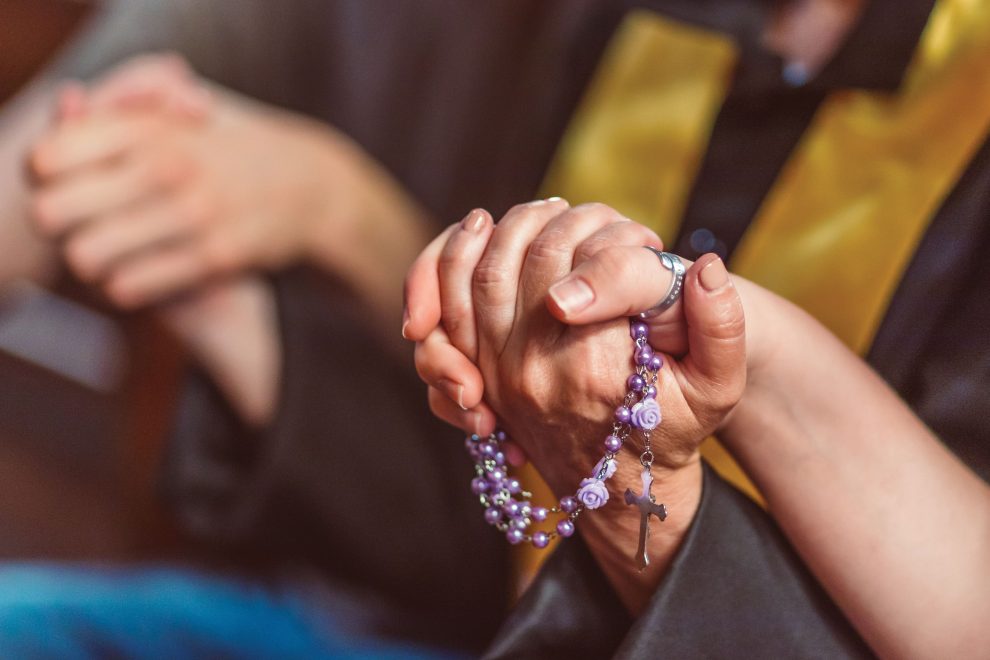
Growing up, I thought of the rosary as a prayer for grandmas. It was—to an active, impatient child like me—a boring prayer the grown-ups forced me to say on Marian feast days in our Catholic grade school. Upon hearing the word rosary, my mind would conjure up the older women sitting in the back of our parish church, silently whispering prayers to themselves as the beads rotated between their fingertips.
But when our youth group learned that our friend Hailey had been diagnosed with cancer at the beginning of her senior year of high school, my relationship with the rosary and our Blessed Mother changed.
Family and friends flooded Hailey and her family with requests to help. As Hailey’s family processed their new reality, they repeated the same request over and over to each of us: Pray the rosary. They were a family who loved and trusted God’s grace and Mary’s intercession; now, they asked us to do the same. So that year, every Wednesday at 8:45 p.m., we gathered in our parish basement to pray the rosary together for Hailey.
In the following months, I put aside my previous opinions about the rosary. In a moment when we, as teenagers, did not have words to express our worries, hopes, and faith—the rosary provided them. When we couldn’t understand the meaning of our friend’s suffering, meditation on the mysteries of the rosary helped us understand Jesus’ nearness to her and to all who suffer. And when we needed comfort, hope, and peace in life’s adversities, we had Mary’s example to encourage us. The practice of communal recitation and meditation became an oasis of calm and connection in our weekly routine. We discovered what so many generations of Catholics—including the old ladies in the pew—had discovered before us: The rosary is a bridge to the life and love of Jesus Christ.
No one is sure of the rosary’s exact origins. It may have begun with the prayer beads the desert fathers and mothers used to count their recitation of the 150 psalms; it may also be connected to the medieval practice of praying the Lord’s Prayer in meditation. Finally, most Catholics have heard the legend that Mary gave the rosary in a vision to St. Dominic, founder of the Dominican order. The Dominicans popularized devotion to the rosary—as we know it today—and then in 1569, Pope Pius V formalized a uniform holy rosary to be used throughout the Catholic Church.
One of the reasons the rosary became so popular was likely how accessible it was. Laypeople, who were largely illiterate in the medieval period, could not join monks and nuns in praying the hours, but they could recite from memory familiar prayers like the Hail Mary. The mysteries of the rosary can be easily memorized and allowed the average person to reflect on the life of Christ without having to read directly from the gospels themselves. And laypeople, too, could “pray without ceasing” (1 Thess. 5:17) in the midst of their daily lives, without needing to follow a monastic schedule or rule of life.
Thanks to modern science, we also know that the rosary is a meditative treasure trove. It engages the body through the tactile experience of counting beads, and it regulates breathing through the physical act of reciting the prayers. These practices help focus the mind and create mental feelings of peace. The rosary also engages the imagination as we recollect the stories of Jesus’ miracles and sacrifice through Mary’s eyes. Psychology tells us that imagination can be a powerful tool to boost creativity, increase self-control, cope with trauma, and influence memory. And, of course, the Holy Spirit is always interceding for us whenever we pray (Rom. 8:26–27).
For me, however, it isn’t simply the benefits of the rosary that are so appealing, but how it helps me encounter Christ through the Blessed Mother. I am able to rejoice with Mary in the liberating love of God at the annunciation as she proclaims God’s favor to Elizabeth. I can walk the way of the cross with Jesus, understanding more fully his love for me and the deep pain of the woman who gave him the life he so willingly sacrificed for us. Through the rosary, I can encounter the mystery of God without having to come up with new words or stunning insights. In words my own mother taught me to pray before I could understand their meaning, I enter into the divine presence that is always with me.
While I no longer pray the rosary weekly, it has become a ballast for me as I navigate discipleship in my adulthood. When I need the Mary of the Magnificat, the Sorrowful Mother, or the Mother of the Church, I pull out my beads. If my spirit cannot find a way to connect with the Jesus who still performs miracles—who lives, resurrected in heaven—the mysteries will help me rediscover my God made flesh. And when I still do not have words, understanding, or hope, the rhythm of the rosary synchronizes my breath with the breath of the Spirit who lives within me.
That’s the power of the rosary and why so many of us return to it again and again. It’s the reason why, more than two decades after Hailey was diagnosed and eventually cured of cancer, the parish’s youth group still meets every Wednesday night to pray together.
The rosary allows anyone, no matter their faith, to connect with the divine using simple prayers anyone can learn. Yes, it’s for grandmas. And it’s for everyone else, too.
This article also appears in the September 2026 issue of U.S. Catholic (Vol. 91, No. 9, pages 44-45). Click here to subscribe to the magazine.
Image: Pexels/RDNE Stock Project