Ruben Botali Kimbulu never imagined himself working for the church. An immigrant from the Democratic Republic of the Congo, he enrolled at Loras College, a private Catholic school in Dubuque, Iowa, intending to become an engineer. But two years into an engineering degree, he switched to a major in religious studies and creative media with a minor in mathematics. After graduating in spring 2026, he is pursuing a master’s degree in theology while working in full-time pastoral ministry through the University of Notre Dame’s Echo program.
“I started as an engineering major because I wanted financial security,” he says. But as he went through the program, he found the classes progressively less rewarding. By the end of his fourth semester at Loras, his mentors helped him be more honest about himself and his true interests. “It’s been a journey of discovery and self-discovery. I want to keep learning about God’s love for me and others.”
Loras provided Botali Kimbulu a welcoming environment that enabled him to discern his gifts and take a risk. He eschewed the seemingly lucrative path of engineering for one that is more uncertain but also more in tune with his passion and vocation.
“The community has been instrumental. Mentors saw me as a freshman, noticed my gifts, and gave me spaces to harness those gifts,” he says. The Central African griot tradition of storytelling, he says, was one of those gifts. “I was encouraged to orate and give talks, drawing on my cultural background. When I was struggling with engineering, I was invited to look at what made me happier. I know that no matter what I go on to do, faith will be at the center.”
It is no secret that the landscape of higher education is undergoing rapid change. Eighteen years after the Great Recession of 2008 caused a baby bust, colleges throughout the Midwest and Northeast are facing a demographic cliff, with fewer traditional-aged college students seeking to enroll. Economic uncertainties have led some students to question whether a bachelor’s degree is worthwhile. Recent political rhetoric and ongoing polarization have created an inhospitable environment for many faculty and students across the United States. The rise of artificial intelligence is changing the way we learn and communicate, forcing educators at all levels to rethink their pedagogy.
Amid these challenges, however, many small Catholic colleges—that is, those enrolling 3,000 students or fewer—offer opportunities that larger institutions cannot. While they may not be household names, many of these lesser-known colleges are beloved in their local regions, serving students who are unable or unwilling to move far from home. Often more open and inclusive in admissions than their more selective counterparts, they pride themselves on being vehicles of upward social mobility, offering academic and social support to low-income and first-generation students who would not attend college otherwise. They also make the traditional liberal arts—usually in the form of a core curriculum required for all majors in such areas as philosophy, theology, literature, and history—accessible to students who otherwise might not encounter them. Drawing on the principles of their charisms and Catholic social teaching, many of these colleges are leaning into a justice-oriented mission.
At a time when some colleges, such as Lourdes University in Ohio, have been forced to close their doors, the decision to remain committed to mission presents a risk. But for students such as Botali Kimbulu, the risk offers possibilities beyond anything they imagined before coming to college. Small Catholic colleges are a vital part of the U.S. higher education landscape and the U.S. Catholic Church.
Grounded in mission
Bill Gregory, a theologian with nearly 20 years of experience in Catholic higher education, recently created a podcast to serve as a resource for leaders in the field: The Mission of Catholic Education. His research has revealed that a college’s capacity to weather change is directly correlated with its commitment to mission.
“In schools where mission integration is taken seriously, you’ll see clear mission officer positions,” he says. “Often these mission officers provide onboarding for all new employees, retreats for administrative leadership and board members, resources for board members, and intentional language. When a college says it is Vincentian, LaSallian, or Jesuit, what does that mean? What is the charism?”
Gregory says that how well an institution integrates its mission affects the culture and vibrancy of the entire body. “Think of the image of a bathtub where water is draining out after a plug is pulled,” he says. “Mission integration is like water coming out of the faucet, keeping the tub full even as there is turnover. People need to learn about the mission and embody it personally. You need people who are torchbearers, who find personal meaning in the mission.”
This commitment to mission is a big part of what made Botali Kimbulu feel welcome at Loras College. One of the mentors who helped him pivot from engineering to religion and media was Stacia McDermott, Loras’ associate vice president of Catholic identity, mission, and vocation. “Our Catholic identity and mission as a diocesan liberal arts college is at the forefront of all we do,” she says. “Throughout our history, that mission has ebbed and flowed and looked different, but in the last number of years, we have found a way to embrace and go deeper into the Catholic identity.”
While this focus on mission involves some of the activities we might traditionally expect from a Catholic college—such as Bible study groups and college-wide Masses—Loras has made a point of welcoming students of various faith backgrounds. Interfaith offerings include tours of sacred spaces, a Diwali celebration, and service on the board of Children of Abraham, a local interfaith organization where members of the three Abrahamic religions meet to discuss ethical issues and current events.
“Our Catholic identity helps us to meet people where they are, accompany them, and recognize the spiritual potential of all persons,” McDermott says. “We do this by going into classrooms as well as offering mission onboarding for faculty and staff. Whether someone is a custodian, a worker in the business office, or a professor in the classroom, we’re all contributors to the mission. Building connections across the institution is vital.”
Some Catholic colleges have turned away from their original missions in favor of a pragmatic approach that seeks to build enrollment at any cost. Others have leaned heavily into a highly traditionalist vision of Catholicism that might alienate students of other faiths. Loras, in contrast, exemplifies a focus on Jesus’ message of inclusion, particularly for those on the margins.
For Gregory, this commitment to mission is paramount for Catholic colleges—even if that commitment ultimately means risking closure. “For all the real issues of the enrollment cliff, institutional survival, AI, the wider insanity we see in the political realm—a college must be true to its identity and Catholic charism. This is a reality that many institutions still have to reckon with,” he says.
Vocation as an ongoing journey
Most college students—particularly lower-income and first-generation ones who populate smaller, regionally focused colleges—are primarily seeking a degree in order to get a job. But students in Catholic colleges learn that vocational discernment goes beyond figuring out how to make a living. Keegan Flanagan, who completed his undergraduate degree at Carlow University in Pittsburgh, has remained there to pursue a master of fine arts in poetry. “We’re living in a very productivity-oriented time, especially in the United States,” he says. “There’s often a disconnect between people’s passions and what they think they need to do to get a firm footing in life.”
A native of Eastern Pennsylvania who initially did not think he would attend college at all, Flanagan came to Carlow, a small college founded by the Sisters of Mercy, because he was drawn to the college’s Irish roots and Catholic identity, which resonated with him even though he no longer identifies with the church. After largely keeping to himself during his freshman year, he began sharing his writing, hosting on-campus reading series, and getting involved in the national English honor society Sigma Tau Delta.
He completed an accelerated undergraduate program and is now pursuing a master’s degree in fine arts to hone his craft as a writer. “Regardless of what I do for a living, I need an education based on what I care about,” he says. “I’ve decided to put off the productivity aspect and focus on my passion for writing. I’ve seen ways that students can apply their learning to careers in ways I didn’t think were possible.”
The fact that Flanagan was inspired to study creative writing at Carlow is no accident. Carlow has a longstanding commitment to making creative writing accessible to all and is home to Madwomen in the Attic, a program founded in 1979 to make creative writing instruction accessible to working-class women. Today, this program has offered inexpensive, rigorous writing workshops on a sliding scale to women across the United States and beyond, most of whom are not enrolled at Carlow. Since its founding, more than 5,000 people have participated.
Sarah Shotland, the program’s director, sees a program like this going hand-in-hand with the Catholic mission. “Being inclusive is so central to the Sisters of Mercy,” she says. “Creative expression is one of the most universal human ways of expressing the dignity of life. Encountering a connection to something bigger than yourself is important to living purposefully, and the creative arts are a key way to access that contemplation. It makes perfect sense to me that Carlow is the home where the Madwomen program has flourished.”
The risk-taking that students such as Botali Kimbulu and Flanagan have chosen is a common theme among students at small colleges. Being open to discovery and change is easier in a smaller, more supportive institution. When Tarin Rietz enrolled at Canisius University, a Jesuit institution in Buffalo, New York, she already knew she wanted to follow in her mother’s footsteps and become a physician. Nevertheless, her journey took an unexpected turn when she took a course on spiritual autobiography in the religious studies department. Although she initially saw this core requirement as merely an item to check off on a long list of requirements, it ended up reshaping her vocational path.
“We read all sorts of texts by people from many walks of life, from soldiers to saints. We looked at people who’ve lost their faith. The professor introduced me to the power of storytelling,” she says.
The ideas in this class came back to Rietz when she worked to complete the service hours Canisius requires. Since she already had experience working with children, her mother urged her to look into working with adults at the other end of the age spectrum. While volunteering at a skilled nursing facility, she met a man named Morrie and asked him if he’d read Mitch Albom’s Tuesdays with Morrie (Doubleday), a memoir about a young man and an old man discussing mortality.
“The smile on his face indicated that he had,” she says. They began reading the book aloud, which led other residents to talk about their past experiences. “It created conversation and community among people who spend time together but maybe don’t know one another well.”
This experience led Rietz to develop a firm interest in geriatrics and end-of-life care. She interned at a nonprofit hospice facility for people who lack stable housing and do not want to die in a hospital. Her inspiration from the spiritual autobiography class has led her to record legacy interviews with people who are dying. After graduating from Canisius in 2026, Rietz is attending medical school at SUNY Buffalo, hoping to work in geriatric care—an unexpected path facilitated by the Catholic education she received.
“My favorite Jesuit value is being a woman for and with others,” she says. “That is what I have aimed to do, really sitting with people as they are taking their final breaths. I’m learning about their life story and helping to pass it on.”
Her studies in religion, she says, inform the work she is setting out to do. “Although I was raised Catholic, I never had the opportunity to study religion growing up in public school. Here at Canisius, you can. Even students who aren’t Catholic feel more open to discussing spirituality. I hope to bring these conversations to medical school and beyond, to focus on the greater good.”
Committed to justice
One commonality that runs across these colleges is a concern for justice. Carlow offers a food pantry and a special program for students coming out of the foster-care system who face housing insecurity. Canisius and Loras are similar to Carlow in their strong focus on first-generation and low-income students. All of them engage their students in service.
Including service in the curriculum is by no means unusual in Catholic education. However, leaders at Loras, Carlow, and Canisius stress the importance of ensuring that this service addresses structural injustices and challenges the status quo. Shyam Sriram, a political science professor at Canisius who teaches a course on refugees, has led students to work with a local refugee resettlement agency. “We collected everything needed to set up a house for a refugee family, from bathroom and kitchen items to bunk beds and kids’ toys,” he says. “We did fundraisers to buy things. We took no pictures, because we do not want to engage in white saviorism.”
That service, Sriram says, is a big part of a Canisius education. “The mission matters. Ignatius of Loyola said we should ‘set the world on fire.’ I see a great fit between service learning and the Ignatian paradigm.” That said, Sriram urges students to avoid performative activism. “We need to make sure that students’ service efforts are not extractive, that they’re actually listening and learning. Being at a small school allows us to change curricula to do this better.”
Jonathan David Lawrence, the Canisius religious studies professor who taught spiritual autobiography to Tarin Rietz, mentions that since a 2022 mass shooting in Buffalo, Canisius—where one-third of the student body are people of color—has sought to form bonds with underserved Buffalo neighborhoods.
“We have tried to focus our urban partnership—including schools where student teachers get sent—to Buffalo’s East Side, near where the shooting happened,” he says. “We want to build a partnership, to pick up on the Jesuit ideas of accompaniment and walking with people rather than telling them, ‘We are here to rescue you.’ We have become more intentional about this. There is still suspicion from some in the community around those who helicopter in and leave—but we are trying to develop lasting relationships.”
Aimee Larson, who founded Canisius University’s physician assistant program in 2021, echoes Lawrence, stating that justice is ingrained in the curriculum—from the diverse cohorts that are accepted to the way courses are taught. “We talk about health and equity,” she says. “Care of the whole person is important. For their clinical year, students get placed in community health centers, including rural ones within 60 miles of Buffalo. A distinguishing element of a Catholic program is a better commitment to the care of the whole human being.”
Looking to the future
As Catholic colleges look toward an uncertain future, they can adapt to rapid change by remaining grounded in mission, focusing on vocation, and working for justice. Carlow University’s president, Kathy Humphrey, remembers that the Sisters of Mercy originally came from Ireland to America to “meet the next great need”; this remains their mission today. “We’re going to handle the demographic cliff by being who we are,” she says.
“Our enrollment has increased because we are focusing on going out to companies, to hospitals, and asking them what they need,” Humphrey says. “How can we help prepare them for the new world we’re in? We created a surgical tech program, because surgeons said they didn’t have enough help; we’re looking to create a medical imaging program; we created a licensed practical nursing program due to a lack of nurses. We created a physician’s assistant program because the need is great. Everything we’ve created has responded to the community’s needs.”
Sister of Mercy Sheila Carney, who has served as Carlow University’s special assistant to the president at the Office of Mercy Heritage & Service for the past 18 years, was recently honored with a lifetime achievement award from the Association of Catholic Colleges and Universities. Some of her initiatives have included opening a campus food pantry, establishing a space of dialogue between Carlow University and the surrounding neighborhoods, and running a monthly program where all faculty and staff gather to learn about one of the Mercy values.
“For the talk on sacredness of creation, we invited a woman from East Palestine, Ohio, to come and talk about the effects of the 2023 chemical spill on their community,” Carney says. While only 30 percent of Carlow’s students are Catholic, her goal is that all will leave with a solid understanding of the Mercy charism that comes from their lived experience.
“In the 1990 encyclical Ex Corde Ecclesiae (On Catholic Universities), Pope John Paul II stated that spreading the message of Catholicism is not the responsibility of one person, but of the whole university,” Carney says. “Our advertising tagline is ‘dedicated to the future of you,’ but I say we’re ‘dedicated to the present of you.’ Sixty percent of our students are nontraditional; many are Pell Grant eligible. We see it as our failing if a student takes out loans and doesn’t graduate. There’s a great effort to make sure everyone leaves with the education they sought.”
Carney believes that artificial intelligence will drastically change the higher education landscape in the coming years. “But I think there will always be a need for young people to go to a place where they can figure out who they are, where they learn that a value-driven life is a life worth living,” she says. “Even as the world becomes more and more based on technology, we want to form students who treasure the human experience and want to share that experience with others.”
On a recent visit to the Catholic University of Central Africa, Pope Leo XIV reaffirmed the importance of Catholic higher education worldwide, saying:
Today more than ever, it is necessary that universities—and all the more so Catholic institutions of higher learning—become true communities of life and research, introducing students and professors alike to a fraternity in knowledge, as an intrinsic requirement for experiencing in community the joy of the truth and appreciating more fully its meaning and practical implications. Today our proclamation of the gospel and the church’s doctrine are called to promote a culture of encounter, in generous and open cooperation with all the positive forces that contribute to the growth of universal human consciousness.
Indeed, a call to “contribute to the growth of universal human consciousness” is a tall order. But this ambitious vision undoubtedly stems from Pope Leo’s own formation at Villanova University and Catholic Theological Union, as well as his knowledge of the U.S. higher education landscape. By extending access to liberal arts education to students who otherwise would not achieve it, guiding them in their vocational discernment, and forming them in a commitment to justice, mission-driven Catholic colleges such as Loras, Carlow, and Canisius live up to Leo’s vision. In challenging political and economic times, they offer a sign of hope.
This article also appears in the September 2026 issue of U.S. Catholic (Vol. 91, No. 9, pages 30-33). Click here to subscribe to the magazine.
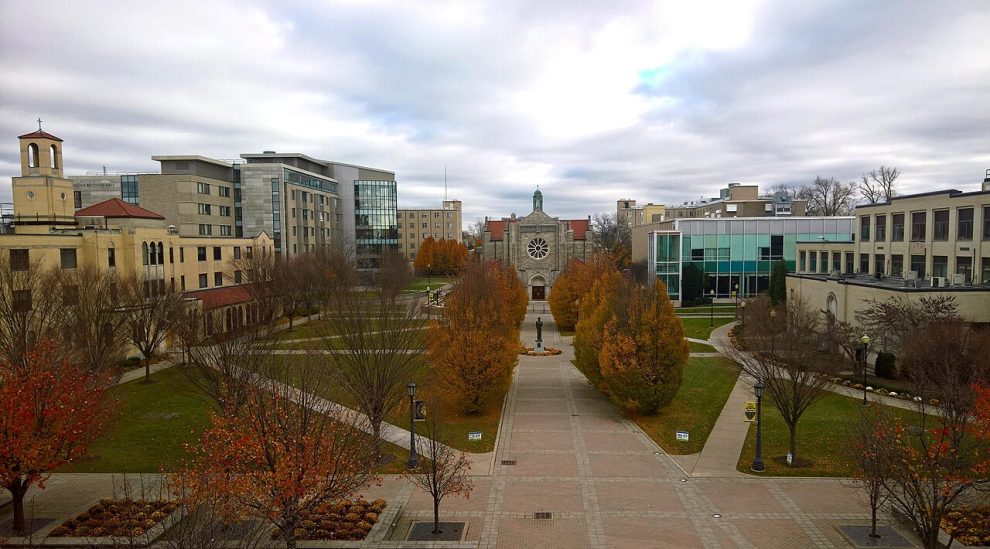
Image: Wikimedia Commons/Andre Carrotflower (CC BY-SA 4.0), The quad of Canisius University in Buffalo, N.Y.