“Don’t just do something, sit there!”
That’s one of my favorite expressions, and I often say it to urge friends to engage in contemplation even when busy. This advice comes from personal experience; prayer enables me to stay centered through good times and bad. And it takes seriously the warning of Jesuit theologian Karl Rahner: “The Christian of the future will be a mystic or will not exist at all.”
Recently, there have been pushbacks to this admonition. Some might say, “Really? With divisions, injustice, and wars, what we need is activism, not navel-gazing meditation.” St. Nicholas of Flue is proof that today’s crises beg for the kind of wisdom that comes through contemplation.
In 1481, Switzerland was not a nation in the modern sense but an alliance of autonomous regions called cantons. The unity of the Swiss Confederation was under serious strain as rural and urban cantons held different values and priorities, and their disagreements threatened to escalate into armed conflict. The rival groups desperately needed a voice they could all trust. At this critical moment, Nicholas’ reputation for genuine mystical experience gave him the moral and spiritual authority to help guide his divided people toward unity. An article written for the Swiss Federal Department of Foreign Affairs calls Nicholas a “Swiss Buddha, Dalai Lama, and Gandhi rolled into one.”
The first half of Nicholas’ life was conventional but still marked by devotion. Born in 1417 in the village of Flűeli, as a child he experienced visions of God’s presence. The Swiss were renowned for their military prowess, and as a young man he distinguished himself in battle. At the age of 30, he married Dorothea Wyss and settled down as a farmer. Over time, they had 10 children, five girls and five boys. In this outwardly stable life, Nicholas remained devoted to prayer—finding the divine in the fields and mountains around him, in private devotion, and at Mass—yet he felt an insistent call to a deeper spiritual life.
Many people change in midlife. American men today might buy a motorcycle, run a marathon, or get a tattoo; Nicholas left his family to become a hermit. Shocking then and still unpalatable now, his choice reminds us that no saint should be uncritically imitated. “I’m leaving the family for God” sounds like something only a privileged and egocentric male would say.
Dorothea and their children surely bore costs that history barely records, and yet contemporary accounts stress that Nicholas had Dorothea’s full support. The household still included three adult men: their 20-year-old son, as well as Nicholas’ father and brother. Nicholas remained closely connected to them, living nearby in Ranft and enjoying weekly Sunday visits with the family. Even so, this decision cautions us against romanticizing his life.
Nicholas’ well-known prayer, quoted in the new Catechism of the Catholic Church, conveys his dedication as a hermit:
My Lord and my God, take everything from me that distances me from you.
My Lord and my God, give me everything that brings me closer to you.
My Lord and my God, detach me from myself to give my all to you.
Nicholas spent mornings indoors in silent prayer, studying “in that High School of the Holy Ghost,” as Heinrich von Gundelfingen, one of Nicholas’ first biographers, put it. In the afternoons, he sauntered in the forest, studying God’s book of nature.
His visions intensified and—though he did not yet realize it—shaped him into the man who would preserve Switzerland’s unity. In one vision he beheld Christ’s face, a gaze that overwhelmed him, with six spokes radiating outward to an all-encompassing circle, showing that Christ’s holiness is wild and untamed, yet also the center of a whole relationally connected universe.
In another vision, a pilgrim came begging; Nicholas gave him a coin. Mountains fell, the earth split, and the stranger was transfigured into Christ, garbed in a bear-fur jacket glittering like gold. Evoking the Germanic berserker (literally “bear-shirt warrior”)—and Nicholas’ past deeds on bloodied battlefields—the vision integrated conflicted elements of his soul. He later told his confessor that this vision assured him he was one with Christ.
Within the hidden temple of his heart and the wilderness of his retreat, Nicholas had received deep, irrefutable wisdom. Word spread and—ironically—the hermit became a celebrity: Crowds flocked to his forest cell seeking advice, church authorities required tickets, pilgrims waited weeks, and he sometimes counseled visitors from sunup to sundown. Nicholas’ reputation for wisdom readied him to be God’s healing voice in a crisis that could have shattered his homeland.
In 1481, as the Swiss Confederacy threatened to come apart, a priest hastened to Nicholas’ cell seeking advice for the situation. Sworn not to leave his cell, Nicholas composed a letter which the priest delivered to the feuding delegates. The exact words of this history-making epistle are unrecorded, but its message was clear: unity, restraint, and peace. So inspired were the divided factions that they forged a stronger confederation, and in the years that followed Nicholas came to be known colloquially as the “father of Switzerland.”
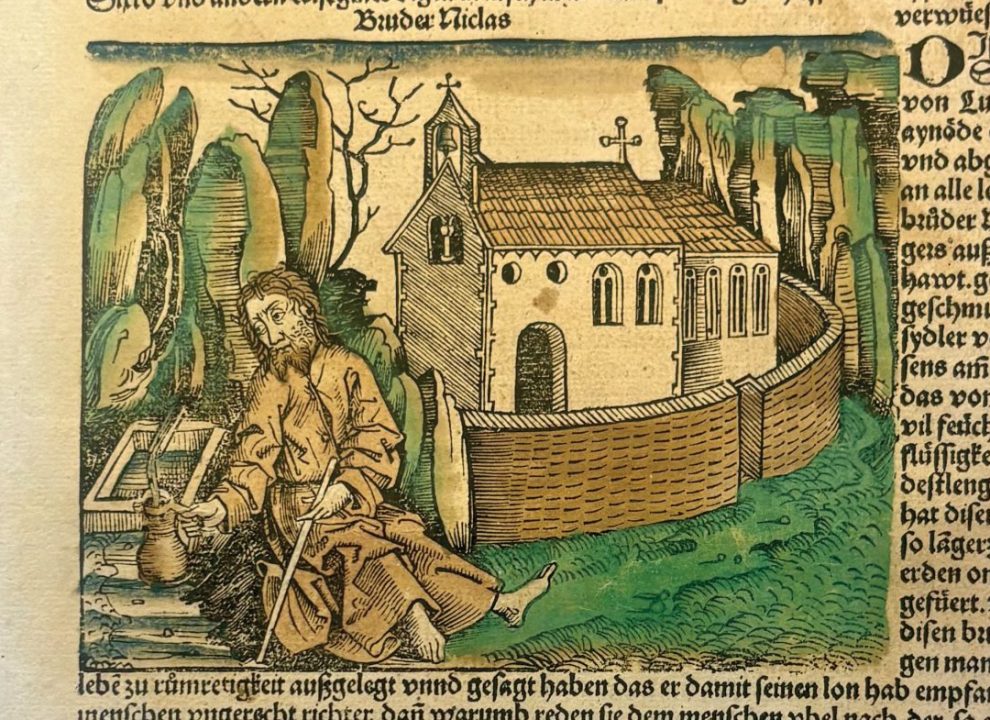
Nicholas died in his hermitage in 1487, widely revered as a holy man. His humble abode became a sacred stopping point on the pilgrimage route leading across Switzerland, France, and Spain to Santiago de Compostela, and people in need began asking “Brother Klaus”—as Nicholas was sometimes called—to intercede for them. Pope Pius XII canonized Nicholas of Flue in 1947, making him the only Swiss saint and patron of that nation, where his feast day is observed on September 25.
Nicholas’ life is but one example of a larger pattern: A person withdraws from the world to seek God, receives divine wisdom, and this transcendent moral authority then speaks to crises in the broader society. We see this pattern historically in the lives of the desert mothers and fathers, Benedict of Nursia, Kevin of Glendalough, Hildegard of Bingen, Catherine of Siena, and Julian of Norwich. More recently, Thomas Merton and Thich Nhat Hanh attest to the healing impact of lives steeped in contemplative stillness.
Depth psychologist Marie-Louise von Franz affirms this: “The miracle is that the simple words of Brother Klaus worked in such a way that a civil war was prevented. This shows us that peace marches and all well-meaning peace sermons are of no use if one has not found peace within oneself. . . . Those who have found the connection with the divine source within their own soul have a charisma through which they can also help other people.”
Maybe you’re troubled by things happening in the larger world and feel the need to make a positive difference. Nicholas of Flue reminds us that time spent in contemplation is not a luxury: It is essential in times of societal upheaval.
This article also appears in the August 2026 issue of U.S. Catholic (Vol. 91, No. 8, pages 42-43). Click here to subscribe to the magazine.
Image: Michel Wolgemut/Wilhelm Pleydenwurff, woodcut from the Nuremberg Chronicle, 1493