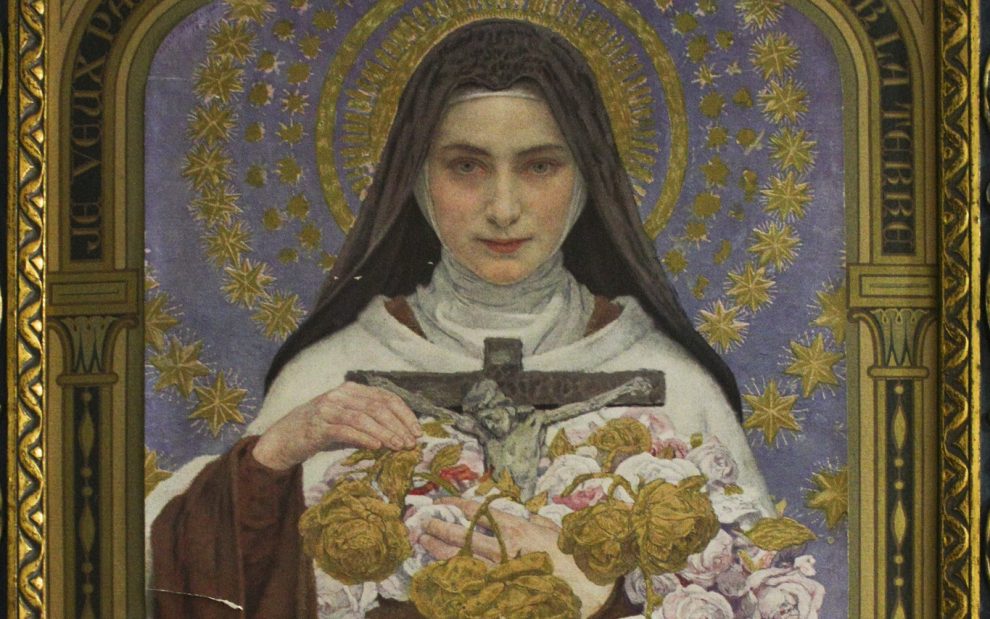
Thérèse Martin was only 15 when she entered the cloistered Carmelite monastery of Lisieux in Normandy, and only 24 when she died there in 1873. Today, she is known as “the Little Flower,” and frequently associated with sweet-faced holy cards and the gift of roses. Yet hers was an intense and passionate personality. She was ambitious, plagued by doubts. She yearned to be a priest, and, like her patron and fellow Carmelite Teresa of Avila, fantasized about martyrdom. Her short life was also marked with intense pain, due to the tuberculosis that killed her. St. Thérèseof Lisieux’s fervent devotion to Jesus is more deeply appreciated in light of her emotional struggles and physical suffering—but also her affection for the small things of this world.
Philip Kolin’s latest collection of poems, A Centenary Garland (Teresian Press, Carmelite Book Service) honors this saint and doctor of the church a century after her canonization in 1925. In these verses, Kolin offers a poet’s-eye view of her life, from her earliest years with her family to her early death. Thérèse’s
modest and unremarkable life, unpunctuated by adventure or glory, is the exact opposite of what our celebrity-obsessed culture considers aspirational. Yet, as Kolin captures in these poems, Therese lived intensely, finding worlds of significance in small things and passing encounters.
One theme running through these poems is how Thérèse connected her own pain with the suffering of the crucified Jesus. Another is the incarnational aspect of her perspective on the world. Both these elements highlight the depth and richness of her spirituality.
For instance, in “ Divine Dew” Kolin writes of Thérèse at fourteen, looking at a painting of the crucifixion, and vowing to “invoke his blood through prayer and work / to cleanse and save sinners.” This devotion also becomes, for Thérèse, a way of bearing her own suffering: “her own tubercular coughs and blood clots became her sacrifice to Him, / knowing His blood sanctified her roses.”
Kolin shows us Thérèse caring for the flowers in her little garden, her awe on first seeing the ocean, her attention to the “glistening tear” on the eyelid of a dying nun, her love for the chestnut trees near Carmel. While washing clothes with the other sisters, in “The Great Laundry Day at Carmel,” one of the nuns splashes water in Thérèse’s face, and she connects it with Veronica, wiping the face of Jesus as he carried his cross. In pinpointing these moments, Kolin highlights how Thérèse’s focus on smallness was not a nihilistic rejection of the things of the world, but the opposite. She thoroughly, passionately inhabited each moment of her life, finding a universe of significance in the humblest of things.
Her sense of wonder at simple things in nature, the “blue-white stars” in a bitter Normandy winter sky, is the wonder of mystic—like Julian of Norwich and her vision of a hazelnut. So it’s no wonder a poet would be drawn to and inspired by her vision. In his poem “St. Thérèse’s Spirituality,” Kolin writes that she “watched nature becoming transcendent,” and “drew upon a deep well of spiritual yearnings.”
Thérèse had her first tubercular haemorrhage on Good Friday as Kolin captures in “In the Sacristy Garden.” That moment was the moment when she understood the inevitability of her death—though not the martyr’s glorious end she’d dreamed of, still, Kolin asserts, “a martyr’s death.” Therese’s suffering prompted her to want to help others, and after her death she became a source of consolation and courage for others who looked to her for healing miracles, including the singer Edith Piaf, and the French pilots in the First World War, who carried her holy cards high over the “blood-soaked trenches.”
I’m not sure it’s possible to understand Thérèse’s “Little Way,” as she called her approach to sanctity, without noting the struggles she went through to arrive at it. She’s one of those saints I did not appreciate at first, because I only saw her holy card aspect, those struggles excised. Kolin’s poems emphasize Therese’s joy, but without disconnecting it from her pain, or from her care for others. I’ve come to see her as a subversive saint, in the way that the Magnificat and the Beatitudes are subversive—her emphasis on smallness an antidote to the world’s mindless lust for power.
Kolin’s poems remind the reader of the courage it required for this young woman to find in her own blood the assurance of a red tabernacle light—to love the world even when it snarled at her.
Image: Flicker/Lawrence OP, St. Therese of Lisieux