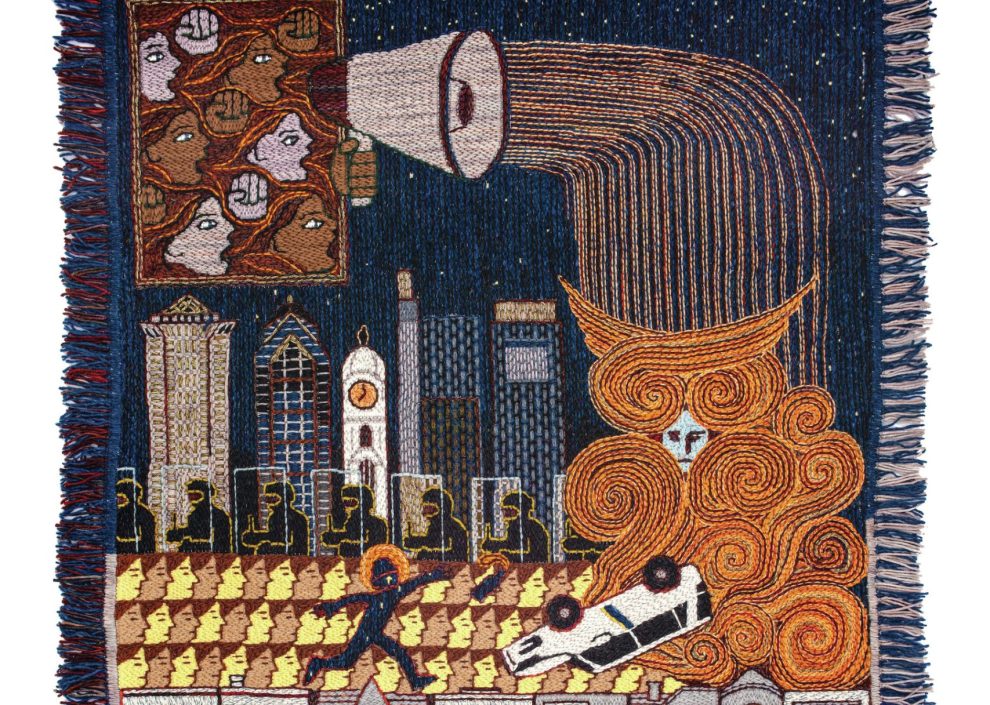
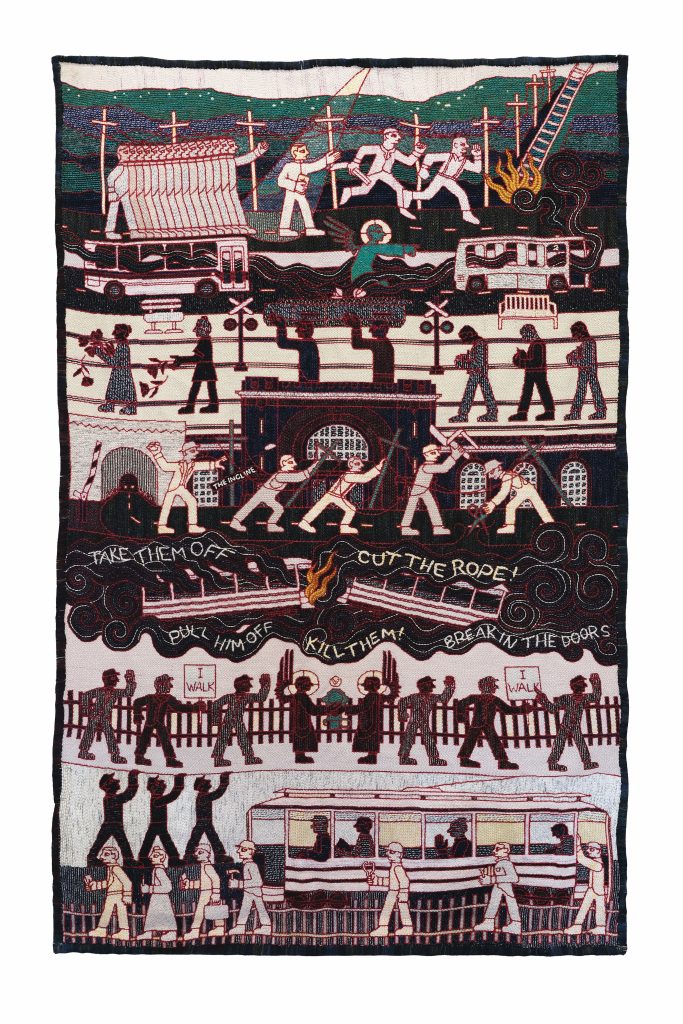
In a small room in Field Projects, a Manhattan art gallery, three punch-needle tapestries hang from banner poles alongside clippings from old newspapers with headlines such as “Textile Workers’ Convention to Call Big Walkout Unless Employers Change Attitude.” The stories beneath those headlines—working-class riots, strikes, victories, and defeats in the railways, factories, and textile mills of Chattanooga, Tennessee—unfold across the tapestries in vertically stacked segments, teeming with hieroglyphic-like figures of workers, bosses, and strikebreakers. The rows of figures evoke ancient Egyptian scrolls, but the scenes of class struggle bring to mind social realist propaganda, a marriage of styles further complicated by triumphalist Christian imagery.
A heavenly beam of light falls upon a preacher, one hand gesticulating, the other clasped around his Bible, as he leads a crowd through a street lined with cross-shaped telephone poles in pursuit of fleeing scabs. Halos frame the heads of strikers gunned down by mercenaries. Trumpeting angels fly above liberated factories. Serpents coil around a textile mill’s smokestacks, recalling both the serpent of Eden and William Blake’s “dark Satanic mills,” while bright whirls of fire bring to mind biblical fires of vengeance or Pentecost.
On a table in the corner of the embroidered room, union pamphlets are displayed alongside St. Basil the Great’s On Social Justice; Robin D. G. Kelley’s Hammer and Hoe (University of North Carolina Press), a history of the Alabama Communist Party during the Great Depression; and Erik S. Gellman and Jarod Roll’s The Gospel of the Working Class (University of Illinois Press), a biography of two Southern preachers, one white, one Black, who organized their working-class congregations across the Jim Crow color line during the 1930s and 1940s.
Socialist textile artist Tabitha Arnold created the exhibit, titled Gospel of the Working Class after Gellman and Roll’s book. With more than 17,000 followers on Instagram, a thriving Etsy store, and many awards and artistic residencies to her name, Arnold has built a career embroidering handmade narrative tapestries commemorating labor struggles past and present. She often tells those stories with the visual language of Christianity, but she is not a practicing Christian (though she notes with a smile that the biblical character Tabitha is also a textile artist).
Trained in painting at the Pennsylvania Academy of Fine Arts, Arnold transitioned to needlework and then began embroidering political tapestries in early 2020 while working as a barista in Philadelphia. “I was in Philly when I started making this work. I got trained as a labor organizer, joined the labor movement, and became a socialist,” she says. Her activities included helping her fellow coffee workers to unionize, joining Philly Socialists, and attending grassroots actions that rocked the city during the turbulent COVID-19 pandemic lockdown: rent strikes, ICE demonstrations, and Black Lives Matter (BLM) rallies protesting the murder of George Floyd.
As Arnold became increasingly politicized, she realized the visual storytelling power of tufted rugs. She melded diverse historical influences, from Afghan war rugs to Bulgarian Soviet murals, in works such as Whose Streets, a wool yarn tufted rug that memorializes Philadelphia’s BLM protests with images of picket lines and flaming cop cars.
She also found herself reaching for Christian symbolism to artistically express the fiery emotions that come with organizing. “This righteous anger, this biblical kind of triumphant struggle, [was] really resonating with me again,” she says. Such imagery became a common motif in her work. Her 2023 Hot Labor Summer, for instance, mythologizes protests against the construction of Cop City, a $90 million, 85-acre police-training facility in Atlanta, with images of angels with flaming swords.
Arnold traces her reflexive use of religious metaphor to her upbringing. “My parents were divorced, so with my mom, I went to a Presbyterian church, very, very conservative. And then with my dad, I went to an Eastern Orthodox church. So one was iconoclast, and the other leaned really heavily into using iconography,” she says. “I felt like it was a very heavy kind of imperative I got from Christianity. You kind of feel like you have the weight of the world on you, and you were supposed to go out and be this world-shifting person.”
Accordingly, she studied the Bible obsessively as a child, seeking to understand and follow Jesus’ teachings. But as she grew older, she became disillusioned with conservative Christianity. “I didn’t feel like it was a great environment to grow up in as a woman, especially,” she says.
Yet when the religious symbols of her youth began to appear in her tapestries, she came to realize how thoroughly Christianity had formed her imagination. “Being raised that way, it’s just part of my source code,” she says. “Even if you decide to leave a culture or a practice behind when you’re an adult . . . it’s still part of that toolset that you have to think about anything else.”
As Arnold delved deeper into the history of labor movements, she was fascinated to discover that Christian churches often supported them, especially in the South. From Kelley’s Hammer and Hoe, she learned that Black sharecroppers in Depression-era Alabama often found their way to the Communist Party through studying the Bible, rather than via Marxist theory. These sharecroppers incorporated African American spirituals into the labor movement, transforming the songs of enslaved people into protest songs. The Black socialists also used Bible studies as union meetings, highlighting relevant passages to communicate with one another rather than taking notes, thus protecting themselves from union busters’ violence, even murder. “There is this really powerful religious socialist tradition here that I just didn’t know about growing up,” Arnold says. “It almost seems essential to Southern organizing in a way that it didn’t feel in the North.”
She found the biblical tradition alive and vibrant when, in 2022, she moved from Philadelphia to her old hometown, Chattanooga. Through her involvement in local labor campaigns, including with the Democratic Socialists of America (DSA), she became acquainted with members of Chattanoogans in Action for Love Equality and Brotherhood (CALEB), a branch of the national network Gamaliel, which organizes faith communities, labor unions, and community nonprofits around issues of social and economic justice.
According to CALEB Organizing Director Michael Gilliland, successful organizing in the South has often relied on churches. He points to Christian churches’ support for labor actions in Tennessee, Georgia, and southern Virginia during the 1930s and 1940s, as well as doctrines in the United Methodist Church that uphold collective bargaining as a human right—a belief shared, he notes, with Catholic social teaching, beginning with Pope Leo XIII’s 1891 encyclical, Rerum
Novarum (On Capital and Labor).
In that document, Leo enshrined in the church’s social justice teachings the right to unionize, alongside other economic rights such as fair wages and leisure time. He thought it “greatly to be desired” that unions “become more numerous and more sufficient,” arguing that they not only improve workers’ skills—“promoting the advancement of art”—but build solidarity, expressing a “natural impulse which binds [people] together in a civil society.”
Successive popes have affirmed Leo’s teachings, from John Paul II’s 1981 encyclical Laborem Exercens (On Human Work) to Benedict XVI’s 2009 encyclical Caritas in Veritate (On Integral Human Development). This last was a response to the global financial crisis that criticized governments for limiting the “freedom or the negotiating capacity of labor unions” and called for Rerum Novarum to “be honored today even more than in the past.”
Gilliland sees CALEB’s work as heeding this call, though it works predominantly with Presbyterian, Methodist, and Episcopal congregations. “It is so much harder to organize with somebody if you’re treating them as an atomized individual, shorn of all the community connections and relationships that they already have,” he says. “We’re not just working to move individuals into collective action toward liberation. We’re looking to mobilize communities.”
As part of that effort, CALEB launched A People’s History of Chattanooga in 2016, educating residents about the city’s neglected history of political activism. The first part of the project used educational walking tours to explore Chattanooga’s history of white supremacy and antiracist resistance. But walking tours did not suit the city’s labor history, which is uniquely robust for the union-sparse South. Gilliland notes that during the 1950s, the city boasted a nearly 40 percent unionization rate, equivalent to Boston or Canada.
CALEB saw Arnold’s artistry, however, as a perfect fit for the subject. Originally, the organization planned to create tapestries to educate the public about past union battles, but in late 2023, it seized the opportunity to connect those battles to current ones, as autoworkers at Volkswagen Chattanooga began their drive to unionize with the United Auto Workers (UAW).
As Arnold attended workers’ rallies in the lead-up to their April 2024 landslide vote to unionize, she was struck by how often workers’ speeches referred to scripture. “They’d be talking about having faith as small as a mustard seed and using it to move mountains. So I was like wow, [Christianity] is actually still an essential ingredient to organizing in the South,” she says.
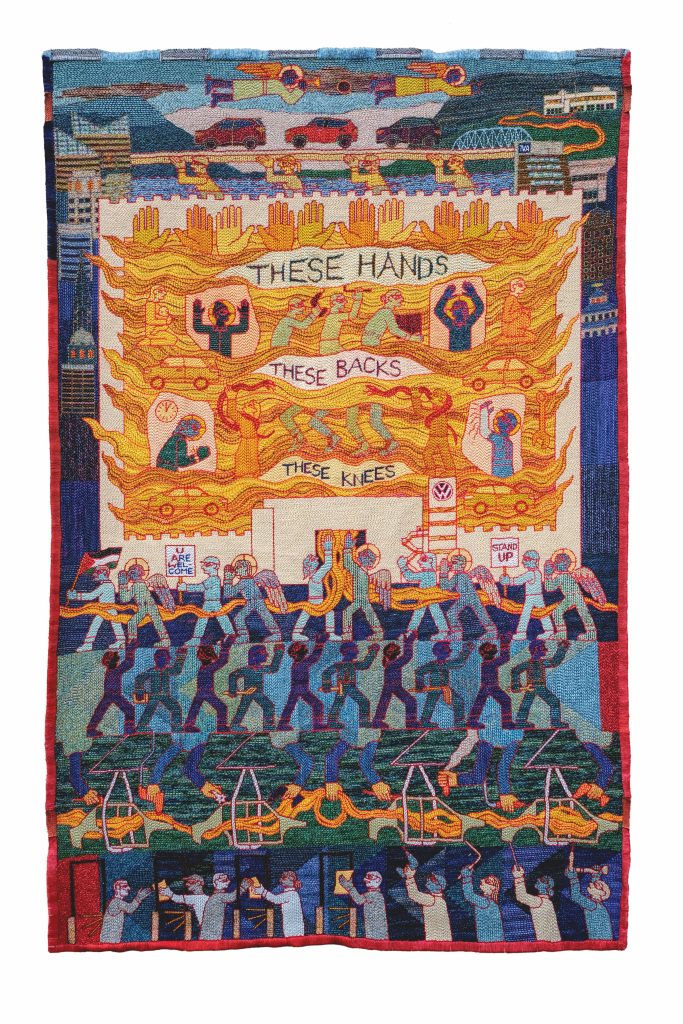
The tapestry she wove for CALEB, These Hands, likewise incorporates religious imagery. The bottommost rung shows a row of workers toiling, streams of fire sparking through the cars they assemble. The fire burns upward into the middle segments, passing between lines of demonstrators receiving whispered messages from angels, then blazes into a conflagration, engulfing a Volkswagen factory filled with workers triumphantly raising their hands, with banners reading “These Hands, These Backs, These Knees.” Finally, the image ascends to a bridge upheld, Atlas-like, on the workers’ shoulders, streaming after the cars they’ve built as angels fly overhead—a vision of democratic socialism that aligns with John Paul II’s vision in Laborem Exorcens of a society in which “each person is fully entitled to consider [themselves] a part-owner of the great workbench at which [they are] working.”
The tapestry was first shown to the workers it commemorates, along with their families and supporters, at a rally CALEB organized one week ahead of the union vote. Arnold worried workers might not welcome art created by a Volkswagen outsider—but she was moved and gratified by their response. “They were really floored, I think, by seeing themselves monumentalized in a way that feels like it’s going to be preserved for a long time, like it has this kind of ancient feeling,” she says.
Gilliland confirms how deeply the workers appreciated Arnold’s reverence. “They were shocked and amazed and deeply grateful . . . having something of such artistic quality to recognize the work they were doing,” he says.
As manual laborers, Arnold says, the Volkswagen workers also understood the incredible physical effort that went into the tapestry. As with most of her works, the labor-intensive process began by stretching fabric on a large set of canvas stretchers and then embroidering with a punch needle—a faster process than traditional embroidery, which nevertheless took more than 225 hours.
Arnold used the same time-consuming method for the two other tapestries in the exhibit. From CALEB’s research, she chose two other periods of Chattanooga’s labor history as subjects. Mill Town, completed in September 2024, portrays an uprising of industrial millworkers during a national 1934 textile strike started by Alabama textile workers. I Walk, completed in January 2025, depicts a series of trolley-car driver strikes and riots in the 1910s.
Mill Town, like These Hands, uses fire as a visual device to guide the eye from hellish exploitation to heavenly freedom. It streams from the speakers of a Congress of Industrial Organizations (CIO) sound truck as it drives past a factory, bearing a banner exhorting “Textile Workers Unionize Now,” and runs through the factory windows, above the heads of workers as they whisper and pass tools to one another. Arnold intends the fire to be a metaphor for the union drive, the spread of knowledge from worker to worker—“that really radicalizing knowledge of your own potential for power when you join a union.” Through the fire metaphor, she hopes to communicate the spread of this knowledge as, in itself, a kind of gospel. “The idea of gospel being this information you want to spread, you want to circulate, something you feel is important,” she says.
Far from subverting biblical spirituality, this vision of the gospel as a transfiguring power within human beings, inseparable from the material world, shares similarities with Catholic social teaching. Pope Francis, in his 2015 encyclical Laudato Si’ (On Care for Our Common Home), noted that Jesus “worked with his hands, in daily contact with the matter created by God” and that he therefore “sanctified human labor and endowed it with a special significance for our development.” By depicting workers’ liberation as a world-transforming spiritual force, Arnold offers a corrective to “unhealthy dualisms” of matter and spirit that Francis believed had “left a mark on certain Christian thinkers and disfigured the Gospel.”
Together, Arnold’s three tapestries comprise the Gospel of the Working Class exhibit, which debuted in January 2025 at the Institute of Contemporary Art in Chattanooga. Along with newspaper clippings, the exhibit features three short documentaries, one on Arnold’s process and intentions for the show, and two on the Chattanooga Volkswagen union drive. In keeping with Arnold’s own view of gospel as knowledge shared from worker to worker, the tapestries prompted some attendees to tell her stories about ancestors who lived through some of the scenes depicted, such as the mill strike.
Stories like these satisfied Arnold’s goal of putting the city’s labor history back into the public living memory. “Even if people had it locked away, they weren’t talking about it,” she says. “I was excited that people finally found that they were invited to share about their amazing grandparents or great-grandparents and what they had accomplished.”
When Arnold moved the show to Fields Gallery in Manhattan from September to October 2025, she felt it served an additional purpose of challenging Northern stereotypes of Bible Belt spirituality and politics; it also educated leftists who may be skeptical of religion’s importance to Southern organizing. “I know some people who consider themselves Marxists or socialists who think that Christianity or religion is just completely bad, completely unhelpful, but in the South, that’s just been documented as false,” she says.
Her message was persuasive to at least some attendees. Ash Croce, a New York-based writer who identifies as a socialist, became disillusioned with Christianity after growing up Catholic in northern Boston during the church’s sex abuse scandal. But Arnold’s exhibit helped persuade Croce that religion and leftist politics need not be at odds.
Croce found These Hands especially impactful, along with a clip in one of the documentaries of UAW President Shawn Fain proclaiming the parable of the mustard seed in a speech to workers on the night of their victory. “Religion is a language that a lot of people speak, and a lot of working people speak,” Croce says. “It is a language that helps them understand the world. This is how we can explain socialism to the masses. The politics of the Bible, the politics of Jesus, was socialism.”
Arnold’s work has received more coverage from leftist publications than from religious ones. But Croce feels that Christians, and especially Catholics, can benefit from engaging with Arnold’s art. She contrasts the current cruel anti-immigrant policies, which many Catholics, including some in government, support and the traditionalist Catholic movement’s authoritarian ideology with the resolutely just, egalitarian Christianity inspiring Arnold’s work, which she feels is closer to the spirit of Pope Francis and now Pope Leo XIV. “I see this imagery, and it feels pure. It feels like what faith should be distilled, and what Christianity should be distilled,” she says. “I respond positively to it, and I do not always respond positively to Christian imagery.”
Although Arnold does not participate in organized Christianity, she sees socialist organizing as a way of practicing humanistic values—universality, the worth of each individual, the need to help the poor—common to Catholic social teaching and the beliefs of other Christian denominations. It was these values, she says, instilled by her religious upbringing, that prepared her to embrace socialism. “I saw class action as this amazing expression of radical love. I felt like I was practicing the values that I had grown up taking very seriously, but I hadn’t felt like I was actually acting on them until I was organizing,” she says.
Arnold plans to continue spreading those values through her art. On November 25, the ninth anniversary of Fidel Castro’s death, she shared at the Cuban Embassy a tapestry, Primero de Mayo, in honor of the Cuban Revolution, and she continues to accept commissions from unions and left-labor organizations.
Gospel of the Working Class will move to Institute 193 in Lexington, Kentucky in 2026. She hopes the tapestry will not only continue to educate viewers on labor history but also inspire them to follow in former movements’ footsteps. “To people who are wondering if they can form unions at their own job, or if they can get active in the Volkswagen union, I want this to be something that keeps people going,” she says at the end of one of the documentaries included in the exhibit. “I might as well pass the torch.”
This article also appears in the May 2026 issue of U.S. Catholic (Vol. 91, No. 5, pages 10-15). Click here to subscribe to the magazine.
All art by Tabitha Arnold