Margaret Heldring clearly remembers a conversation she had in 2012, after 20 children died in a gun attack at Sandy Hook Elementary School. She was having coffee with friends, sharing their horror and grief, when she realized: “It could have been my grandchild who died.”
Many of her friends were also grandmothers. Again and again, they found themselves asking the same question: What can we do?
Grandmothers for Gun Responsibility was born from that moment. Heldring began with a state-based group in Washington, then created a national organization that expanded across the country. She realized that while our culture often considers older women “past their prime,” the reality is just the opposite. People in their elder years can be extraordinarily potent messengers for social change. Today, Heldring’s organization runs educational programs, promotes safe gun storage, and plans public awareness campaigns.
Heldring’s story is not an anomaly; many other elders have experienced similar calls to activism. For some, like Heldring, that call comes first in the “third stage” of life (the stage after education and career). For others, such as 83-year-old Wilma May, activism has always been a part of their identity—and they see no reason to stop now.
In the 1960s, Wilma May took part in the work led by Martin Luther King Jr., and she kept on working for social justice even when many of her peers gave up. She’s encouraged now when she sees the size of the protest crowds, “especially all those grandmas like me coming out,” she says. She remembers seeing people throwing stones in the 1967 Detroit riots, and says she wishes more people would use stones to build something rather than destroy something. “Even at my age,” she says, “there’s still plenty you can do. You don’t realize, but every little thing we do counts. Even if all I have to add is a pebble, it’s still something. Enough pebbles make a mountain.”
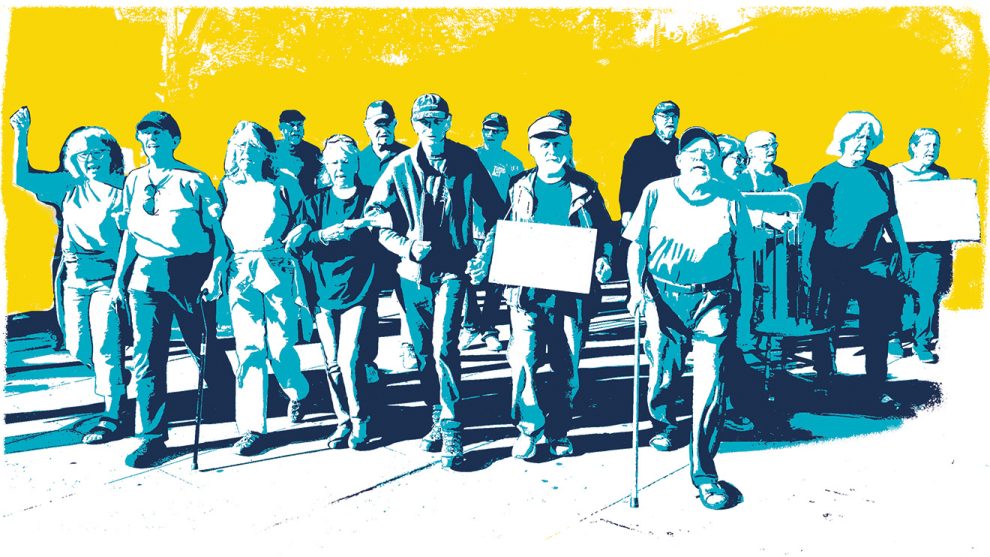
Heldring and Wilma May are not exceptions. Across the United States—and around the world—people in their 60s, 70s, 80s, and 90s are standing up for justice, environmental healing, and other causes. In a culture that fears and often denigrates aging, their examples call us to see this stage of life in a new way.
As Betty Friedan once put it, “Aging is not ‘lost youth’ but a new stage of opportunity and strength.”
Why elders and why now?
We are all, regardless of age, living amid climate grief, democratic fragility, and spiritual exhaustion. Our world needs all the voices, all the wisdom, all the work humanity can offer. Elder movements respond to that challenge.
Pam Murphy says, “Not only do I have more time at this stage of my life, but I don’t have the same worries I had when I was younger.” Murphy is Potawatomi; she is also Catholic, and she is the development director at Third Act, an organization that defines itself as a “community of Americans over 60 determined to change the world for the better.” She says the pieces of her identity all intersect in her work to mobilize older adults around climate and democracy.
Although women lead and carry many elder-led movements, Murphy stresses that this may reflect historical and cultural patterns rather than any biological difference. And while men may be the minority in these movements, each activist group welcomes them. “To grandma can be a verb,” says Heldring. “It’s about the role, not the gender.”
For both men and women, elderhood is not withdrawal from the world. Instead, it’s a sense of responsibility for the world. Third Act’s work, for example, is focused on “collective action and moving the needle towards a sustainable, joyous, and equitable future for everyone.”
A new understanding of aging
Anthropologist Lynsey Farrell, founder of the Grandmother Collective, says that “age segregation and the idea that aging is diminishment rather than enrichment is a modern Western phenomenon.” The Grandmother Collective “connects older women across generations and geographies to lead on issues that matter: education, climate, care, democracy, and more.” Farrell says that as elders claim the authority of their own wisdom—a process she calls sage-ing, a word coined by Zalman Schachter-Shalomi, one of the founders of Sage-ing International—they are empowered to reach out to families, communities, and societies, working to create positive change.
But for that to happen, Farrell says, we need to unlearn the cultural script that equates worth with productivity and material possessions. As “eldering” reframes aging as a time of greater meaning, we have new opportunities to consider what we value most in life. This shift in perspective can begin long before we are old. As Farrell says, “Eldering is a lifelong process.”
Inner work beneath outer action
This movement is not only political; it’s also spiritual. It asks us to reconsider the purpose of aging itself and to recognize that external action is often rooted in inner transformation. As Joan Chittister says in her book The Gift of Years (Bluebridge), growing older is a “call to spiritual growth,” a challenge we can accept, allowing ourselves to experience the process of inner transformation—or refuse, clinging hopelessly to lost youth.
Spiritual faith is important to elder activists. Many of them speak of their sense of calling; in some way, God spoke to them, asking them to grow, to learn, and to act. Heldring, for example, describes how Quakerism’s nonviolence and inclusivity have shaped her work. She also recognizes the enormous potential parishes have to channel the energy of older members into meaningful action beyond routine church life. “This is an opportunity,” she says, “to direct that energy outward,” beyond altar flowers, bingo, and church suppers.
Farrell also points out that churches have historically offered older women agency through service and stewardship. Catholic social teaching has been the perfect structure for many older people to find a place where they are still needed. “But,” she says, “today’s elder movement offers opportunities beyond church walls.”
This sense of vocation can empower and give new meaning to our Catholic tradition’s emphasis on human dignity, solidarity, the common good, and care for the vulnerable—as well as the conviction that prayer must lead to action. As activist Fannie Lou Hamer once said, “You can pray until you faint, but if you don’t get up and try to do something, God is not going to put it in your lap.”
The “something” elders are doing
People don’t have to march in protests to be activists. Third Act encourages elders to participate in ways that fit their capacities: letter writing, training, and coalition building. Its members bring rocking chairs to demonstrations, not only for comfort but also because vulnerability can be a form of power. Jen Chandler of Elders Climate Action agrees; sometimes, she says, simply being there is enough. “Just show up however you can,” she tells elders. “Consistency matters more than scale.”
As Murphy says, “We all have a responsibility to create a better world, even if our actions are small.” Activism, she emphasizes, is not a single event but a way of life.
Danielle Lyons, program director for Foster Grandparents in Fort Wayne, Indiana, describes the ways elders are making a difference in elementary schools. Her program focuses on children from low-income or traumatized backgrounds, and its effectiveness shows up in improved literacy scores. But, Lyons says, “Foster Grandparents are more than classroom helpers”; they also model listening, tenderness, and patience. They are storytellers, witnesses to history, and their lived memories counter the cynicism that dismisses the past as propaganda or “fake news.” “These people lived firsthand in a very different world,” Lyons says. “As witnesses, they have authority.”
While many older people may find the role of grandparent a good fit, Raging Grannies, a nationwide movement that sings protest songs put to familiar tunes, offers elders a livelier, more public way to make a difference. The Grannies show up at protests in aprons and funny hats, where, says Maggie, one of the Rochester, New York Grannies, they use humor to disarm hostility. “We make people laugh,” she says. At the same time, she hopes the catchy tunes lodge new ideas in listeners’ minds. The Grannies’ anger is real—but singing, they say, transforms their anger into hope.
Farrell points out that elders around the world have always been the ones who shaped social change. She describes the various ways elders have responded to their communities’ crises: In Zimbabwe, the Friendship Benches program trains grandmothers to be community mental-health counselors. In Uganda, thousands of grandmothers raise AIDS orphans and rebuild social networks. In Argentina, grandmothers marched for decades to recover stolen grandchildren. These grandparents are definitely not “old and in the way,” as Jerry Garcia put it in a song by the same name.
Jen Chandler of Elders Climate Action admits she sometimes feels discouraged—seeing the federal administration undo decades of progress, while hard-won legal protections are reversed—but she still insists on persistence. “We did it before,” she says. “We can do it again.” That sense of history gives hope and steadiness to elder activists, hope they can share.
“We have a sense of perspective,” Chandler says, that’s shaped by both past successes and past failures. Her organization is working now to position itself to make change at the local level, educating communities and influencing businesses. “Climate change,” she says, “is already here. The question now is how to build resilience.” Elders can play important roles in helping their communities survive.
Activism also benefits elders themselves. Foster Grandparents, says Lyons, builds networks that push back loneliness and nurture mental and physical health. Third Act offers meaning beyond the end of a career; for example, a 92-year-old woman, Murphy says, is finding renewed purpose working at Third Act’s help desk. The Rochester Raging Grannies check in with one another regularly, forming tight-knit friendships that reach beyond their performances. As they plan protests, they help each other work around surgeries, disabilities, and fatigue. As elders work to heal the world, their own lives—physically, emotionally, and socially—are also improved.
Generational responsibility
Barbara Aston, a Wyandotte Faith Keeper and a Catholic, does not define herself primarily as an activist; she says she’s simply fulfilling her role as a Faith Keeper, connecting past, present, and future as she serves the Creator. “The seven generations idea reaches both ways, past and future,” she explains. “When you look from that perspective, you see a bigger picture. You see that things have been terrible in the past, but people acted and survived. You also look to see what the consequences of your actions today will be on future events” (whether personally or societally).
She emphasizes that as elders, they exercise responsibility rather than claim authority, and they model compassion instead of rage. Anger is natural, she says, but one of elders’ responsibilities is to guide us all through anger toward renewed connection.
“Of course,” she says, “all traditions—all people—contain both good and bad.” Elders must exercise discernment and choose what to carry forward to the next generation and what to leave behind.
Bill McKibben, cofounder of Third Act, acknowledges that the mistakes his generation made are part of the legacy they carry into activism. He writes in The Bill McKibben Reader (St. Martin’s) that it would be fitting if the “angry troublemakers came from the ranks of those of us who are older. For one thing, we’re the ones who caused the problem.”
That’s not the only reason for older people to get involved, though, says McKibben. “Now is the boomers’ chance to reclaim their better natures and to end their run as they began.” Elderhood offers the opportunity to become the people we always wanted to be, the people God has been calling us to be all along.
Working together
Jane, one of the Rochester Raging Grannies, was an activist in the 1960s and is now back in public resistance, singing protest songs with other Grannies. Looking back, she sees mistakes her generation made, especially in the form of ageism. Treating other generations as enemies made earlier movements unsustainable. “We made older people the enemy,” she says. “We didn’t have a plan for how to get older ourselves while staying faithful to our ideals.” She also recalls the scorn she showed Vietnam veterans returning home; the resistance of the ’60s and ’70s, she admits, was often rooted in division as much as solidarity.
Interior division is a weak foundation for any form of activism. We are more powerful and more effective when we work together across our differences, whether those differences are racial, religious, or age-related. Elder movements would be inherently destined to die out, but they endure when they are intergenerational. Many Indigenous councils model this explicitly: Elders are mandated to teach, transmit culture, and lead by example.
Farrell describes social workers in Senegal who were seeking to empower young women but getting nowhere. Then they shifted their attention to the grandmothers. When they educated the communities’ elders, opening them to new ways of thinking about child marriages and female circumcision, the entire communities changed—and those changes were permanent.
The empowerment and learning can go both ways. Wilma May, for example, says she’s seen an encouraging shift in younger white allies’ attitudes. “White people my age can be condescending,” she says. “Like they think they’re doing you a favor by helping out. But I’m seeing these younger white protesters stepping out in front of Black people, taking risks. That says to me they’re using their privilege the right way. They’re even willing to risk it.” That’s an important attitude she hopes more older white people will learn.
Chandler tells how Elders Climate Action began when her mother, who had been a climate activist her entire life, became aware that young people were working to protect the planet, “but they felt as though adults didn’t care, that it was all up to them.” She gathered together a group of elders who said, “We’re here. We want to help. You’re not alone.”
Today, Chandler sees elders acting as bridges, connecting their skills and stories with younger people facing a precarious future. Gardening, sewing, preserving, repairing—once dismissed as old-fashioned hobbies—may become essential again, she says. “I learned those skills from my mother and grandmother. Now my generation can pass them along to current generations. Those skills may very well become essential as we face the challenges of climate change.”
When Barbara Shaiman felt called to pass along her own heritage of giving and kindness, she founded Champions of Caring, “dedicated to inspiring, empowering, and activating change-makers of all ages and backgrounds to create social change.”
Shaiman began her work with young people, but she realized that loneliness and the need for empowerment and self-confidence is cross-generational. Young people, she says, are empowered when they are seen and affirmed—and so are elders.
Shaiman has also noticed that ageism can go both ways; not only do younger people disregard older people, but older people often underestimate younger people. Instead, she says, “we need to form opportunities for collaborative work,” forming networks of relationships that reach out in many directions. “Our needs, our problems, their causes, and their consequences never apply to only one group. They always intersect, and we need to address them that way to bring true, lasting change.”
Today, Shaiman’s organization emphasizes intergenerational collaboration, rooted in kindness as a learned practice. When she was growing up, she says, her mother asked her every day: “What did you do today to be a mensch?” In other words, how were you kind today? What did you do to ease someone else’s life? We never outgrow our need to answer that question, says Shaiman, adding, “Anyone can be kind. And kindness is the only way society is truly changed.”
An invitation
Roughly 80 million elders live in the United States today; that reality could have powerful implications as elders take up the mantle of activism. But the deeper invitation is spiritual, not numerical. As Thomas Moore writes in Ageless Soul (St. Martin’s), “Growing old can mean growing deep.”
Schachter-Shalomi affirms this same truth in his book From Age-ing to Sage-ing (Balance). Elders, he says, act “as conduits between the divine realm and the mundane world.” They can become powerful mentors, teachers, spiritual leaders—and activists.
“And now in age I bud again,” wrote the poet George Herbert, and Psalm 92 agrees: In our elder years, we can “still produce fruit.” “Green and full of sap,” we need never stop giving and receiving life.
Join the movement
These organizations are always seeking new members to support their work—and you don’t have to be an elder to get involved.
Champions of Caring
Provides practical tools to empower and activate social change-makers of all ages and backgrounds.
Elders Action Network
“Guiding solutions for today’s environmental, social, and governance challenges.”
Elders Climate Action
“Older generations of Americans mobilizing one another to protect and preserve a livable planet for our children and grandchildren.”
Foster Grandparents
Offers opportunities for people 55 and older to serve as mentors, tutors, and caregivers for children with special needs. Funded by AmeriCorps, separate states and regions have their own programs. Check with your local Office of the Aging to see if this opportunity is available in your area.
Grandmother Collective
Supports the advocacy of many elder groups, empowering elders to play a role in global challenges, while also carrying out sociological research into elder issues.
Grandmothers for Gun Responsibility
A nationwide movement of grandmothers, advocates, and influencers working for safe schools, families, and communities.
Raging Grannies
They promote peace, justice, and social and economic equality through song and humor. If there’s no “gaggle” near you, they encourage you to start your own—and they’ll teach you how. You’re also welcome to use any of their protest songs, which you can find on their website.
Sage-ing International
“A community of elders around the globe whose mission is to create a world that respects and honors elders, helping them in growing into the role of sage or a wise elder.”
Third Act
“Using our life experiences, skills, and resources, we unite to tackle the unfinished work of our lifetimes and ensure a safe and stable planet for generations to come.”
This article also appears in the May 2026 issue of U.S. Catholic (Vol. 91, No. 5, page 20-24). Click here to subscribe to the magazine.
Image: Adapted from photo by John Seakwood