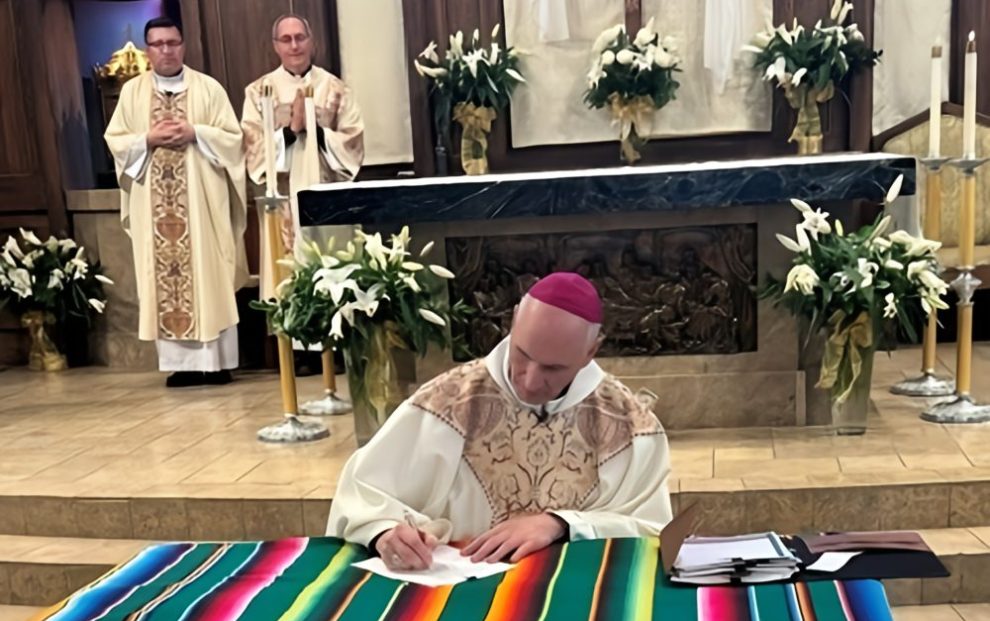
On Divine Mercy Sunday, April 12, Bishop Steven Biegler of Cheyenne, Wyoming published a pastoral letter on migration called “Be a Merciful Neighbor” in response to ICE’s presence and actions in the state of Wyoming. He delivered the letter from Our Lady of the Mountains Catholic Church in Jackson.
What makes Bishop Biegler’s letter stand out among Catholic bishops’ immigration statements
Dozens of Catholic dioceses and bishops across the country have put out letters or statements about upholding the dignity of immigrants in the wake of the Trump administration’s mass deportation campaign that started in January 2025. Many of these statements are collaboratively written by multiple bishops in a state and are typically addressed to government officials or to immigrants as a declaration of solidarity, usually a few paragraphs long.
There are a few longer letters: In August 2025, the Iowa Catholic Conference published a pastoral reflection on immigration that touched on similar points as Biegler’s, with reflections on gospel teachings and Catholic social doctrine. The Bishop of Syracuse also has a letter that lays out Catholic teaching for just immigration policies.
Like many other bishops’ letters, Biegler connects solidarity with the immigrant community as one of the church’s pro-life responsibilities. What makes Biegler’s letter unique is that it includes the words of Wyoming Catholic immigrants who have been impacted by these policies and specifically lays out the situation in Wyoming. The reflection questions also invite more interaction with readers and are an invitation for parish communities to implement this letter in a concrete way.
Addressed to the immigrant community, Catholic community, and “all people of goodwill in the state of Wyoming,” Biegler’s letter includes an overview of the current situation affecting immigrant rights in Wyoming, reflections from the gospel story of the Good Samaritan, principles of Catholic social teaching, a moral evaluation of mass deportations, and concrete actions the Wyoming Catholic community can take to be in solidarity with immigrant neighbors.
“In this letter, I hope to deepen our reflection on the critical issue of the rights and dignity of migrants and refugees in our community, and on migration as an urgent issue affecting the common good in Wyoming,” Biegler writes. “While the situation is complex, to do nothing is simply not an option.”
Biegler includes excerpts from letters that immigrants and children of immigrants have sent him. Each section also includes questions for discussion and reflection. “In the last several months, I have heard from our priests as well as families in our community who have been directly affected by these changes,” he writes.
One quote was from Maria, a 15-year-old in the diocese. “I am afraid to go to school because I may not see my mother or my siblings when I get back home,” she wrote to Biegler.
Biegler writes how many “Wyoming and Catholic families are like Maria’s, where members may have different immigration statuses. With indiscriminate mass deportations, families are experiencing tremendous stress and anxiety.”
Wyoming’s small but essential immigrant community
Three percent of Wyoming’s population are immigrants (born in another country), and 5 percent are native-born U.S. citizens with at least one parent who is an immigrant. The immigrant population in the United States overall is about 14 percent.
Though Wyoming’s immigrant population is small, it makes up 10 percent of Wyoming’s healthcare workers and 8 percent of its food workers. Thousands of Wyoming U.S. citizens have a family member who is undocumented. Wyoming’s total population is just over half a million.
Since January 2025, Wyoming Highway Patrol and local law enforcement officers have been working with ICE and assisting them in immigration enforcement duties. The lack of training local law enforcement receives and inadequate fuding for these efforts has historically led to cases of civil rights violations.
How mass deportations are affecting Wyoming Catholic families
Elena, a single mom, wrote to Biegler: “Back in October 2025, my husband was working in Cheyenne, and the police asked him for his documents. He did not have them with him at the time and he was arrested and then moved to a detention center. Even though he has legal documents, he was deported to Mexico,” she writes.
Biegler points out how this collaboration between Wyoming law enforcement and ICE in mass deportations has eroded trust in police departments. “Tension has arisen for local officials expected to take on federal duties beyond their job description, and for which they are not properly trained,” he writes. “The trust between local communities and law enforcement that is essential to keeping all of us safe, citizen and non-citizen, is sadly being eroded, as well as the good reputation of law enforcement officials who have served with distinction over the years.”
Another story Biegler includes in the letter is Lucia’s, who wrote about her mother, who has been in the United States for 20 years. As her mother was heading to her parish’s Our Lady of Guadalupe celebration, she “was in the passenger seat, but the car was pulled over by the police due to a traffic violation,” Lucia wrote. “The agent asked my mother for her ID, even though she was not driving. My mother told the police that she did not have an ID with her and she was arrested.”
Because of mass deportations and arrests like this, “family members missing from our pews, afraid to travel because they might be pulled over by law enforcement during a traffic stop, and afraid immigration agents might then detain them,” Biegler writes.
Offering reflection questions for readers, Biegler asks: “What are concrete ways we can help people who are living in fear feel safe?” and “As our nation discusses the plight of migrants and refugees, what cultural norms have shaped our attitudes or made us look the other way? Can I leave behind an ‘us vs. them’ point of view?”
“Be a Merciful Neighbor”addresses not only the immigrant community and the church but everyone in Wyoming, a state that voted majority for Donald Trump in 2024. Biegler acknowledges Wyoming’s Indigenous communities of the Eastern Shoshone and Northern Arapaho tribes, who were “among the first peoples forced to migrate in this country,” he writes. “We commit to working for a world in which the pain of racism, exclusion and displacement has no place.”
What the Diocese of Cheyenne plans to do
In terms of specific actions the diocese will take to enact the preferential option for the poor and the uplifting of human dignity that he points out in the letter, Biegler writes that the Diocese of Cheyenne will “redouble our efforts to stand in solidarity with those affected by the current campaign of mass deportations. Following the publication of this letter, it is my intention to form a diocesan commission to aid our efforts in standing alongside our local immigrant communities and making our compassion concrete.”
Catholic Charities of Wyoming will continue providing legal and social services to immigrant families. “We will work to provide pastoral care to those experiencing fear and family separation, including those in immigrant detention,” he writes. Catholic Charities of Wyoming developed a packet of educational resources to accompany the letter, which can be used in parishes, among families and more.
Biegler also writes that the diocese will provide formation to clergy and “promote prayer and study at the deanery level to aid our faithful in more deeply appreciating the Church’s social teaching. And, in collaboration with community, business and other leaders, we will work vigorously for essential immigration reforms with our local and federal elected officials.”
“Be a Merciful Neighbor” heavily references Dilexi Te (“To All Christians On Love for the Poor”) by Pope Leo XIV and various other teachings and statements put out by U.S. Catholic bishops over the years, including the 2003 letter Strangers No Longer: Together on the Journey of Hope.
“To our Wyoming immigrant community, know that the local Catholic Church walks with you in this moment of fear and challenge,” Biegler writes. “We honor your immigration stories, your contributions to our Church and our community, your resilience, and your desires to belong and raise your families with dignity. We will work together to defend your human dignity, assist you in the process of acquiring legal status, and build a society where all can be neighbors to one another.”
Image: DIocese of Cheyenne